

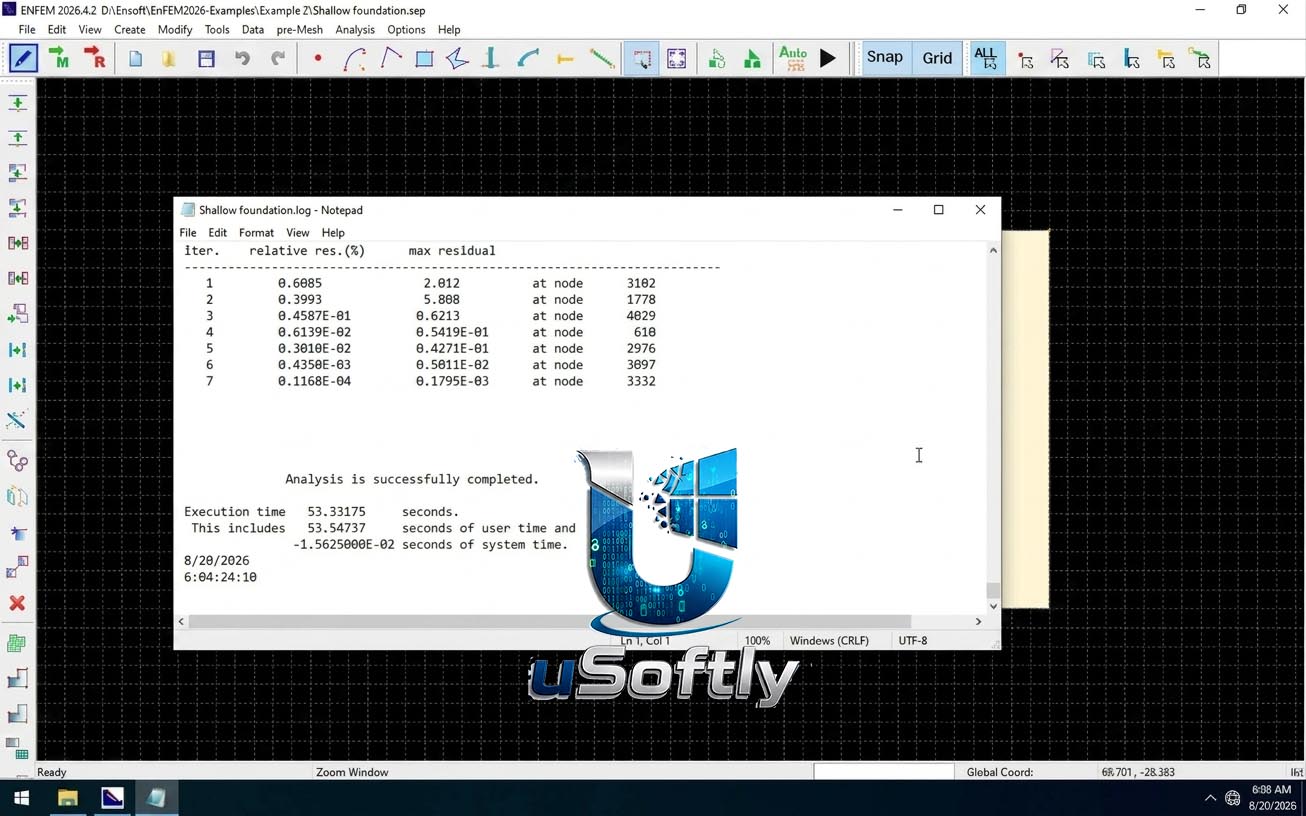
Ensoft EnFEM 2026.4.2 – General‑Purpose 2D Finite Element Analysis Software for Geotechnical and Structural Applications
EnFEM is a general‑purpose 2D finite element analysis (FEA) software developed by Ensoft Inc. for simulating the mechanical behaviour of solid materials under various loads . The software performs plane‑strain, plane‑stress, and axisymmetric analyses with an emphasis on solving problems in geotechnical engineering . It is equipped with a range of linear and nonlinear material models, boundary conditions, and element types, making it suitable for applications from simple linear‑elastic analyses to highly nonlinear, multi‑stage soil‑structure interactions .
Version 2026.4.2 is a recent update in Ensoft’s 2026 release cycle, with the version number indicating the 2026 data‑file format and an April 2026 revision. The software is available through Ensoft’s download centre and is supported by comprehensive documentation, including a User’s Manual, Technical Manual, and Example Manual.
Primary Users
EnFEM 2026.4.2 is designed for geotechnical and structural engineers who need to perform 2D finite element analysis for a wide range of soil‑structure interaction and solid mechanics problems. It serves professionals who:
-
Analyse staged excavations, slope stability, and soil‑structure interaction using advanced constitutive models and contact mechanics
-
Perform finite element slope stability analysis with the built‑in Strength Reduction Method (SRM) to automatically determine critical slip surfaces without predefined failure planes
-
Simulate geostatic stresses and multi‑stage construction sequences for complex geomechanical problems
-
Model reinforced slopes and retaining structures where failure mechanisms are governed by soil‑structure interaction rather than simple limit equilibrium
Key Features & Capabilities
Finite Element Analysis Capabilities
-
Analysis Types: Plane‑strain, plane‑stress, and axisymmetric analyses for 2D problems
-
Element Library: First‑ or second‑order quadrilateral and triangular elements, in structured, unstructured, or combined meshes
-
Nonlinear Direct Solver: Based on multithreading and parallel processing optimisation
-
Material Models: Linear elastic, Tresca, von Mises, Mohr‑Coulomb, Drucker‑Prager, Duncan‑Chang hyperbolic, and Modified Cam‑Clay
Strength Reduction Method (SRM) for Slope Stability
The current version includes a built‑in SRM for finite element slope stability analysis . The SRM analysis consists of two stages:
-
Application of gravity, tieback forces, and surface loads
-
Incremental reduction of soil strength until convergence can no longer be achieved; the safety factor is determined based on maximum allowable deformation
The critical slip surface develops automatically as shear strength decreases, eliminating the need to assume a predefined slip surface (as required in limit equilibrium methods) . This is particularly useful for:
-
Slopes with complex geometries where slip surfaces are irregular
-
Slopes reinforced with tiebacks or other structural elements, where failure mechanisms are governed by soil‑structure interaction
Geostatic Stress and Multi‑Stage Analysis
EnFEM supports multi‑stage analysis for simulating sequentially applied loads, geostatic (initial) soil stresses, and excavations . For geomechanical problems, an initial stress field can be specified as the first analysis stage (geostatic step), during which soil particles have stresses due to self‑weight but are free of deformation . The software estimates initial stress fields for both normally and lightly consolidated clays based on user‑specified input .
Contact and Soil‑Structure Interaction
EnFEM implements robust computational contact analysis using penalty methods to enforce contact constraints between conforming or non‑conforming meshes . The software can simulate:
-
Material separation along contact interfaces
-
Finite sliding between contacting bodies
-
Tie and free‑face options for contact interfaces




Reviews
There are no reviews yet.