

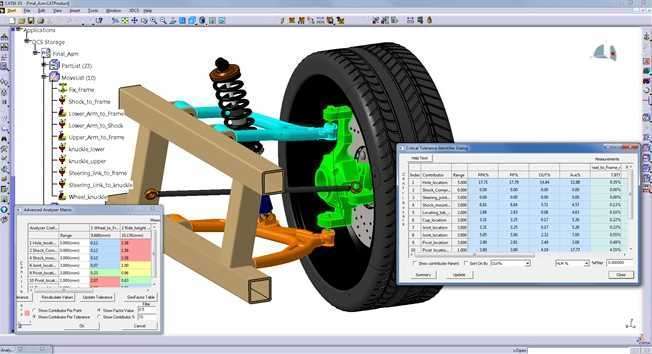
Download 3DCS Variation Analyst 8.0 – Advanced Tolerance Analysis Software
3DCS Variation Analyst 8.0 is a specialized tolerance analysis software developed for engineers to predict and manage dimensional variations in manufactured products. It is a critical tool for professionals in the aerospace, automotive, medical equipment, machinery, and electronics industries, enabling them to ensure product quality and assembly efficiency through advanced simulation and analysis.
Understanding Tolerance Analysis in Engineering
Tolerance analysis is a fundamental engineering discipline focused on quantifying the variability inherent in manufacturing processes and component dimensions. In complex product design and assembly, ensuring that parts fit together within specified limits is paramount to functional performance and overall product reliability.
Importance of Tolerance Analysis
The importance of tolerance analysis cannot be overstated in modern manufacturing. It directly impacts product quality, assembly success rates, and manufacturing costs. By proactively identifying and addressing potential variations, engineers can prevent costly design flaws, reduce scrap and rework, and ensure that final products meet performance specifications. This process is essential for achieving robust designs that can withstand real-world manufacturing tolerances.
Key Features of 3DCS Variation Analyst
3DCS Variation Analyst offers a sophisticated suite of tools designed to provide deep insights into product variability. Its strength lies in its advanced analytical capabilities, which go beyond simple geometric checks to simulate real-world manufacturing conditions.
Simulation Techniques
The software utilizes advanced simulation methods to accurately predict how part and assembly variations propagate. Its analytical engine is built upon robust methodologies:
- Monte Carlo Simulation: This method allows for the statistical modeling of variation, simulating thousands of assembly scenarios to understand the distribution of potential outcomes and identify probabilities of assembly failure.
- Sensitivity Analysis: This technique helps engineers pinpoint the specific dimensions or parameters that contribute most significantly to overall variation, enabling focused design adjustments.
- Geofactor Methods: 3DCS employs geofactor analysis to quantify the geometric relationships and their impact on dimensional variation across an assembly, providing a deeper understanding of how part interactions affect performance.
Integration with CAD Systems
Seamless integration with major CAD platforms is a cornerstone of 3DCS Variation Analyst’s workflow. This integration ensures that tolerance analysis can be performed directly within the user’s existing design environment, without the need for complex data re-creation.
By linking directly to CAD models, the software allows engineers to leverage their digital design data efficiently. This connection enables the direct application of tolerances and the visualization of variation effects on the 3D model, streamlining the analysis process and reducing the potential for errors associated with data translation.
Industry Applications and Case Studies
3DCS Variation Analyst is instrumental in driving innovation and ensuring quality across a wide range of demanding industries. Its ability to accurately model complex assemblies and variations makes it indispensable for product development.
- Aerospace: Used to ensure the precise fit and function of critical aircraft components, such as wing assemblies and engine modules, where even minor deviations can have significant safety implications.
- Automotive: Applied to optimize the assembly of vehicle components like door systems, engine compartments, and chassis, ensuring consistent quality, reduced NVH (Noise, Vibration, Harshness), and efficient manufacturing.
- Medical Equipment: Essential for analyzing the dimensional accuracy of intricate medical devices and diagnostic equipment, guaranteeing patient safety and device reliability.
- Machinery: Utilized in the design of complex industrial machinery to ensure parts align and operate correctly under operational stresses and varying environmental conditions.
- Electronics: Employed to manage tolerances in compact electronic device assemblies, ensuring proper connectivity and preventing interference issues.
Performance and Accuracy
3DCS Variation Analyst is engineered for both speed and precision in dimensional variation analysis. The software’s advanced algorithms and efficient simulation techniques allow for rapid analysis of complex models, significantly reducing the time required for design validation.
The accuracy of its simulations ensures that engineers receive reliable predictions regarding assembly performance and potential issues. This leads to more informed design decisions, fewer physical prototypes needed for validation, and ultimately, a faster path to market for high-quality products.
Comparative Analysis with Other Tolerance Software
While various tools exist for tolerance analysis, 3DCS Variation Analyst distinguishes itself through its specialized, feature-rich approach, particularly excelling in complex 3D tolerance stack-up. Its deep integration with CAD environments and its robust simulation methodologies, including advanced Monte Carlo and geofactor analyses, provide a more comprehensive understanding of variation effects.
Other tolerance analysis software may offer simpler 2D stack-ups or less advanced simulation capabilities. 3DCS Variation Analyst, however, is designed for engineers who require detailed, statistically significant insights into the behavior of their designs under manufacturing variability, making it a powerful solution for critical applications.
Frequently Asked Questions
What is tolerance analysis and why is it important?
Tolerance analysis is the process of measuring and predicting dimensional variations in manufactured parts. It’s important because it helps engineers minimize the impact of these variations on product quality and assembly efficiency, saving costs and enhancing design reliability.
How does 3DCS Variation Analyst improve CAD design?
3DCS Variation Analyst enhances CAD design by integrating tolerance analysis directly within the CAD platform, allowing engineers to visualize and quantify the effects of variances during the design phase, leading to better informed decisions and optimized designs.
What industries benefit from using 3DCS Variation Analyst?
Industries such as aerospace, automotive, medical, machinery, and electronics benefit significantly from using 3DCS Variation Analyst, as it provides critical insights into dimensional stability and assembly performance in complex manufacturing processes.






Reviews
There are no reviews yet.