
Download 3diemme 3Diagnosys 4.1 – Advanced Digital Dentistry Software for Implant Planning and Guided Surgery
3diemme 3Diagnosys 4.1 is an advanced specialized software application designed for digital dentistry workflows, with a core focus on sophisticated implant planning and guided surgery. Developed by 3diemme, an Italian leader in digital dental technologies, this software empowers oral and maxillofacial surgeons, implantologists, and dental specialists by integrating key diagnostic imaging modalities. It facilitates complex treatment planning through the fusion of Cone Beam Computed Tomography (CBCT) data and intraoral scans, offering enhanced precision for clinical procedures.
Overview of 3Diagnosys 4.1 and Its Role in Digital Dentistry
3Diagnosys 4.1 represents a significant advancement in digital dentistry software, building upon previous iterations to offer cutting-edge tools for diagnosticians and clinicians. Its primary function is to translate complex 3D volumetric data into actionable treatment plans, especially for implantology and oral surgery. The software integrates technologies such as AI-driven segmentation and virtual planning to support a comprehensive digital workflow, from initial diagnosis through to the design of custom surgical guides.
The evolution of 3Diagnosys, culminating in version 4.1, highlights a commitment to incorporating artificial intelligence to automate and refine diagnostic processes. This version specifically enhances the user experience and efficiency for professionals working in specialized dental fields like implantology, orthodontics, and endodontics. By leveraging advanced visualization and planning capabilities, 3Diagnosys 4.1 aims to improve surgical accuracy and patient outcomes.
Fusion of CBCT Imaging with Digital Dental Scans for Accurate 3D Modeling
At the heart of 3Diagnosys 4.1’s diagnostic capability is its ability to accurately fuse disparate imaging data into a single, precise 3D model. This process begins with Cone Beam Computed Tomography (CBCT), considered a gold standard for oral and maxillofacial imaging. The software accepts CBCT scans in DICOM format, capturing detailed volumetric information of bone structure, nerve pathways, and sinus cavities.
This CBCT data is then seamlessly integrated with surface scan data, typically acquired using intraoral scanners and provided in STL format. The resulting hybrid 3D model offers a superior representation of the patient’s anatomy, combining the internal detail of CBCT with the external morphology from intraoral scans. This comprehensive view is critical for achieving diagnostic precision and enabling highly informed treatment planning, particularly in complex surgical cases.
Advanced Implant Planning and Prosthetic-Driven Treatment Workflow
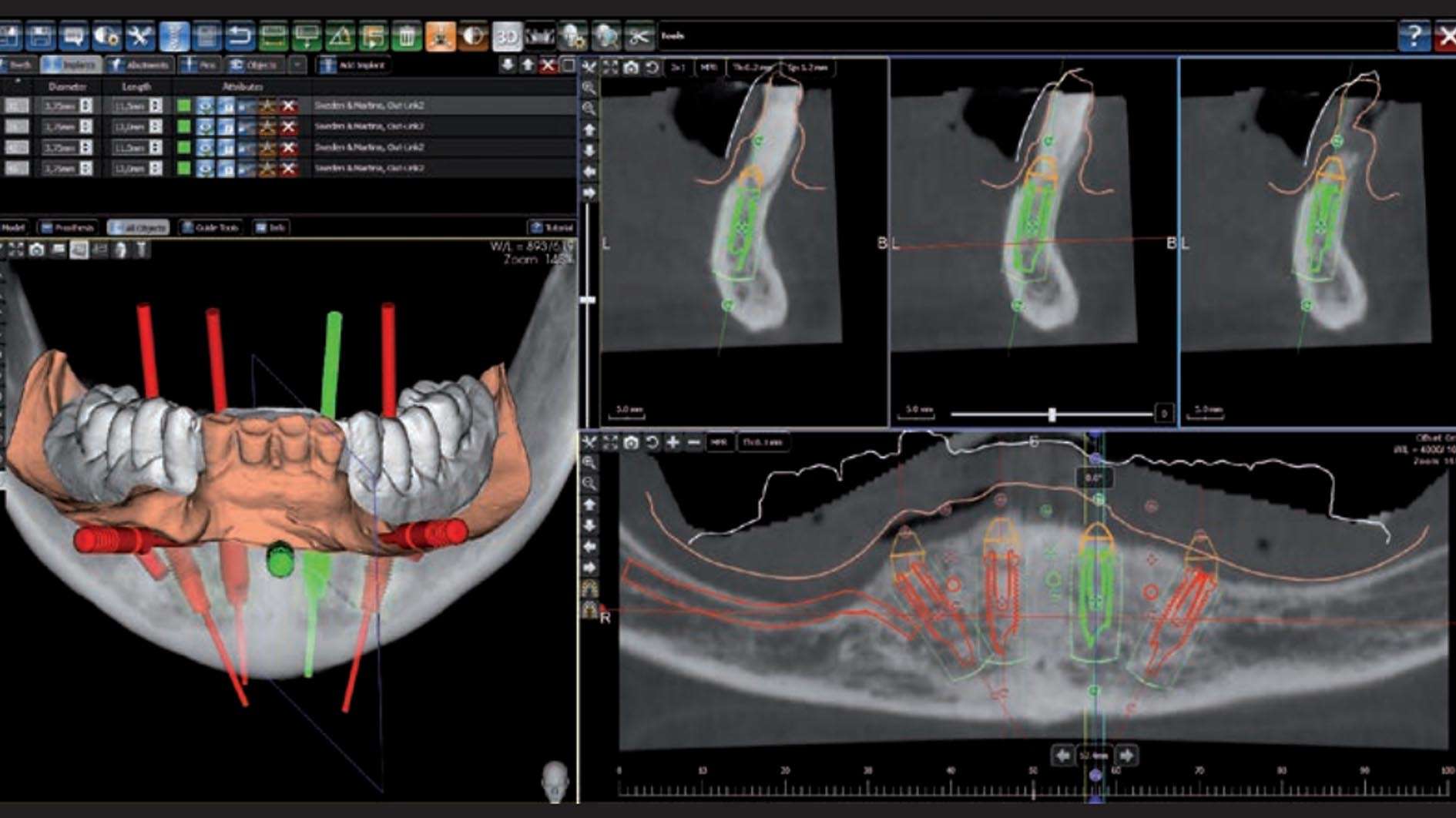
3Diagnosys 4.1 provides a robust suite of tools specifically tailored for advanced implant planning. The software facilitates virtual implant placement by allowing specialists to position implants within the fused 3D anatomical model. This virtual planning process meticulously considers patient-specific bone density, anatomical landmarks, and the proximity of critical structures such as the inferior alveolar nerve and maxillary sinuses.
A key feature of the software is its support for prosthetic-driven implant planning, a reverse planning approach that begins with the desired final restoration. By digitally designing the prosthetic crown or bridge first, clinicians can then determine the ideal implant position, angle, and depth necessary to support it. This methodology ensures that the surgical plan is optimized for functional and aesthetic outcomes, aligning surgical intervention directly with prosthetic requirements.
Designing Surgical Guides and Integration with 3D Printing
A critical output of the implant planning process in 3Diagnosys 4.1 is the design of patient-specific surgical guides. The software offers both automated and semi-automated tools to create these precise guides, which are essential for accurately transferring the virtual implant plan into the patient’s mouth during surgery. These guides ensure correct implant angulation and depth, minimizing the risk of errors and improving the predictability of the procedure.
The designed surgical guides can be exported directly in stereolithography (STL) format, a standard file type compatible with most dental 3D printers. This direct integration with 3D printing technology allows dental practices and laboratories to fabricate custom surgical guides quickly and cost-effectively. The availability of these custom guides significantly enhances surgical accuracy, reduces operative time, and contributes to smoother clinical workflows.
Additional Diagnostic and Analytical Tools for Comprehensive Treatment
Beyond implant planning, 3Diagnosys 4.1 equips dental professionals with a range of complementary diagnostic and analytical tools. The software includes capabilities for 3D cephalometric analysis, providing detailed measurements and assessments of craniofacial structures, which can be invaluable for orthodontic treatment planning. It also offers tools for airway assessment, aiding in the diagnosis and management of sleep-related breathing disorders.
For endodontic applications, the software enables detailed root canal evaluation, allowing for precise visualization of complex root morphology and canal systems. Enhanced visualization features further assist clinicians by allowing for better differentiation and analysis of soft tissues and bone structures within the 3D environment. These multifaceted tools support a comprehensive approach to dental diagnostics and treatment planning.
Workflow Automation and AI Enhancements in Version 4.1
Version 4.1 of 3Diagnosys introduces significant advancements through the integration of artificial intelligence (AI) for workflow automation. The software features AI-driven automatic segmentation capabilities, which can rapidly and accurately identify and delineate key anatomical structures such as teeth, nerve canals, and bone boundaries. This automation dramatically reduces the time manual segmentation typically requires, streamlining the preparation process before virtual implant placement.
Further enhancements in 3Diagnosys 4.1 include an improved user interface designed for intuitive navigation and efficient operation. The guided surgery workflow has been optimized for speed and clarity, making the transition from planning to surgical execution more seamless. Additionally, the software boasts expanded implant system libraries and performance optimizations, ensuring compatibility with a wider range of implant components and delivering a more responsive user experience.
Integration with Digital Laboratories and CAD/CAM Systems
3diemme 3Diagnosys 4.1 is designed to be a central hub within a fully digital dental ecosystem, emphasizing seamless connectivity with other digital devices and systems. It ensures high compatibility with intraoral scanners from major manufacturers, facilitating the input of accurate patient scan data. This interoperability is crucial for building a precise digital foundation for all subsequent treatment planning phases.
The software also supports robust export capabilities for Computer-Aided Design/Computer-Aided Manufacturing (CAD/CAM) processes, enabling efficient communication with digital dental laboratories. This connectivity streamlines the fabrication of custom prosthetics, implant abutments, and other dental appliances. By fostering a connected digital workflow, 3Diagnosys 4.1 enhances collaboration between clinicians and laboratories, ultimately improving the efficiency and accuracy of restorative and surgical dental treatments.
Frequently Asked Questions
How does 3diemme 3Diagnosys 4.1 utilize CBCT data for implant planning?
3diemme 3Diagnosys 4.1 integrates CBCT DICOM imaging with digital dental scans to generate highly accurate 3D models of the patient’s anatomy. This fusion enables precise virtual implant placement while respecting vital structures like nerves and sinuses, providing a detailed anatomical context for surgical decisions.
What new AI-driven features are included in 3Diagnosys 4.1?
Version 4.1 introduces enhanced AI algorithms for automatic segmentation of teeth, nerve canals, and bone, significantly reducing manual preparation time and streamlining the guided surgery workflow. These AI features improve efficiency and accuracy in identifying critical anatomical details.
Can 3Diagnosys 4.1 designs be exported for 3D printing of surgical guides?
Yes, the software supports automated and semi-automated design of surgical guides with direct export in formats compatible with stereolithographic 3D printers, ensuring accurate transfer of the virtual implant plan to clinical procedures.





Reviews
There are no reviews yet.