
Download Adaptive Groundwater – Advanced Groundwater Simulation Software
Adaptive Groundwater is a sophisticated environmental engineering software designed for simulating three-dimensional groundwater flow and solute transport. It is particularly suited for professionals in hydrology, water resource management, and environmental science who require precise and efficient modeling capabilities for complex hydrological systems. The software’s advanced features enable detailed analysis of groundwater dynamics, making it an invaluable tool for environmental assessments and resource planning.
Introduction to Adaptive Groundwater
Overview and Applications
Adaptive Groundwater serves as a powerful tool for simulating complex subsurface hydrological processes. Its primary purpose is to provide environmental engineers and hydrologists with the means to accurately model groundwater flow and the movement of dissolved substances within aquifers. This capability is essential for a wide range of applications, including managing water resources effectively, conducting thorough environmental impact assessments, and developing remediation strategies for contaminated sites.
Core Features and Capabilities
Dynamic Adaptive Mesh Refinement (AMR)
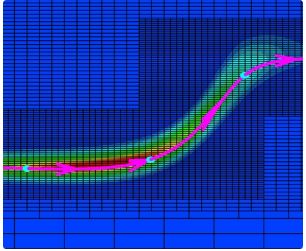
A key differentiator of Adaptive Groundwater is its implementation of dynamic adaptive mesh refinement (AMR). This advanced technique allows the software to automatically adjust the computational grid resolution during a simulation. Areas requiring higher detail, such as those with steep gradients in hydraulic head or solute concentration, are automatically meshed more finely, while less critical areas use a coarser mesh. This selective refinement ensures optimal accuracy where it is most needed, without the computational overhead of a uniformly high-resolution grid.
Multi-threading and Computational Efficiency
Leveraging modern multi-core processors, Adaptive Groundwater is engineered for significant computational efficiency through multi-threading. The software is designed to distribute simulation tasks across multiple CPU cores simultaneously, drastically reducing the time required for complex or large-scale groundwater flow and transport models. This parallel processing capability makes it feasible to run simulations that would be prohibitively time-consuming on standard, single-threaded applications.
Modeling and Simulation Flexibility
The software offers substantial flexibility in modeling groundwater dynamics. Users can define simulations with varying grid resolutions tailored to specific problem areas, accommodating both localized phenomena and broad regional analyses. Adaptive Groundwater is capable of handling very large, high-resolution regional models, efficiently managing the computational demands associated with extensive aquifer systems. This flexibility extends to its ability to accurately simulate advection-dominated transports, where the movement of contaminants is primarily driven by fluid flow.
Groundwater Flow and Transport Modeling
Understanding Flow Dynamics
Adaptive Groundwater provides robust tools for simulating the intricate patterns of groundwater flow. It calculates key hydrological parameters such as hydraulic head distributions and flow vectors, enabling users to visualize and analyze how water moves through subsurface geological formations. Furthermore, the software excels at modeling solute transport, tracking the movement and dispersion of dissolved substances within these water flows. This is critical for predicting contaminant plumes or assessing the movement of injected substances.
Case Studies in Environmental Engineering
In environmental engineering, Adaptive Groundwater finds extensive application in real-world scenarios. It has been utilized for detailed site characterization to understand groundwater contamination sources and pathways, aiding in the development of effective remediation plans such as pump-and-treat systems or in-situ treatment strategies. The software is also instrumental in water resource management, helping to assess the sustainable yield of aquifers and predict the impact of groundwater extraction or artificial recharge operations. Its capabilities support detailed impact analyses for proposed developments that may affect local hydrology.
Conclusion and Getting Started
Adaptive Groundwater represents a significant advancement in groundwater simulation technology, offering unparalleled precision through dynamic adaptive mesh refinement and efficient computation via multi-threading. Its flexibility in handling complex, large-scale models makes it an indispensable tool for environmental engineers, hydrologists, and water resource managers. By enabling more accurate predictions and detailed insights into groundwater dynamics, the software supports informed decision-making for critical environmental and resource management challenges.
Frequently Asked Questions
What is Adaptive Groundwater used for?
Adaptive Groundwater is used for simulating three-dimensional groundwater flow and transport, crucial for environmental assessments, resource management, and understanding hydrological dynamics. It allows professionals to visualize and analyze subsurface water movement and the behavior of dissolved substances within aquifers.
What are the benefits of dynamic mesh refinement in groundwater modeling?
Dynamic mesh refinement allows for automatic adjustment of the grid, enhancing model accuracy in areas with high velocity or concentration gradients, which leads to more reliable simulation results. This targeted refinement increases precision in critical zones without extensive manual setup or excessive computational cost.
Can Adaptive Groundwater handle large-scale simulations?
Yes, Adaptive Groundwater can efficiently manage very large, high-resolution regional models, significantly reducing the computational effort and costs associated with model development. Its adaptive meshing and multi-threading capabilities are specifically designed to handle extensive aquifer systems effectively.






Reviews
There are no reviews yet.