

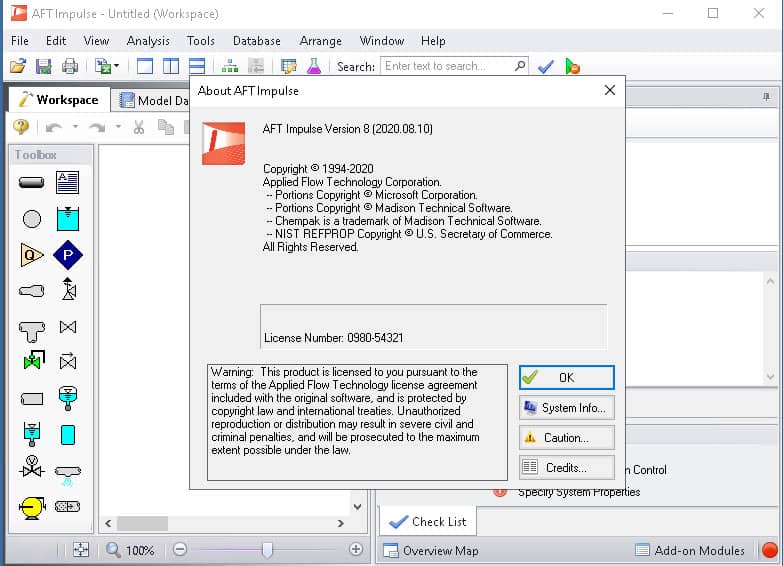
Download AFT Impulse 10.0 – Advanced Fluid Dynamics Simulation Tool
AFT Impulse 10.0 is a specialized fluid dynamics simulation software developed by Applied Flow Technology, designed for the analysis of pressure transients in liquid piping systems. This powerful tool is essential for engineers in the mechanical and manufacturing sectors, particularly those involved in chemical processing, oil and gas, and water resource management, enabling them to simulate and mitigate complex fluid flow events.
Introduction to AFT Impulse and Its Industry Applications
AFT Impulse is an industry-leading software application dedicated to the analysis of transient fluid flow phenomena in liquid piping systems. It provides engineers with sophisticated tools to model, simulate, and understand dynamic events such as water hammer, pump startup/shutdown, and valve closures. Its primary applications span critical sectors including chemical processing, oil and gas transportation, water and wastewater management, and power generation, where the integrity and safety of fluid systems are paramount.
Key Features and Capabilities of AFT Impulse
- Advanced transient solution methods provide robust results for various fluid system conditions.
- Extensive cavitation modeling functionalities accurately simulate the formation and effects of vapor bubbles during low-pressure events.
- Dynamic simulation capabilities combined with comprehensive scenario management enable the analysis of multiple operational conditions and system designs within a single model.
- Integrated graph and reporting tools facilitate detailed post-processing and communication of simulation results, including dynamic animation of flow events.
Understanding Pressure Transients in Fluid Systems
Pressure transients, often referred to as surges or water hammer, are rapid changes in fluid pressure and flow rate within a piping system. These events can be triggered by sudden changes in operational conditions, such as pump trips, valve operations, or pipe ruptures. Uncontrolled pressure transients can lead to significant equipment damage, system failures, and safety hazards. AFT Impulse models these phenomena by applying fundamental fluid dynamics principles and advanced numerical methods, allowing engineers to predict the magnitude and timing of pressure waves and implement protective measures.
Real-world Applications and Case Studies Using AFT Impulse
Engineers utilize AFT Impulse to address critical challenges in various industrial settings. For instance, in the oil and gas sector, it is employed to analyze surge pressures in pipeline operations, ensuring the safe transport of hydrocarbons and preventing catastrophic failures. In water resource management, the software aids in designing resilient distribution networks by simulating pump startup/shutdown sequences and valve closure events to prevent damage to pumps and pipelines. Chemical processing plants leverage AFT Impulse to model reaction kinetics under transient conditions and ensure the safe handling of hazardous fluids, mitigating risks associated with pressure surges.
Comparison with Other Fluid Dynamics Software Tools
While other fluid dynamics software tools may offer capabilities in steady-state flow analysis, AFT Impulse distinguishes itself through its specialized focus on transient liquid systems. Its unique strengths lie in its comprehensive cavitation modeling, advanced dynamic simulation features, and detailed valve modeling options. Unlike general-purpose CFD packages, AFT Impulse provides targeted functionalities optimized for calculating pressure transients and understanding complex phenomena like vapor pocket collapse and propagation, making it a highly efficient and precise tool for engineers dealing with surge analysis.
Getting Started with AFT Impulse
For engineers new to AFT Impulse, a systematic approach to learning the software is recommended. Begin by familiarizing yourself with the principles of pressure transients and cavitation. The software’s interface is designed for intuitive model building, starting with defining the piping network, specifying fluid properties, and inputting operational parameters for pumps, valves, and other components. Utilizing the scenario management feature early on can help organize analyses for different operating conditions. Practicing with sample models provided with the software can accelerate the learning curve before applying it to specific project requirements.
Frequently Asked Questions
What industries can AFT Impulse be used in?
AFT Impulse is exceptionally useful across a range of industries that manage liquid flow and potential pressure surges. Key sectors include oil and gas for pipeline integrity, water resource management for distribution network safety, chemical processing for handling dynamic reactions, and the power generation industry for turbine protection. Essentially, any field requiring detailed analysis of fluid dynamics and pressure transients in piping systems benefits from its capabilities.
How does AFT Impulse model cavitation phenomena?
AFT Impulse incorporates extensive and sophisticated cavitation modeling features designed to simulate the complex effects of vapor collapse and liquid separation during transient flows. The software can predict the formation, growth, and collapse of vapor bubbles, providing critical insights into potential erosive damage and system performance impacts. This allows engineers to accurately assess risks and implement design modifications or operational changes to mitigate issues effectively.
What is the primary function of scenario management in AFT Impulse?
The primary function of scenario management in AFT Impulse is to allow engineers to efficiently track and compare multiple design types and operational opportunities within a single, unified model file. This feature significantly enhances workflow efficiency by enabling users to seamlessly switch between different simulation conditions, such as various pump speeds or valve closure rates, without needing to create duplicate models. It streamlines the analysis process and facilitates comprehensive design evaluation.