

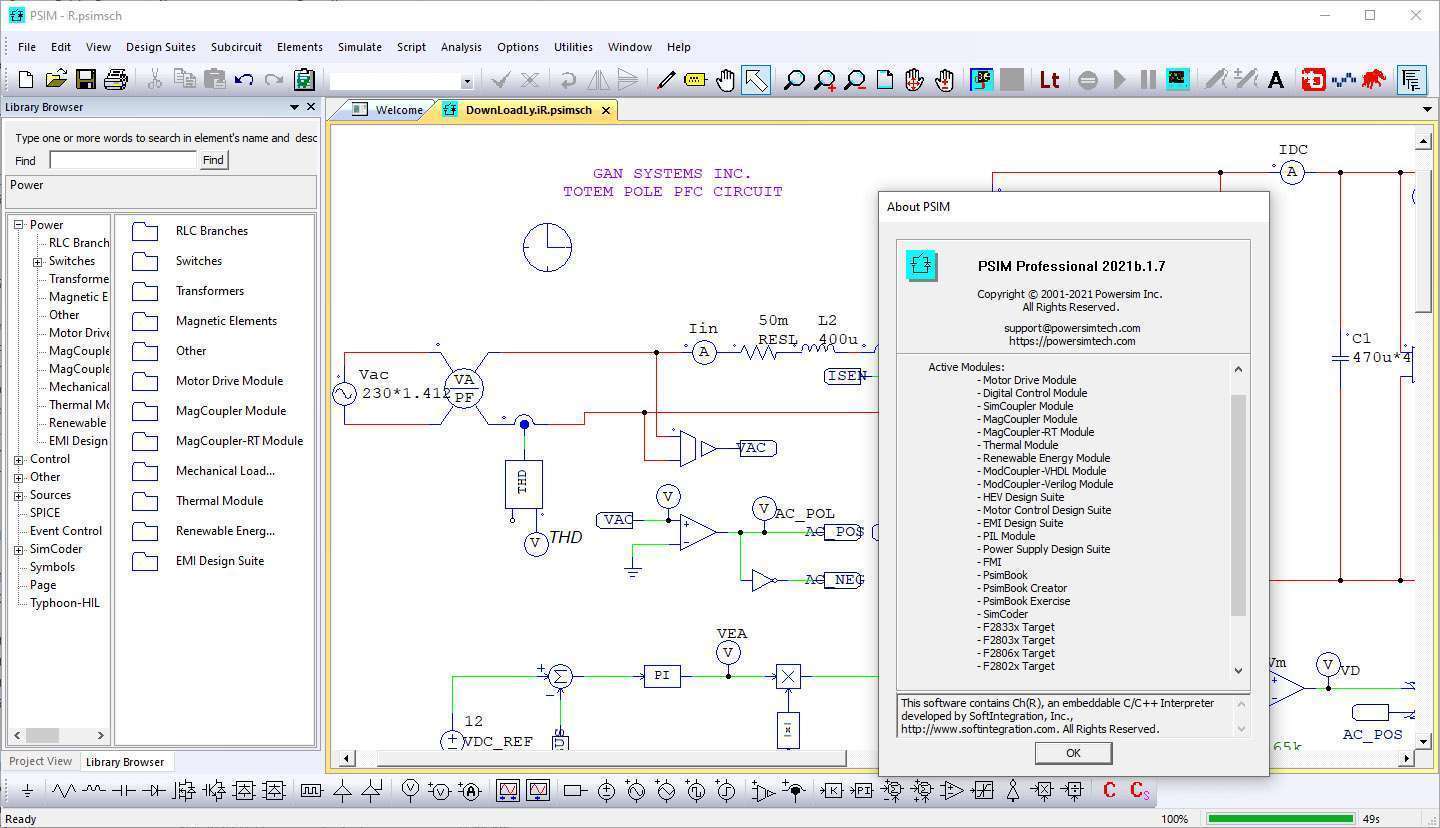
Download Altair PSIM Professional 2026.1 – State-of-the-Art Electronic Circuit Simulation Software
Altair PSIM Professional 2026 is a sophisticated electronic circuit simulation software developed by Altair Engineering, Inc. Designed for professionals and academics in power electronics and motor drive industries, it provides advanced capabilities for analyzing and visualizing circuit performance. The software excels in high-speed simulations, making it an efficient tool for system-level analysis in electrical engineering.
Overview of Altair PSIM Professional 2026
What is PSIM?
PSIM (Power Simulation) is a specialized software tool engineered for the simulation and analysis of power electronic circuits and motor drives. Acquired by Altair Engineering in March 2022, PSIM leverages Altair’s extensive engineering solutions to offer users a powerful platform for designing and testing complex electrical systems. Its core strengths lie in its user-friendly interface and rapid simulation engine, which significantly outperforms traditional SPICE-based simulators for system-level tasks.
Key Features and Capabilities
High-Speed Simulation
Altair PSIM Professional 2026 distinguishes itself with exceptionally fast simulation speeds. Unlike SPICE-based simulators that can be computationally intensive for large systems, PSIM is optimized for efficient execution, enabling engineers to conduct rapid system-level analyses. This speed advantage is critical for iterative design processes and for evaluating the performance of complex power electronic converters and motor control systems within reasonable timeframes.
Interactive Waveform Visualization
The software provides robust tools for visualizing simulation results. Users can interactively display, measure, and customize waveforms to gain deep insights into circuit behavior. This feature allows for detailed examination of voltage, current, and other electrical parameters, facilitating accurate performance assessment and debugging of designs.
Extensive Module Support
PSIM’s modular architecture supports a wide range of specialized functionalities, catering to diverse application needs. Available modules extend its capabilities into areas such as renewable energy systems, electric vehicle powertrains, motor control, and thermal management. This modular approach allows users to select and utilize the specific tools that best fit their simulation requirements, from power quality analysis to advanced control system design.
Applications in Industry and Education
Use Cases in Power Electronics
In the power electronics industry, Altair PSIM Professional 2026 is employed for the design, analysis, and optimization of various circuits. Professionals utilize it for simulating power converters, inverters, rectifiers, and motor drives, ensuring efficient and reliable operation. The software aids in validating control strategies, performing thermal analyses, and developing solutions for applications ranging from consumer electronics to industrial automation and renewable energy integration.
Academic Applications
Educational institutions and research facilities benefit from PSIM’s capabilities for teaching and advanced research in electrical engineering. Its intuitive interface makes it an effective tool for students to learn about power electronics principles and control system design. Researchers leverage PSIM’s speed and modularity to explore novel topologies, develop advanced control algorithms, and simulate complex renewable energy systems, contributing to academic advancements.
Integration with Other Tools
Collaboration with MATLAB and Simulink
Altair PSIM Professional 2026 offers seamless integration with popular simulation and analysis platforms like MATLAB and Simulink. This compatibility allows engineers to combine PSIM’s specialized power electronics simulation strengths with MATLAB’s analytical and algorithm development capabilities or Simulink’s system-level modeling environment. Such integrations facilitate a more comprehensive workflow, from control design to hardware implementation.
Machine Learning and AI Analytics
As engineering workflows evolve, PSIM is finding applications in emerging fields such as machine learning and artificial intelligence for system analysis. Its simulation data can be used to train AI models for predictive maintenance, fault detection, or performance optimization in IoT and smart grid applications. This allows for the development of more intelligent and adaptive power electronic systems.
Comparative Insights: PSIM vs. SPICE
Compared to traditional SPICE (Simulation Program with Integrated Circuit Emphasis) simulators, Altair PSIM Professional 2026 offers a distinct advantage in simulation speed, particularly for complex power electronic systems and motor drives. While SPICE excels at detailed analysis of semiconductor switching transitions and low-level circuit behavior, PSIM is optimized for higher-level system analysis. This makes PSIM more efficient for tasks requiring large time steps or simulations across a wide range of operating conditions, enabling quicker design validation and system-level performance assessment.
Conclusion
Altair PSIM Professional 2026 stands as a powerful and efficient electronic circuit simulation solution for the power electronics and motor drive sectors. Its rapid simulation capabilities, comprehensive module support, and integration with industry-standard tools like MATLAB and Simulink make it an indispensable asset for professionals and researchers. By providing clear insights into circuit performance and facilitating complex system analysis, PSIM empowers engineers to drive innovation in electrical design.
Frequently Asked Questions
What types of circuits can Altair PSIM Professional simulate?
Altair PSIM Professional can simulate a variety of electronic circuits, particularly excelling in power electronics and motor drive simulations, making it suitable for both industrial and educational applications. It is adept at handling the complexities of power converters, motor control systems, and renewable energy interfaces.
How does PSIM compare to SPICE in terms of performance?
PSIM offers significantly faster simulation speeds compared to SPICE-based simulators, which makes it more effective for system-level studies rather than detailed switching transition analysis. This performance difference allows for more comprehensive and time-efficient exploration of system dynamics and control strategies.
Can I integrate PSIM with other engineering tools?
Yes, PSIM supports integration with popular tools such as MATLAB and Simulink, which allows users to enhance simulations and analyze results more effectively. This interoperability ensures that PSIM can be a central component within a broader, integrated engineering workflow.





Reviews
There are no reviews yet.