
Download Altair S-Concrete 2026.0 – Advanced Structural Concrete Design Software
Download Altair S-Concrete 2026.0, a specialized structural concrete design software developed by Altair Engineering. This application is tailored for structural and civil engineering professionals, providing robust tools for the analysis and design of reinforced concrete elements. It serves industries focused on infrastructure, bridge engineering, and construction consulting, as well as academic institutions engaged in structural research.
Reinforced Concrete Design: Overview and Applications
Altair S-Concrete 2026.0 offers a streamlined environment for the design and code checking of reinforced concrete structures. Its core functionality revolves around providing engineers with tools to accurately model, analyze, and validate concrete components according to international standards.
Intuitive Modeling Environment
Users can define the geometry of concrete elements, apply material properties, and assign loads within a user-friendly workspace. The software facilitates efficient modeling of beams, columns, walls, and slabs, enabling engineers to focus on design intricacies rather than complex input procedures.
Industry Use Cases
The software is applied across various sectors of structural engineering. This includes the design of conventional building structures, such as floor systems and shear walls, as well as specialized applications like bridge piers, retaining walls, and other critical infrastructure components. Academic and research institutions also utilize Altair S-Concrete for educational purposes and advanced design studies.
Comprehensive Structural Analyses for Concrete Elements
Altair S-Concrete 2026.0 performs detailed structural analyses essential for reinforced concrete design, covering critical aspects like bending, shear, axial forces, and slenderness effects.
Beams: Shear, Moment, Torsion and Deflection
The software enables the analysis of singly and doubly reinforced beams, T-beams, and deep beams. It calculates critical shear forces, bending moments, torsional stresses, and deflections, incorporating checks for crack control and serviceability limits to ensure structural integrity and occupant comfort.
Columns and Walls: Axial, Biaxial and P-Delta Effects
For columns and walls, S-Concrete provides robust analysis capabilities. This includes assessing axial and biaxial bending capacities, evaluating P-Delta effects on slender members, and generating interaction diagrams. The software also addresses wall stability and the design of boundary elements for complex structural configurations.
Continuous Beams and Retaining Walls
Engineers can model and analyze continuous beams with multiple support conditions, managing moment redistribution and secondary moments. The software also supports the design of various types of retaining walls, ensuring stability against earth pressures and overturning.
Automated Code Compliance and Validation
A key strength of Altair S-Concrete 2026.0 is its automated approach to code compliance, ensuring that designs meet regulatory requirements efficiently.
International Code Coverage
The software supports a broad range of international and regional concrete design codes, including ACI 318 (American Concrete Institute), CSA A23.3 (Canadian Standards Association), and Eurocode 2 (EN 1992). This extensive coverage allows engineers to work on projects globally and adhere to local design standards.
Detailing Checks and Clause References
Altair S-Concrete 2026.0 automates critical detailing checks, such as reinforcement spacing, development length requirements, and crack width limitations. The design reports provide direct references to specific clauses within the applicable design codes, aiding in validation and documentation.
Real-Time Visualization and Result Interpretation
Understanding design performance is facilitated by S-Concrete’s live visualization tools, which offer immediate feedback on structural behavior.
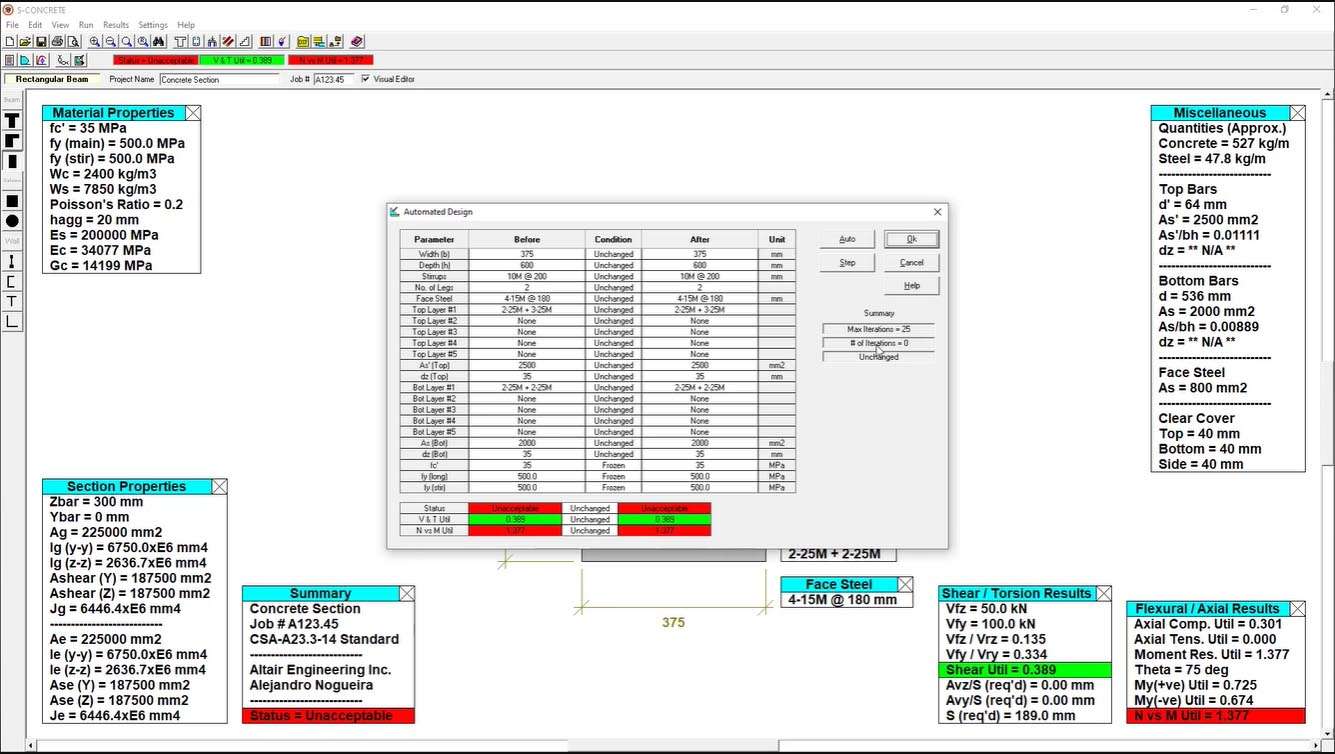
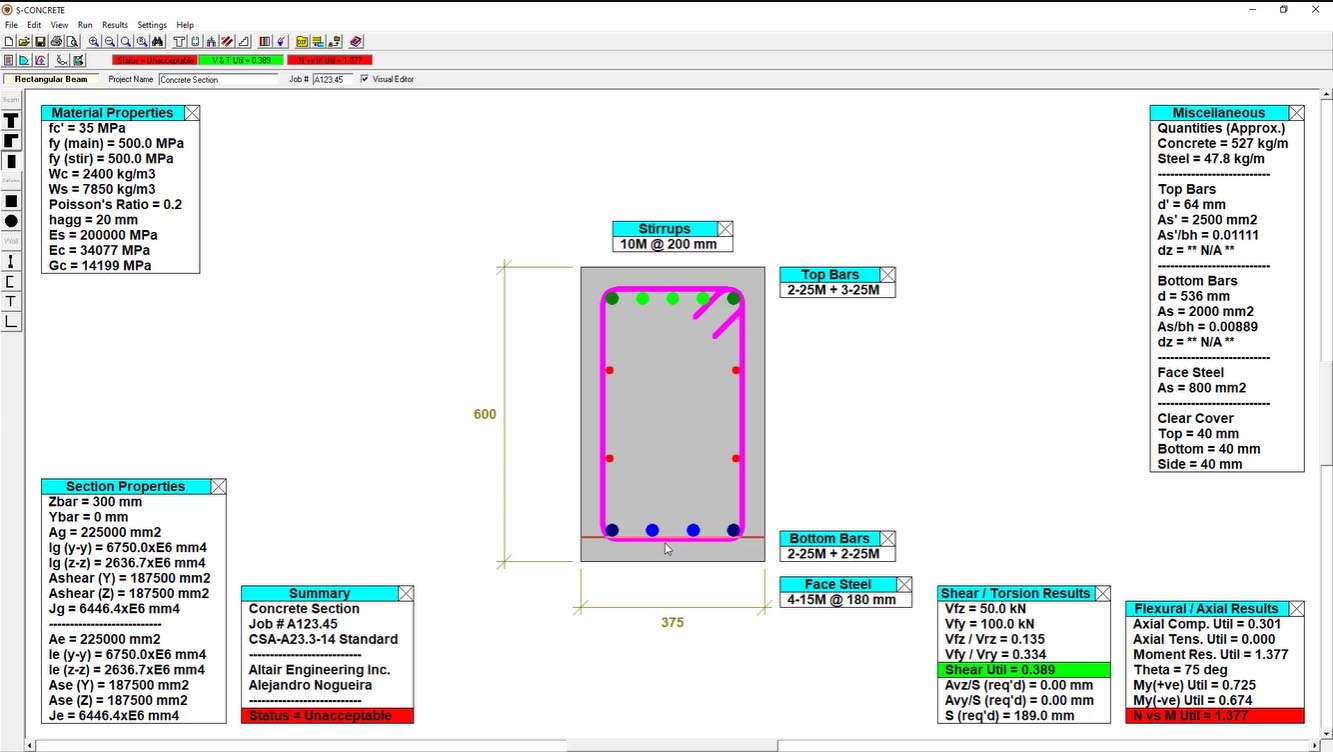
The software displays color-coded utilization ratios for material and section capacities, allowing engineers to quickly identify critical areas. It presents live load case envelopes and helps in the precise identification of critical sections requiring attention, improving the efficiency of the design review process.
Parametric Optimization and Reporting
Altair S-Concrete 2026.0 integrates tools for optimizing reinforcement quantities and generating comprehensive, customizable reports.
Reinforcement Quantity Minimization
The software’s optimization routines assist in minimizing reinforcement quantities by suggesting optimal bar sizes and spacings. It can explore multiple design alternatives, enabling engineers to identify efficient solutions that balance structural performance with material costs.
Customizable Engineering Reports
Users can generate customizable engineering reports detailing the design process and results. These reports can be exported to standard formats such as PDF, Word, and Excel, including intermediate calculation steps and detailed formulas used in the analysis, facilitating clear communication and project documentation.
Integration with Structural Analysis Workflows
Seamless integration with other analysis tools is a key capability, streamlining the overall engineering workflow.
Altair S-FRAME Interoperability
Altair S-Concrete 2026.0 offers direct interoperability with Altair S-FRAME, a comprehensive structural analysis platform. This allows for the direct import of member forces, moments, and other analysis results, creating a unified modeling and design environment without cumbersome data re-entry.
Third-Party and BIM Data Exchange
The software supports data exchange with various third-party analysis and detailing applications. It can export designs using common formats, fostering integration with Building Information Modeling (BIM) platforms and downstream detailing software, thereby enhancing collaboration and project management.
Real-World Case Studies and Industry Adoption
Altair S-Concrete 2026.0 is utilized in numerous real-world engineering projects, demonstrating its practical applicability and effectiveness in professional settings.
Practitioners employ it for designing complex elements in commercial buildings, including floor systems and core walls. It is also instrumental in the structural design of bridge piers and abutments, ensuring these critical infrastructure elements meet stringent performance requirements. Furthermore, its advanced capabilities make it a valuable tool for academic research projects focused on reinforced concrete behavior and innovative design methodologies.
Frequently Asked Questions
What international design codes are supported in Altair S-Concrete 2026.0?
Altair S-Concrete 2026.0 supports major concrete codes including ACI 318 (American Concrete Institute), CSA A23.3 (Canadian Standards Association), Eurocode 2 (EN 1992) and several regional standards. Users can switch code parameters on the fly and view clause-by-clause references in design reports, ensuring compliance with diverse project specifications.
How does Altair S-Concrete integrate with Altair S-FRAME and other structural analysis tools?
S-Concrete offers seamless interoperability with Altair S-FRAME, allowing direct import of member forces and moments into the design environment. It also supports standard export formats (e.g., IFC, DXF) for BIM integration and data exchange with third-party detailing and analysis software, enhancing workflow efficiency.
Can I optimize reinforcement layouts and perform parametric studies in S-Concrete?
Yes. S-Concrete includes reinforcement optimization routines that minimize bar quantities while ensuring code compliance. Users can run parametric studies by varying section dimensions or load intensities and compare multiple design alternatives based on utilization ratios and cost metrics, facilitating informed design decisions.




Reviews
There are no reviews yet.