

Download Amsterdam Modeling Suite 2025 – Advanced Computational Chemistry Software
The Amsterdam Modeling Suite (AMS) 2025, developed by Scientific Computing & Modelling (SCM) and now part of Synopsys, is a comprehensive computational chemistry software suite designed for advanced molecular modeling and quantum chemistry. It is utilized across chemical, pharmaceutical, materials science, and nanotechnology industries by researchers and engineers to simulate molecular structures, properties, and reaction dynamics. This suite offers a powerful, integrated environment for tackling complex scientific challenges.
Overview of Amsterdam Modeling Suite and its Scientific Applications
Amsterdam Modeling Suite (AMS) 2025 represents a significant evolution in computational chemistry software, merging a suite of specialized tools developed by SCM, now under Synopsys. Its primary function is to provide researchers with a unified platform for performing accurate electronic structure calculations and molecular dynamics simulations. The suite is a cornerstone in both academic research and industrial R&D, particularly within sectors like the chemical industry, materials science, petroleum, polymer science, pharmaceuticals, nanotechnology, biochemistry, catalysis research, electrochemistry, physical chemistry, and materials engineering. AMS facilitates in-depth analysis of molecular behavior and material properties.
Comprehensive Computational Methods Integrated in AMS
Density Functional Theory (DFT) and Quantum Chemistry
At the heart of AMS lies its robust implementation of Density Functional Theory (DFT), primarily through the ADF (Amsterdam Density Functional) package. This module allows for high-accuracy electronic structure calculations, crucial for understanding molecular bonding, electronic properties, and reaction pathways. AMS supports a range of DFT functionals, including hybrid functionals, enabling precise predictions for a variety of chemical systems. Beyond DFT, the suite incorporates other quantum chemistry methods essential for detailed molecular analysis.
Reactive Force Field Modeling for Chemical Reactions
The suite features the highly advanced ReaxFF module, which provides precise simulation capabilities for dynamic chemical processes. ReaxFF is a reactive force field that can model bond breaking and formation during simulations, making it invaluable for studying complex chemical reactions, combustion, catalysis, and materials degradation. This enables researchers to explore reaction mechanisms and kinetics in unprecedented detail, bridging the gap between quantum accuracy and the scale of molecular dynamics.
Approximate and Semi-Empirical Methods
For modeling larger molecular systems and achieving faster calculation times, AMS integrates approximate methods such as Density Functional Tight Binding (DFTB) and semi-empirical methods via the MOPAC package. These techniques offer a balance between computational cost and accuracy, making them suitable for initial system setup, exploring conformational space, or simulating biomolecules and polymers where full DFT calculations would be prohibitively expensive. This scalability is a key advantage for complex research projects.
Modeling Capabilities for Complex Molecular and Material Systems
Amsterdam Modeling Suite 2025 is engineered to handle a wide array of complex systems, from intricate biomolecules and polymers to bulk materials and nanomaterials. Its capabilities extend to modeling solid-state properties using the BAND module, which employs periodic boundary conditions for simulating crystalline structures and surfaces. Furthermore, the COSMO-RS module provides sophisticated predictions for solvation effects, thermodynamics, and phase behavior, crucial for understanding chemical processes in solution and designing new materials with specific environmental interactions. This holistic approach supports multi-scale modeling needs.
Advanced Analysis and Data Interpretation Tools within AMS
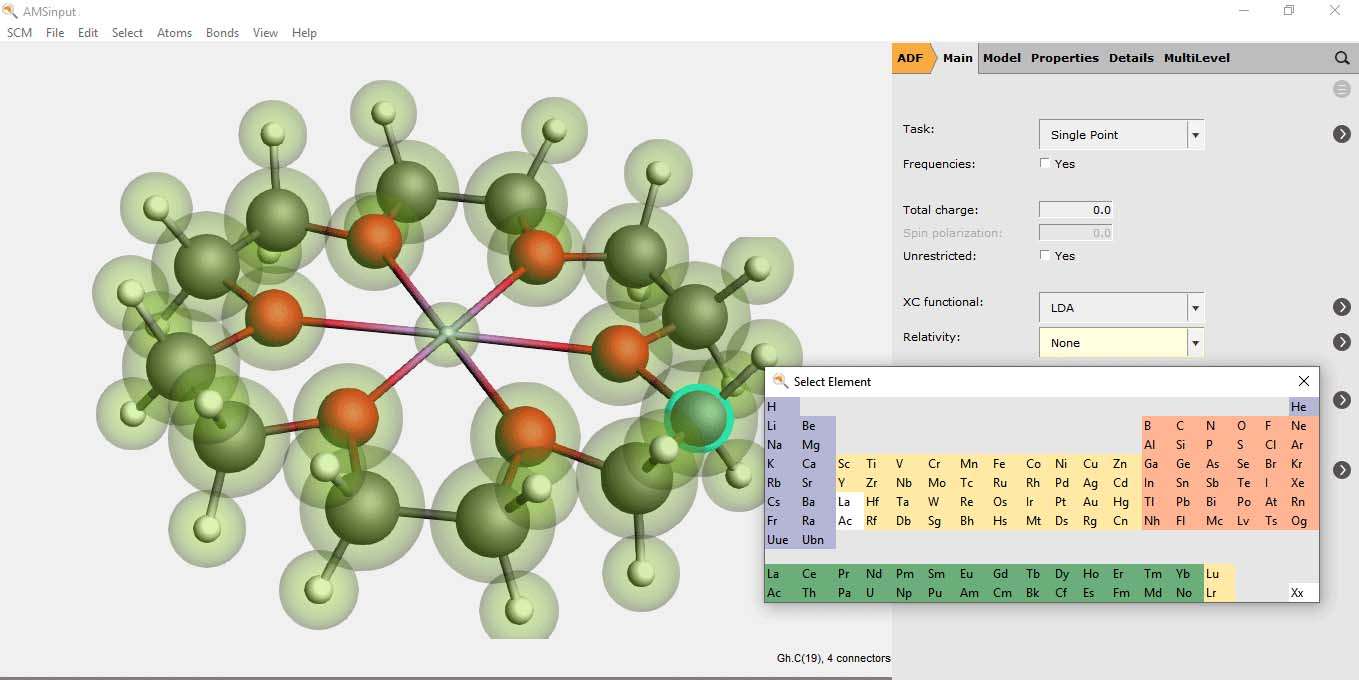
Beyond performing simulations, AMS 2025 provides a comprehensive suite of post-processing and analysis tools designed to interpret complex computational data effectively. Users can visualize molecular structures, electron densities, and reaction pathways with advanced graphical rendering. The software facilitates the prediction of various material properties, including electronic, optical, mechanical, and electrochemical characteristics. Statistical analysis tools are also integrated, aiding in the interpretation of dynamic simulations and the extraction of meaningful scientific insights from extensive datasets.
Integration and Interoperability with Other Chemistry Software
Recognizing the need for flexible research workflows, Amsterdam Modeling Suite 2025 emphasizes interoperability. The suite supports the import and export of molecular structures and calculation results in various standard file formats, allowing seamless integration with other computational chemistry software packages and experimental data analysis tools. This capability ensures that AMS can effectively fit into diverse research pipelines, enabling users to leverage its unique features alongside other specialized software for comprehensive scientific investigations.
Real-world Research and Industry Use Cases of Amsterdam Modeling Suite
The diverse capabilities of Amsterdam Modeling Suite 2025 are applied across numerous real-world research and industry scenarios. In pharmaceutical development, it is used for drug design, modeling molecular interactions with target proteins and predicting binding affinities. The catalysis sector benefits from AMS for understanding reaction mechanisms and designing more efficient catalytic converters, leveraging the ReaxFF module for dynamic process simulation. Materials science and nanotechnology research utilize AMS for investigating the properties of new polymers, analyzing nanomaterials, and predicting material performance. The suite also supports electrochemical studies and the investigation of physical chemical properties.
Frequently Asked Questions
What types of molecular simulations can Amsterdam Modeling Suite 2025 perform?
AMS 2025 supports a wide range of simulations including quantum chemistry calculations via Density Functional Theory, reactive molecular dynamics with ReaxFF, semi-empirical methods with MOPAC, and solid-state calculations using BAND. This enables modeling from small molecules to complex materials and dynamic chemical reactions.
How does Amsterdam Modeling Suite handle large molecular systems and materials?
AMS uses approximate methods like DFTB for rapid modeling of large biomolecules and nanoparticles. The BAND module allows simulations of periodic solids, and COSMO-RS models solvent and material environments, making AMS suitable for large-scale molecular and materials modeling.
Can Amsterdam Modeling Suite be integrated with other computational chemistry software?
Yes, AMS supports interoperability by exporting and importing calculation results to various file formats, facilitating integration with other chemistry software suites. This allows users to combine AMS’s capabilities with other modeling tools for comprehensive analyses.





Reviews
There are no reviews yet.