

Download ANSYS Motion 2022 R1 Multilanguage – Advanced Simulation for Mechanical Systems
ANSYS Motion software, developed by Ansys, Inc., is a specialized application designed for the dynamic analysis of mechanical systems. As a key part of the broader ANSYS simulation suite, it enables engineers in the automotive, aerospace, manufacturing, and robotics sectors to perform complex multibody dynamics simulations. Founded in 1970, Ansys, Inc. has established itself as a leader in engineering simulation, and ANSYS Motion embodies this expertise by providing advanced tools for analyzing the motion of both rigid and flexible bodies.
Understanding ANSYS Motion and Its Applications
What is ANSYS Motion?
ANSYS Motion is a sophisticated multibody dynamics (MBD) analysis tool that forms an integral part of the ANSYS simulation platform. It is engineered to accurately model and simulate the behavior of mechanical systems that involve moving parts. This software provides engineers with the capability to analyze complex interactions, predict performance, and optimize designs before physical prototyping. Its origins are rooted in Ansys, Inc.’s long history of delivering comprehensive engineering simulation solutions across various disciplines.
The software’s primary function is to simulate the motion and forces within mechanical assemblies. This includes everything from simple linkages to complex vehicle suspensions and robotic arms. By leveraging Ansys’s multi-physics simulation capabilities, ANSYS Motion offers a powerful environment for understanding the dynamic performance characteristics of engineered products.
Key Applications and Industries
ANSYS Motion finds its most prominent applications within the automotive industry, where it is essential for simulating vehicle dynamics, suspension systems, and powertrain components. This enables manufacturers to refine vehicle handling, stability, and occupant comfort.
Beyond automotive engineering, the software is highly relevant in other demanding sectors:
- Aerospace: Used for analyzing the dynamics of flight control systems, landing gear mechanisms, and satellite deployment systems.
- Manufacturing: Applied in the design and simulation of automated machinery, conveyor systems, and industrial robots to ensure efficient and reliable operation.
- Robotics: Critical for designing and testing robotic arms, mobile robots, and complex robotic work cells, optimizing their movement, speed, and precision.
Dynamic Analysis Capabilities
Simulating Rigid Multibody Systems
A core capability of ANSYS Motion is the accurate simulation of rigid multibody systems. This involves modeling mechanical components as perfectly rigid bodies that interact through joints and constraints. Engineers utilize this functionality to analyze the kinematics and dynamics of mechanisms, such as engine components, linkages, and robotic end-effectors, focusing on forces, torques, and accelerations without considering deformation.
The software provides robust tools for defining joints, contacts, and forces that govern the motion of these rigid bodies. This allows for detailed study of the mechanical behavior of assemblies under various operating conditions, ensuring proper function and identifying potential design flaws early in the development cycle.
Flexible Body Modeling
Recognizing that many real-world components exhibit flexibility under load, ANSYS Motion incorporates advanced flexible body modeling capabilities. This feature allows engineers to represent mechanical parts not as infinitely rigid, but as deformable bodies whose physical properties can influence the system’s overall dynamics. By incorporating modalFEM analysis, the software can predict how vibrations, stress, and strain affect the motion of the system.
This capability is crucial for high-precision applications or systems where component deformation significantly impacts performance, such as in high-speed rotating machinery or complex aerospace structures. Flexible body analysis in ANSYS Motion enhances simulation accuracy by accounting for phenomena like vibration, flutter, and dynamic stress.
Integration with Other Engineering Tools
Compatibility with MATLAB and Simulink
ANSYS Motion offers significant advantages through its seamless integration with MATLAB and Simulink, widely used environments for algorithm development, modeling, and simulation. This interoperability allows engineers to embed ANSYS Motion models within a larger Simulink environment or to use MATLAB scripts for advanced control system design, data analysis, and automation of simulation workflows.
This connection empowers users to develop sophisticated control strategies for their mechanical systems and to leverage the extensive libraries and toolboxes available in MATLAB and Simulink. It facilitates a more holistic approach to mechatronic system design, bridging the gap between mechanical dynamics and control engineering.
Interfacing with Other ANSYS Products
As a component of the ANSYS suite, ANSYS Motion benefits from and contributes to the integrated simulation environment. It can interface effectively with other ANSYS products, such as ANSYS Mechanical for detailed finite element analysis of individual components, ANSYS Fluent for fluid dynamics simulations that might affect mechanical performance, and ANSYS Maxwell for electromagnetic analyses. This connectivity allows for comprehensive multi-physics simulations, where the results from one domain inform the analysis in another.
This integration streamlines the engineering workflow, enabling a more complete understanding of how different physical phenomena interact and influence the overall product behavior. Designers and analysts can move efficiently between different simulation types, ensuring that all relevant physical effects are considered for accurate product development.
User Interface and Modeling Tools
Intuitive User Interface Features
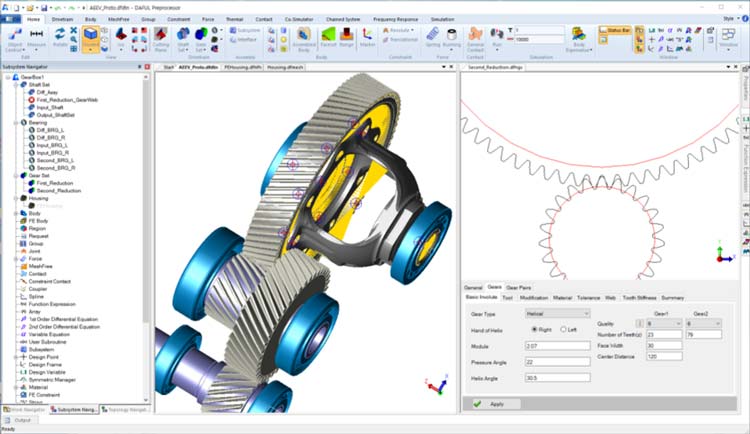
ANSYS Motion is designed with an intuitive user interface that aims to simplify the complex process of multibody dynamics simulation. The graphical environment allows engineers to easily build, validate, and analyze mechanical models. Features like drag-and-drop functionality for adding components, visual feedback during model construction, and clear organization of simulation setup parameters contribute to an efficient user experience.
The interface guides users through the simulation process, from model creation to result interpretation. This focus on usability helps reduce the learning curve and allows engineers to concentrate on achieving accurate simulation results rather than struggling with software complexity.
Advanced Modeling Features
Beyond basic multibody dynamics, ANSYS Motion provides a rich set of advanced modeling features essential for comprehensive mechanical system design. This includes sophisticated tools for creating and managing complex assemblies, defining intricate joint properties, applying realistic contact definitions, and specifying various load conditions. The software also supports the import of CAD geometry, allowing for direct use of designs created in other CAD systems.
Key advanced features include the ability to model non-linear phenomena such as friction and backlash, simulate component wear, and perform parameter studies to optimize system performance. The software’s capacity for 3D modeling ensures that spatial relationships and complex geometries are accurately represented in simulations.
Real-World Use Cases
Automotive Industry Applications
Within the automotive sector, ANSYS Motion is indispensable for simulating a wide array of vehicle systems. This includes the dynamic behavior of suspension systems under various road conditions to optimize ride comfort and handling, analysis of steering mechanisms for precise control, and testing of powertrain components like engine mounts and drivetrains to minimize vibration and noise (NVH). It is also used to simulate crashworthiness scenarios and the kinematics of seatbelt and airbag deployment systems.
Engineers use ANSYS Motion to virtually prototype and test vehicle designs, significantly reducing the need for expensive physical prototypes and accelerating development cycles. The software’s ability to model interactions between rigid and flexible components allows for highly accurate predictions of vehicle performance under diverse operational demands. This results in safer, more efficient, and more comfortable vehicles.
Beyond Automotive: Aerospace and Robotics
In aerospace engineering, ANSYS Motion is applied to simulate the complex dynamics of critical systems. Examples include the deployment and retracting mechanisms of landing gear, the motion of control surfaces like ailerons and flaps, and the actuation and stability of robotic equipment used in spacecraft assembly or maintenance. The analysis of flexible structures is particularly important in aerospace to account for the effects of aerodyanmic forces and material fatigue.
For the burgeoning field of robotics, ANSYS Motion provides the tools to design and validate robotic manipulators, autonomous mobile robots, and collaborative robot systems. Engineers can simulate robot arm trajectory execution, analyze joint loads, ensure collision avoidance, and optimize motion paths for industrial automation, material handling, and exploration. The integration with control systems through MATLAB/Simulink is often critical in these applications.
Conclusion: The Future of Mechanical Simulation with ANSYS Motion
ANSYS Motion 2022 R1 represents a significant advancement in the field of mechanical system simulation, offering engineers powerful tools to tackle complex design challenges. Its comprehensive capabilities in multibody dynamics, coupled with flexible body modeling and robust integration with other essential engineering software like MATLAB and Simulink, position it as a vital asset for innovation in automotive, aerospace, robotics, and manufacturing industries.
As engineering demands continue to push the boundaries of complexity and performance, tools like ANSYS Motion are essential for predicting and optimizing the behavior of mechanical systems. The ongoing development within the ANSYS suite promises even greater integration and advanced functionalities, driving the future of virtual product development and engineering efficiency.
Frequently Asked Questions
What are the main features of ANSYS Motion?
ANSYS Motion includes capabilities for simulating both rigid and flexible bodies, enabling detailed multibody dynamics analysis. It offers robust modeling tools to define complex joints, contacts, and forces, along with features that facilitate the analysis of mechanical systems, particularly in demanding applications like automotive simulation.
How does ANSYS Motion integrate with other software?
ANSYS Motion can seamlessly integrate with MATLAB and Simulink, allowing for enhanced modeling capabilities and broader analysis of system dynamics within various engineering frameworks. This interoperability is key for developing sophisticated control strategies and automating simulation workflows.
In which industries is ANSYS Motion primarily used?
ANSYS Motion is predominantly utilized in the automotive sector for intricate motion analysis and design optimization. However, its powerful simulation capabilities also make it a valuable tool in aerospace, robotics, and various other mechanical engineering fields requiring detailed dynamic system analysis.






Reviews
There are no reviews yet.