

Download APF PlaneFailure 3.1 – Advanced Planar Failure Slope Stability Analysis Software
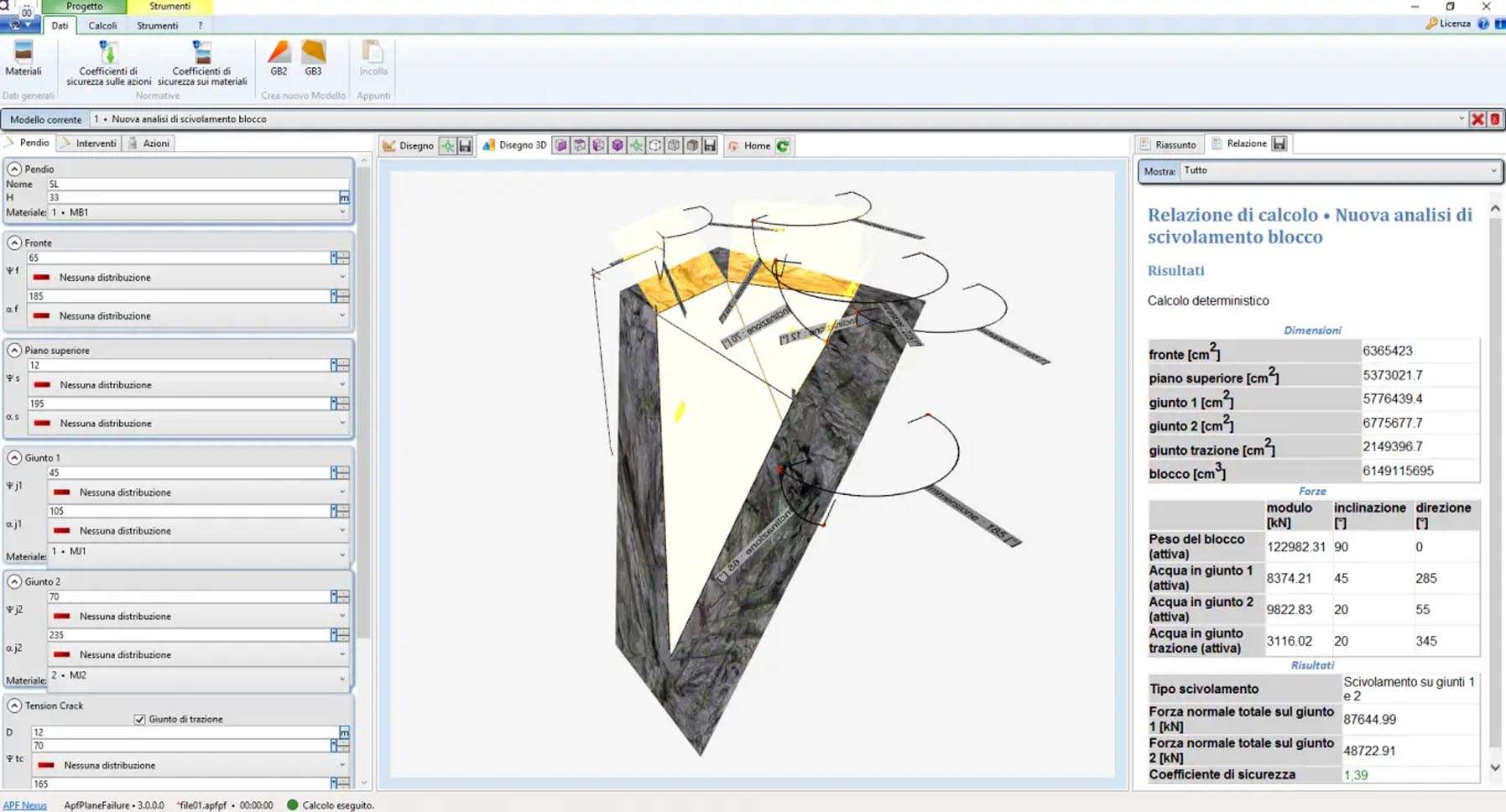
APF PlaneFailure 3.1 is a specialized geotechnical engineering software designed for assessing the stability of slopes susceptible to planar failure mechanisms. Developed for engineers in civil, mining, and geotechnical fields, this software provides advanced tools for quantitative analysis of rock slopes, embankments, and engineered excavations, with a particular focus on the plane failure slope stability analysis. It aids professionals in validating designs and ensuring safety by simulating complex geological and loading conditions.
Detailed Overview of Planar Failure in Slope Stability
Planar failure represents a critical failure mode in geotechnical engineering, particularly in rock masses where discrete geological discontinuities govern slope behavior. These discontinuities, such as bedding planes, faults, or joints, can act as slip surfaces, facilitating large-scale block sliding. Analyzing the stability of slopes influenced by these planar structures is paramount in the design of open-pit mines, natural cliff remediation, and engineered cut slopes. APF PlaneFailure specifically addresses these scenarios, providing engineers with a tool to evaluate the integrity of structures where such mechanisms are a primary concern.
Core Analytical Capabilities for Slope Safety Assessment
Force Modeling and Factor of Safety Calculation
APF PlaneFailure quantifies slope safety by calculating the Factor of Safety (FoS) against sliding along a defined planar surface. This calculation integrates various forces acting on the potential sliding block, including gravitational forces, the resisting forces derived from the shear strength along the discontinuity (cohesion and friction angle), and external destabilizing influences. By computing this ratio, engineers can determine the margin of safety for a given slope geometry and material properties.
Incorporation of Water Pressure Effects
The presence and distribution of water within geological structures significantly impact slope stability. APF PlaneFailure models the destabilizing effects of hydrostatic and tension water pressures acting within discontinuities and tension cracks. Accurate simulation of these pressures is crucial, as they can reduce the effective normal stress along the failure plane, thereby diminishing the shear resistance and potentially leading to instability.
Seismic Load Simulation
For slopes situated in seismically active regions, earthquake forces can act as a major triggering mechanism for failure. APF PlaneFailure employs pseudo-static analysis to simulate the effects of seismic loading. By incorporating horizontal and vertical seismic coefficients, the software allows engineers to assess how earthquake-induced accelerations might reduce the factor of safety and increase the risk of sliding along planar failure surfaces.
Support Systems Integration
Engineers frequently employ artificial support systems to enhance slope stability. APF PlaneFailure facilitates the analysis of these reinforcements, such as rock bolts, anchors, and dowels. The software allows for the modeling of these elements as passive or active resistance forces, enabling users to quantify the effectiveness of designed support systems in preventing or mitigating planar failures and improving overall rock slope safety.
Advanced Probabilistic and Sensitivity Analysis Features
Recognizing the inherent uncertainties in geological materials and loading conditions, APF PlaneFailure incorporates advanced probabilistic analysis methods. Utilizing techniques such as Monte Carlo simulations, the software can model the variability of input parameters like friction angle, cohesion, water pressure, and seismic coefficients. This approach permits the calculation of a probability of failure, offering a more comprehensive risk assessment than deterministic methods alone, and enabling the identification of the most sensitive parameters influencing slope behavior.
Improved User Interface and Reporting in Version 3.1
Version 3.1 of APF PlaneFailure introduces enhancements aimed at improving engineering workflow efficiency and usability. Notable updates include improvements to the user interface for more intuitive input of complex geometries and water pressure distributions. Furthermore, the software features expanded reporting capabilities, offering more detailed analysis summaries and customizable export options for technical documentation and client communication, streamlining the presentation of critical geotechnical slope stability findings.
Applications in Civil, Mining, and Infrastructure Slope Projects
APF PlaneFailure is applied across various demanding engineering scenarios. In mining engineering, it is used for the detailed stability assessment of open-pit mine highwalls, where planar failure is a common concern. For civil infrastructure, the software supports the design and analysis of stable engineered cut slopes and embankments. It also aids in evaluating the potential failure modes of natural slopes and excavations, providing crucial data for risk management, design optimization, and the implementation of effective remediation or reinforcement strategies for mining slope safety software applications.
Frequently Asked Questions
What types of geological discontinuities can APF PlaneFailure analyze?
APF PlaneFailure is specifically designed to analyze slopes where failure is anticipated to occur along distinct planar geological discontinuities. This includes features commonly found in rock masses such as bedding planes, joints, and faults, which often dictate the stability of rock slopes and engineered excavations.
How does APF PlaneFailure incorporate water pressure effects in slope stability calculations?
The software accounts for the destabilizing influence of water by modeling hydrostatic and tension water pressures within potential failure planes and tension cracks. Accurately simulating these pressures is essential, as they can significantly reduce the effective normal stress, thereby decreasing the shear resistance along the discontinuity.
Can APF PlaneFailure perform seismic loading analysis for earthquake-prone areas?
Yes, APF PlaneFailure supports seismic load analysis using the pseudo-static method. This method allows engineers to simulate the effects of earthquake forces by incorporating defined horizontal and vertical seismic coefficients, enabling an assessment of their impact on overall slope stability and the factor of safety.







Reviews
There are no reviews yet.