
Download ASDIP Analysis 2.0 – Structural Load Generation and Continuous Beam Analysis Software
ASDIP Analysis 2.0 is a specialized structural engineering software developed by ASDIP Structural Software, designed to streamline the calculation and analysis of structural members. It plays a critical role in the civil engineering and construction sectors by providing tools for load generation and continuous beam analysis, with a particular focus on compliance with up-to-date ASCE 7-22 standards. This application is engineered for structural engineers and civil professionals who require precise, code-compliant load calculations for ensuring building safety and validating structural designs.
Overview of ASDIP Analysis in Structural Engineering
ASDIP Analysis 2.0 represents a key advancement in structural engineering software, developed by ASDIP Structural Software to address the complex demands of modern design. The software is built to simplify and automate critical calculations, ensuring that structural designs adhere to the rigorous requirements of contemporary building codes. A cornerstone of its functionality is its robust integration with standards like ASCE 7-22, providing engineers with a reliable tool for load analysis and design verification. This focus on code compliance and detailed calculation makes ASDIP Analysis an indispensable asset for professionals managing structural integrity and safety in diverse construction projects.
Comprehensive Load Generation for Structural Safety
Ensuring structural safety begins with accurately calculating and applying all relevant loads. ASDIP Analysis 2.0 offers specialized modules to address the most critical environmental and occupancy loads that buildings must withstand. The software automates these complex computations, allowing engineers to focus on design implementation rather than labor-intensive calculations.
Seismic Load Generation for Multistory Buildings
ASDIP Analysis 2.0 facilitates the precise calculation of seismic loads essential for the design of multistory structures. By integrating the methodologies outlined in ASCE 7-22, the software accounts for factors such as seismic design category, response modification factors, and building period to generate accurate seismic forces. This capability is crucial for ensuring that buildings can safely withstand earthquake events, a key concern in seismically active regions.
Snow Load Calculations: Uniform and Drift Loads
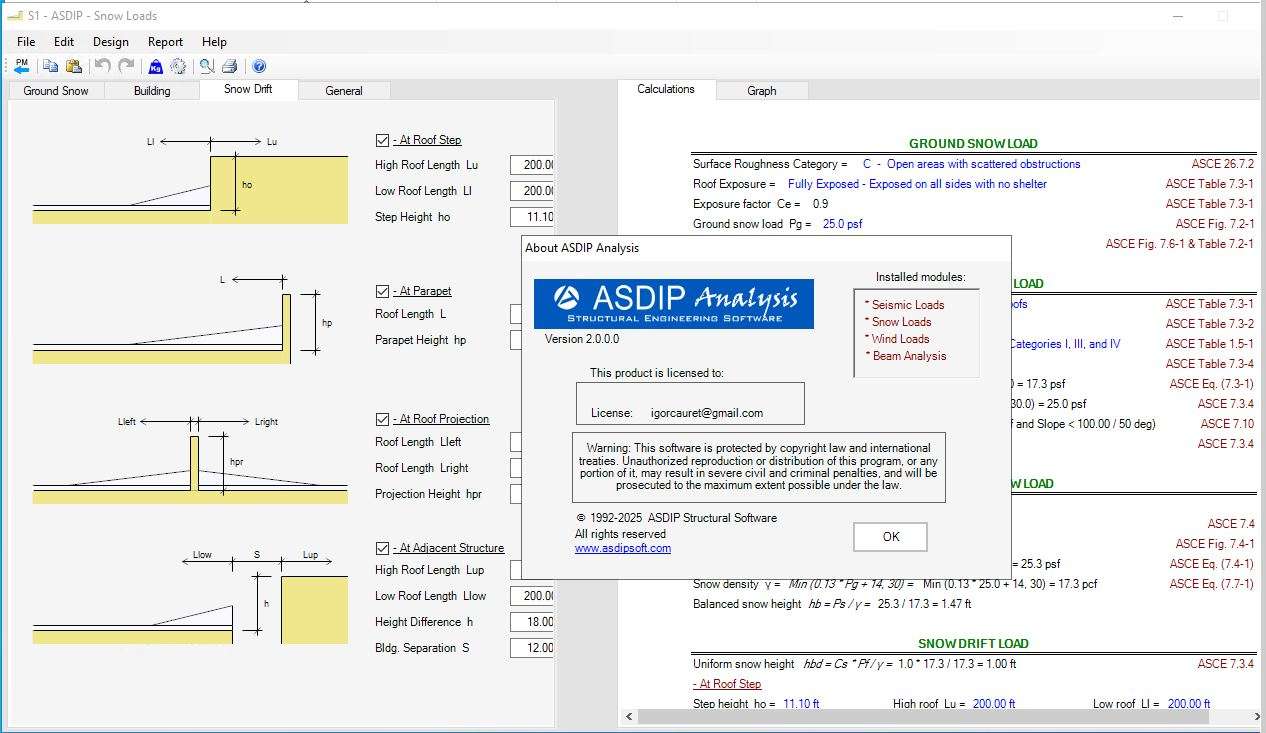
The software provides comprehensive tools for calculating snow loads, encompassing both uniform snow accumulation and potentially hazardous snow drift conditions. ASDIP Analysis 2.0 guides users through the requirements of ASCE 7 for determining ground snow loads, exposure factors, and thermal factors, alongside specific considerations for roof geometry and adjacent structures that influence drift formation. This detailed approach helps prevent structural failures due to excessive snow accumulation.
Wind Load Analysis for MWFRS and C&C Systems
ASDIP Analysis 2.0 enables detailed wind load analysis for crucial building components. It supports the calculation of wind pressures on Main Wind Force Resisting Systems (MWFRS) and Components & Cladding (C&C) systems as defined by ASCE 7. The software considers parameters such as wind speed, exposure category, topographic effects, and building shape to provide accurate wind load distributions, which are vital for the integrity of the building envelope and its primary structural framework.
Continuous Beam Analysis Capabilities
Beyond load generation, ASDIP Analysis 2.0 excels in analyzing the behavior of continuous beams, a common structural element in buildings and bridges. The software processes various load combinations to generate detailed shear and moment diagrams, providing engineers with critical insights into stress distribution and potential failure points. This capability supports precise design verification, ensuring that beams are adequately sized and reinforced to meet performance requirements under service and ultimate load conditions.
Advanced Reporting and Project Management Features
ASDIP Analysis 2.0 supports professionals by streamlining the documentation process. The software generates comprehensive, professional reports that include detailed calculation steps, load combinations, and analysis results, directly referencing the applicable code provisions. These reports are essential for project submission, review, and record-keeping. Furthermore, the software aids in organizing calculation files, allowing engineers to manage multiple projects efficiently and securely store all structural analysis data.
Industry Applications and Compliance
ASDIP Analysis 2.0 finds extensive application in civil engineering and construction projects requiring meticulous structural analysis. Its adherence to current codes, including ASCE 7-22, ASCE 7-16, and CSA A23.3, establishes it as a trustworthy tool for validating structural designs against stringent regulatory requirements. Professionals leverage this software for tasks ranging from the seismic design of residential and commercial buildings to ensuring facade elements can withstand specified wind pressures and that roofs can safely support calculated snow loads. The software’s strength lies in its targeted approach to load combination and member analysis, providing a high degree of confidence in the structural integrity of designed elements.
Frequently Asked Questions
How does ASDIP Analysis 2.0 ensure compliance with the latest ASCE 7 standards?
ASDIP Analysis 2.0 integrates the most up-to-date provisions from ASCE 7-22 and ASCE 7-16, automating load combinations and calculations per these codes. This ensures structural loads and member analysis meet current regulatory requirements critical for safety and approval.
What types of loads can I analyze using ASDIP Analysis 2.0?
The software supports generation and analysis of seismic loads, snow loads (both uniform and drift), and wind loads for major structural framing systems like MWFRS and Components & Cladding (C&C). This comprehensive coverage enables precise load design for diverse environmental conditions.
Can ASDIP Analysis 2.0 handle continuous beam analysis with multiple load combinations?
Yes, ASDIP Analysis 2.0 features dedicated modules to calculate shear and moment diagrams for continuous beams under multiple load combinations, helping engineers accurately assess structural behavior and design requirements.




Reviews
There are no reviews yet.