

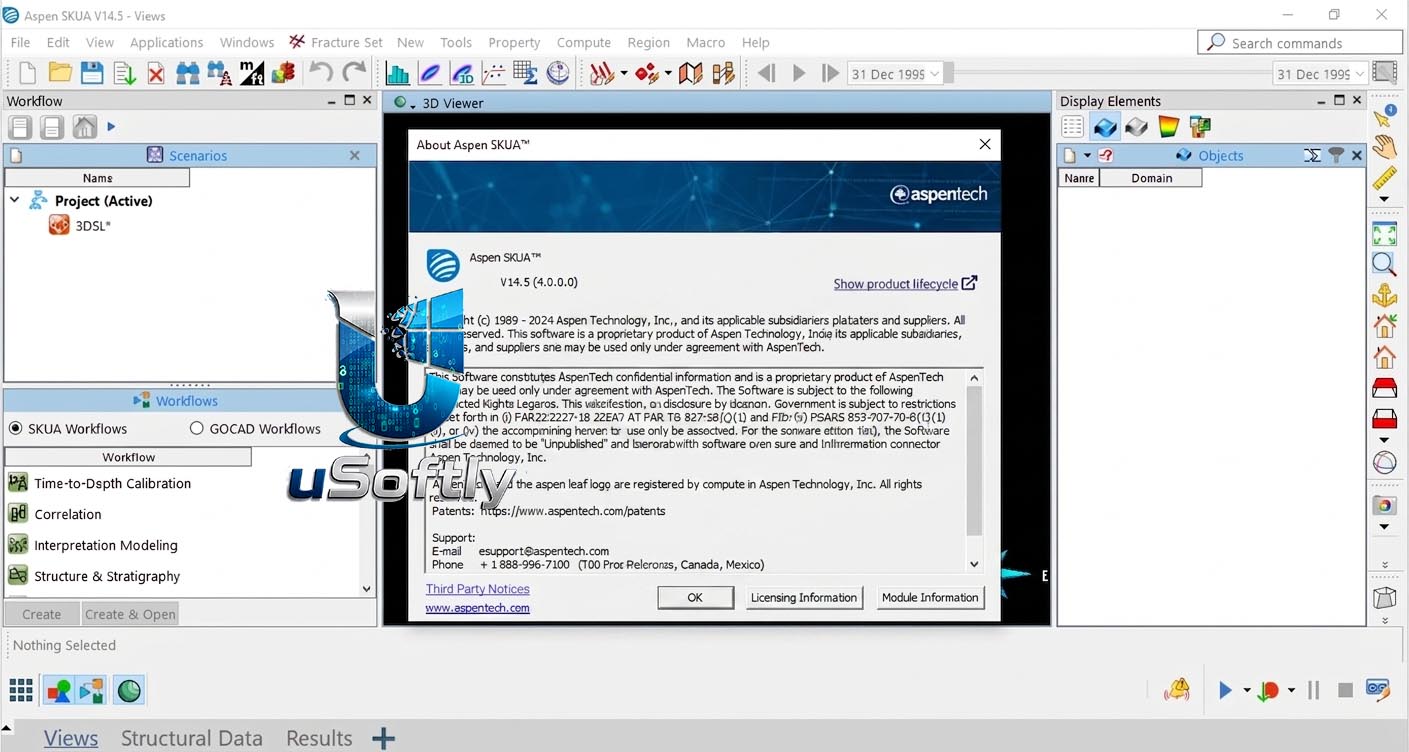
Aspen SKUA 14.5 – Geology-Driven 3D Modeling and Subsurface Interpretation Software
Aspen SKUA is the next-generation geological modeling platform developed by AspenTech, succeeding the well-known SKUA-GOCAD technology following the 2022 merger of Emerson and AspenTech . The platform provides a suite of geology-driven modeling solutions that enable users to quickly and accurately construct models suitable for multiple applications, including flow simulation, drilling, and imaging .
The 14.5 release represents a significant milestone as the first version built on the rebranded Aspen SKUA technology . It introduces expanded programmability, enhanced interoperability, and numerous stability improvements across the platform.
Primary Users
Aspen SKUA 14.5 is designed for geologists, geophysicists, reservoir engineers, and mining professionals who require a powerful platform for constructing accurate 3D geological models. It serves professionals who:
-
Build complex 3D geological models incorporating structural, stratigraphic, and property data for oil & gas, mining, and geothermal applications
-
Perform structural restoration and validation to ensure geologically consistent models using Kine3D technology
-
Integrate multiple data sources including seismic, well logs, and geological interpretations in a unified workflow
-
Collaborate across disciplines using open data formats like GEOH5 for seamless data exchange
-
Automate workflows and customize analysis through an expanded Python API
Key Features & Capabilities
Core Modeling and Analysis
-
Structural and Stratigraphic Modeling: Build complex 3D geological models with sophisticated structural frameworks, fault networks, and stratigraphic layering
-
3D Restoration (Kine3D-3): Validate geological interpretations by performing sequential 3D restoration, ensuring structurally consistent models
-
Well Planning and Correlation: Integrated tools for well path planning and well-to-seismic correlation
-
Reservoir Properties and Uncertainty: Geostatistical modeling, property simulation, and uncertainty quantification through the Jacta module
Integration and Interoperability
-
Python API: Expanded Python scripting capabilities for workflow automation and customization, enabling greater flexibility and integration with other tools
-
GEOH5 Open Format: Improved interoperability via the open GEOH5 format, streamlining data exchange with other geoscience applications such as Geoscience ANALYST
-
Data and Trend Analysis: Enhanced support for large datasets, including the ability to use more than 32,000 wells in analysis workflows
Data Exchange
-
Seamless data import/export for collaboration and integration with other software
-
Compatibility with TemisFlow products for advanced basin and petroleum systems modeling, including the export of kinematic meshes
What’s New in Aspen SKUA 14.5
The 14.5 release introduces several key enhancements and fixes:
Expanded Python API and Interoperability
The Python API has been expanded to provide greater automation capabilities and flexibility . Connectivity with Geoscience ANALYST has also been enhanced, and interoperability is improved via the open GEOH5 format .
Stability and Bug Fixes
Numerous stability improvements and bug fixes are included, such as:
-
Resolving unexpected exits in the Compute Geothermal Potential command
-
Fixing compatibility issues in the Macro Player workflow
-
Correcting project archive corruption issues
-
Resolving issues with 3D Viewer tools and cross-section views
Enhanced Data and Trend Analysis
-
Support for more than 32,000 wells in analysis workflows
-
Improved data blocking options after log editing
-
Ability to transfer spatial VTC/VPC curves onto voxets with the first axis as Time or Depth
Reservoir Properties and Uncertainty
-
Performance improvements in geostatistical simulations
-
Better handling of channel width definitions in Fluvsim
-
Fixed unexpected exits in Jacta simulations when model regions are not finalized
.





Reviews
There are no reviews yet.