

Download Autodesk Inventor Tolerance Analysis 2026 – Advanced Tolerance Analysis Tool for Mechanical Design
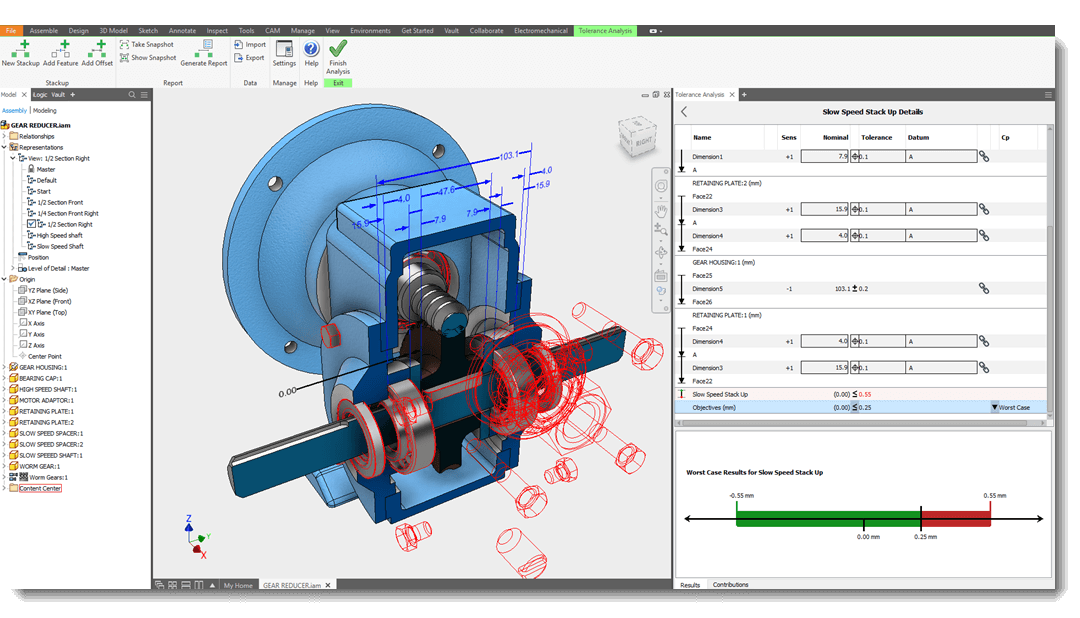
Autodesk Inventor Tolerance Analysis 2026, an extension developed by Autodesk, Inc., is a specialized CAD software designed for mechanical engineers and manufacturing professionals. It integrates seamlessly with Autodesk Inventor to provide precise calculations for geometric dimensions and tolerances, directly addressing the impact of manufacturing variability on part fit and assembly success. This tool is crucial for optimizing designs early in the development cycle, ensuring functional performance and manufacturability in demanding industrial environments.
Overview of Autodesk Inventor Tolerance Analysis
Introduction to Tolerance Analysis
Tolerance analysis is a critical engineering practice that involves evaluating the cumulative effect of dimensional variations on mechanical components and assemblies. In computer-aided design (CAD), it allows engineers to predict how variations in manufacturing tolerances will affect the fit, function, and performance of parts when assembled. By performing detailed calculations, designers can identify potential interferences, excessive clearances, or other assembly issues before production, leading to more reliable and cost-effective designs.
Key Features of the Software
Cumulative Effects Calculation
Autodesk Inventor Tolerance Analysis employs robust methods to calculate the cumulative effects of individual part tolerances on critical assembly dimensions. This feature enables engineers to understand how variations from multiple dimensions across several parts can add up, potentially leading to assembly failures or performance degradation. The software quantizes these effects, providing clear numerical results.
Manufacturing Tolerance Validation
This software allows engineers and designers to validate manufacturing tolerances by simulating real-world assembly conditions within the design environment. It helps confirm that specified tolerances will allow parts to fit and function together as intended, even with the inherent variations introduced during manufacturing. This proactive validation process minimizes the risk of production delays and costly rework.
Statistical Analysis Capabilities
Beyond simple worst-case analysis, Autodesk Inventor Tolerance Analysis offers advanced statistical analysis capabilities. It generates detailed statistical results based on various distribution models, providing engineers with a probabilistic understanding of assembly outcomes. This approach allows for more informed design decisions by quantifying risks and optimizing tolerance allocation for improved product reliability.
Applications in Mechanical Engineering
In mechanical engineering and manufacturing, the precise management of tolerances is paramount for product quality and performance. Autodesk Inventor Tolerance Analysis provides engineers with the tools needed to systematically analyze Geometric Dimensioning and Tolerancing (GD&T) and dimensional variation effects. This capability is essential for ensuring that complex mechanical assemblies, from intricate consumer electronics to heavy machinery, function reliably despite manufacturing imperfections, thereby enhancing operational efficiency and product longevity.
Comparison with Other Tolerance Analysis Tools
While several tools offer tolerance analysis capabilities, Autodesk Inventor Tolerance Analysis stands out due to its deep integration with the Autodesk Inventor CAD environment. This tight coupling streamlines workflows, allowing designers to seamlessly transition from design to analysis without exporting models or re-entering data. Its statistical analysis features and the ability to flag potential 2D and 3D effects, even when performing 1D stackups, further differentiate it from standalone solutions that may require more manual setup or offer less intuitive GD&T validation.
Real-World Use Cases
In the automotive industry, Autodesk Inventor Tolerance Analysis is critical for ensuring that complex engine components or chassis elements fit precisely during assembly, maintaining performance and safety standards. Aerospace engineers utilize it to validate the tight tolerances required for critical flight systems, where even minor deviations can affect functionality and airworthiness. Similarly, in the medical device sector, precise assembly tolerances are vital for the reliable operation of sophisticated equipment, making this software an indispensable tool for engineers focused on product accuracy and dependability.
Conclusion
Autodesk Inventor Tolerance Analysis 2026 empowers mechanical design and manufacturing professionals to proactively manage dimensional variation within their designs. By leveraging its comprehensive features for cumulative effects calculation, tolerance validation, and statistical analysis, engineers can confidently optimize GD&T, reduce assembly issues, and improve overall product quality and reliability. Its seamless integration with Autodesk Inventor makes it an efficient and valuable tool for anyone committed to engineering excellence.
Frequently Asked Questions
What is Autodesk Inventor Tolerance Analysis?
Autodesk Inventor Tolerance Analysis is a plugin that enhances Autodesk Inventor by providing tools for calculating and validating manufacturing tolerances. It helps designers understand the impact of dimensional variations in assemblies, ensuring that parts will fit and function correctly even with manufacturing imperfections.
How does tolerance stackup analysis benefit manufacturing?
Tolerance stackup analysis allows manufacturers to anticipate and minimize issues that arise from dimensional variations, ensuring parts fit together correctly and perform as intended. This leads to improved product reliability and efficiency in production by reducing scrap, rework, and assembly line problems.
Can Autodesk Inventor Tolerance Analysis handle 3D tolerance stackups?
While Autodesk Inventor Tolerance Analysis primarily supports 1D stackup problems, it has capabilities to detect and provide warnings for potential 2D and 3D effects. This helps in identifying complex interactions that might arise in higher-dimensional assemblies.






Reviews
There are no reviews yet.