

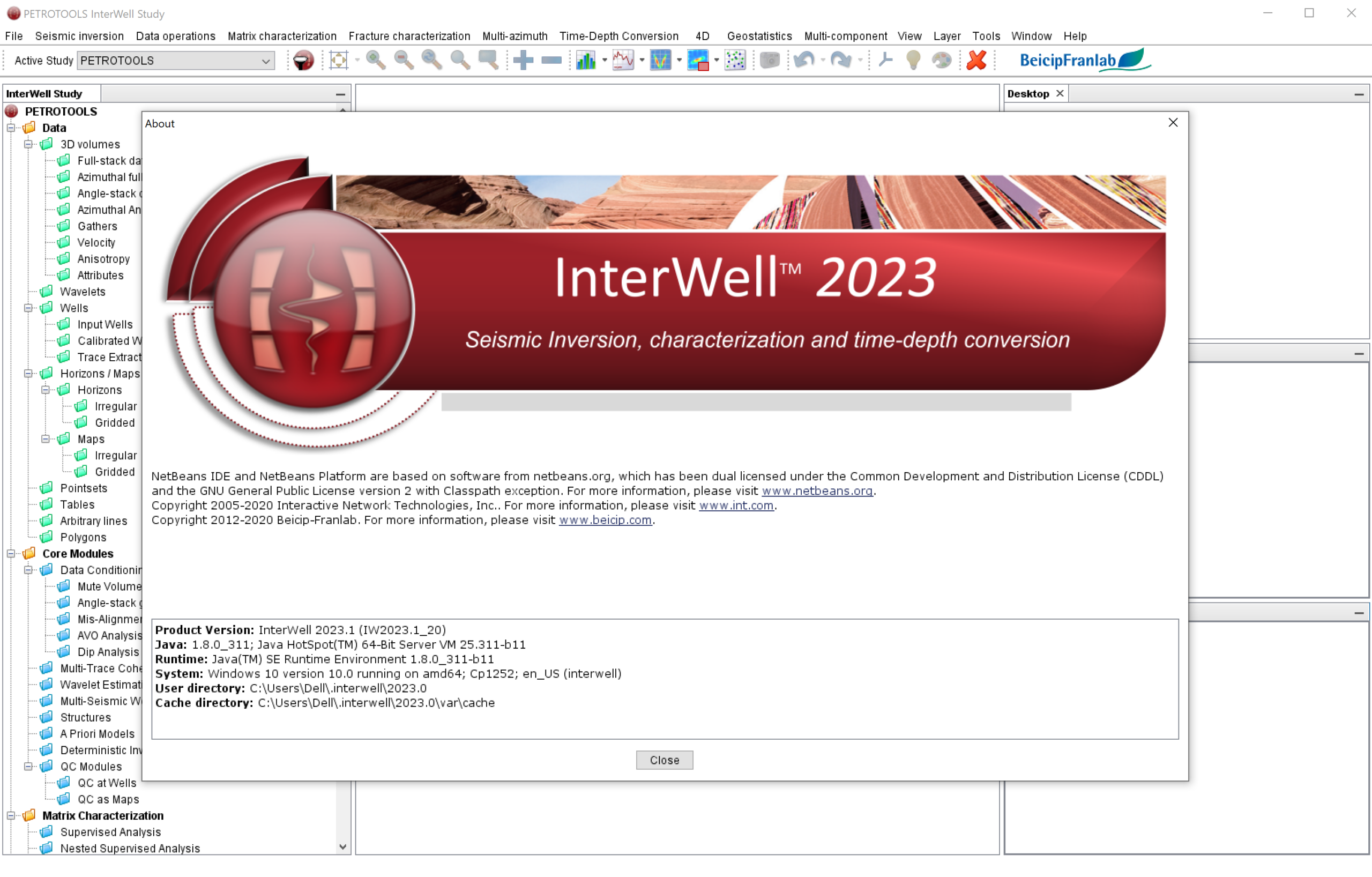
Download Beicip Franlab InterWell 2025.1 – Advanced Seismic Inversion Software
Beicip Franlab InterWell 2025.1 is a specialized application designed for advanced seismic inversion and reservoir characterization. Developed by Beicip-Franlab, a company with strong ties to the French Petroleum Institute (IFPEN), this software caters specifically to geophysicists and reservoir engineers within the oil and gas exploration and production sector. It provides a comprehensive suite of tools to analyze subsurface geological data and enhance the understanding of hydrocarbon reservoirs.
Overview of Beicip Franlab InterWell 2025.1
Introduction to InterWell
Beicip Franlab InterWell 2025.1 stands as a comprehensive solution for complex subsurface analysis in the oil and gas industry. It offers advanced capabilities designed to interpret seismic data and characterize geological formations with high fidelity. The software’s primary function is to assist geoscientists, particularly geophysicists, in making informed decisions during exploration and reservoir management phases by providing detailed insights into subsurface structural and lithological properties.
Seismic Inversion Capabilities
Advanced Techniques in Inversion
InterWell employs sophisticated seismic inversion techniques to transform seismic wave data into detailed earth models. These methods are crucial for estimating subsurface properties such as acoustic impedance, which is directly related to lithology and fluid content. The software supports various inversion schemes to maximize accuracy and effectiveness in complex geological settings.
- Post-stack inversion for generating impedance models from processed seismic data.
- Pre-stack inversion to incorporate angle-dependent reflectivity information for better resolution and fluid discrimination.
- Multi-channel inversion capabilities to leverage a wider range of seismic attributes for more robust results.
- Integration of a Bayesian formalism approach to quantify uncertainties in inversion outputs.
Matrix and Fracture Characterization
Machine Learning Applications
A key differentiator for InterWell is its integration of machine learning algorithms to refine the characterization of both the rock matrix and natural fracture systems. This advanced approach allows for more nuanced interpretations of reservoir complexity, which is critical for optimizing production strategies.
- Machine learning models are trained on seismic and well log data to identify patterns indicative of specific rock types and fluid saturations.
- Automated workflows for fracture characterization help in identifying fracture density, orientation, and aperture, crucial for understanding reservoir permeability.
- The Bayesian formalism is extended to machine learning approaches, providing probabilistic assessments of characterization results.
- Enhanced lithology and fluid distribution predictions based on integrated geophysical and geological datasets.
Time-Depth Conversion Features
Building Accurate Velocity Models
Accurate time-depth conversion is fundamental for correctly positioning geological structures and reservoir boundaries in three-dimensional space. InterWell provides robust tools to create and refine velocity models, ensuring reliable depth-based interpretations.
- Utilizes seismic velocity analysis and well log data to construct precise velocity-depth profiles.
- Offers calibration techniques to tie seismic interpretations to well data, ensuring geological consistency.
- Supports various velocity modeling approaches to accommodate complex subsurface velocity variations.
- Facilitates the accurate mapping of subsurface features for volumetric calculations and drilling planning.
Integration with Other Tools
Beicip Franlab InterWell 2025.1 is designed to function effectively within broader geophysical workflows. Its interoperability allows seamless integration with other industry-standard software, enabling geophysicists to incorporate its advanced analysis into their existing data processing and interpretation pipelines.
- Compatibility with common seismic data formats and well log formats.
- APIs or data export options to facilitate data transfer to other reservoir modeling and simulation tools.
- Enables a holistic approach to reservoir analysis by combining seismic inversion results with other geological and engineering data.
Applications Across Industries
The advanced capabilities of Beicip Franlab InterWell 2025.1 are extensively applied across various facets of the oil and gas industry, primarily focusing on exploration and reservoir management sectors. Its utility extends to optimizing efforts and reducing risks associated with hydrocarbon discovery and production.
- Oil and Gas Exploration: Identifying prospective hydrocarbon traps and estimating reservoir potential before drilling.
- Reservoir Characterization: Detailed analysis of reservoir properties like porosity, permeability, and fluid content to understand reservoir heterogeneity.
- Reservoir Management: Monitoring time-lapse seismic data to track fluid movement and optimize production strategies.
- Geophysics Software Development: Providing a platform for research and development in seismic interpretation and inversion techniques.
Final Thoughts on Beicip Franlab InterWell 2025.1
Beicip Franlab InterWell 2025.1 represents a significant advancement in seismic inversion and reservoir characterization software. By integrating innovative techniques such as machine learning and a rigorous Bayesian formalism, it delivers enhanced accuracy and deeper insights into subsurface geology. This comprehensive geophysics software empowers geophysicists and reservoir engineers to tackle complex exploration challenges, optimize reservoir performance, and make more confident decisions in the dynamic oil and gas landscape.
Frequently Asked Questions
What is Beicip Franlab InterWell used for?
Beicip Franlab InterWell is primarily used for seismic inversion, reservoir characterization, and time-depth conversion in the oil and gas industry, aiding geophysicists in exploration and analysis. It helps in interpreting complex subsurface data to understand geological formations and hydrocarbon potential.
How does InterWell integrate machine learning in its processes?
InterWell utilizes machine learning algorithms to enhance both matrix and fracture characterization, allowing for more accurate evaluations of rock properties, lithology, and fluid distributions. These ML techniques help in identifying complex patterns within the data that traditional methods might overlook.
What types of data does InterWell accept?
InterWell can handle a variety of data types, including seismic data, well logs, and other geophysical data, making it versatile for different geological contexts. This broad data compatibility ensures it can integrate into diverse project workflows.





Reviews
There are no reviews yet.