

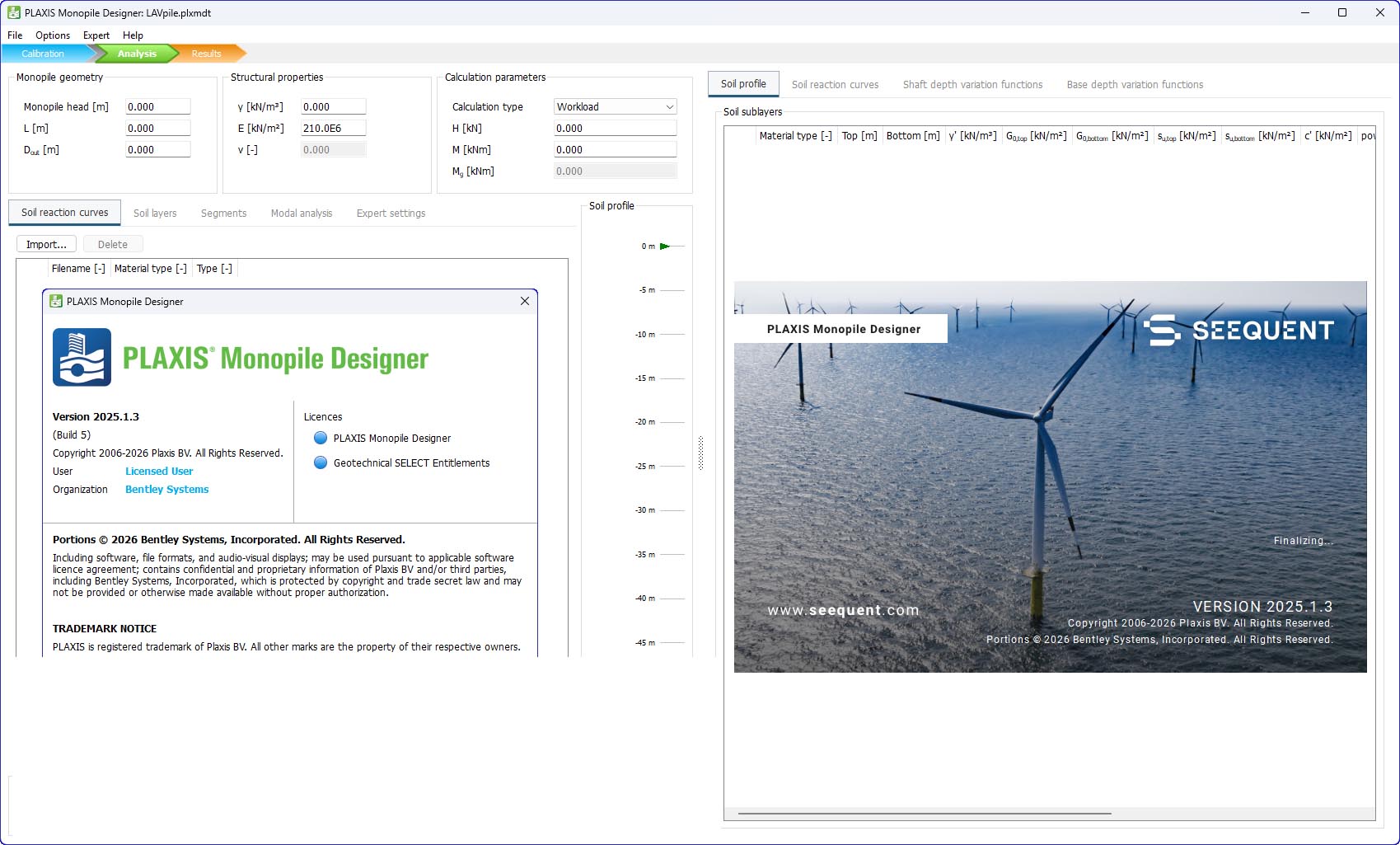
Bentley Seequent PLAXIS Monopile Designer 2025.1.3.5: Offshore Wind Foundation Engineering Software
PLAXIS Monopile Designer 2025.1.3.5 is a specialized finite element software package engineered for the analysis and design of monopiles used as foundation elements for offshore wind turbines, specifically under lateral loading conditions .
This software transforms the findings of the PISA (Offshore Wind Joint Industry Research Project) into daily engineering practice . While it functions as a stand-alone tool for rule-based design, its full potential is unlocked when integrated with PLAXIS 3D, allowing for advanced numerical calibration of soil reaction curves derived from 3D FEM models .
The 2025 version continues to refine the enhanced design method based on PISA Phase 2, enabling precise 1D analysis of large-diameter monopiles in complex layered soils. Ultimately, this methodology empowers engineers to reduce the embedded pile length by up to 35%, resulting in substantial savings in steel, fabrication, and transportation costs
???? Primary Users
This specialized geotechnical software is designed for:
-
Offshore Wind Engineers & Geotechnical Specialists designing monopile foundations for wind turbines with a focus on reducing steel usage and installation costs
-
Civil & Marine Geotechnical Consultants performing 1D finite element analysis (FEM) for laterally loaded piles using the advanced PISA methodology
-
Renewable Energy Project Developers optimizing foundation designs to significantly cut fabrication, transport, and installation expenses for offshore wind farms
-
Research & Academic Institutions studying soil-structure interaction and implementing the latest PISA research into practical design
⚡ Key Features & Capabilities
???? PISA Methodology & Cost Reduction
-
Enhanced 1D FEM Analysis: Utilizes the Timoshenko beam theory for precise analysis of large-diameter monopiles .
-
Steel Reduction: Implements the PISA design method to potentially decrease the embedded length of piles by up to 35% .
-
Layered Soil Support: Conducts nuanced 1D analyses of monopiles confronting the realities of layered soil conditions (fully compliant with PISA Phase 2 insights) .
???? Interoperability with PLAXIS 3D
-
Automated Workflow: Seamlessly transfers data to PLAXIS 3D to automate the generation and calculation of complex 3D FEM models .
-
Curve Calibration: Derives, normalizes, and parameterizes soil reaction curves from 3D analysis results to verify 1D design integrity .
????️ Design & Validation Tools
-
Soil Reaction Curves: Supports API/DNV-GL P-Y curves for clay and sand soils, alongside specific curves for distributed horizontal loads, moments, shear, and pile-tip resistance .
-
Design Validation: Automatically generates FEM models in PLAXIS 3D to validate the final monopile geometry against the 1D design approach .
???? Advanced Analysis
-
Nonlinear Behavior: Considers nonlinear ground reaction curves and accurately visualizes load-displacement relationships and bending moment distribution .
-
Scripting & Automation: All functionality is accessible via a Python scripting interface, enabling full workflow automation






Reviews
There are no reviews yet.