

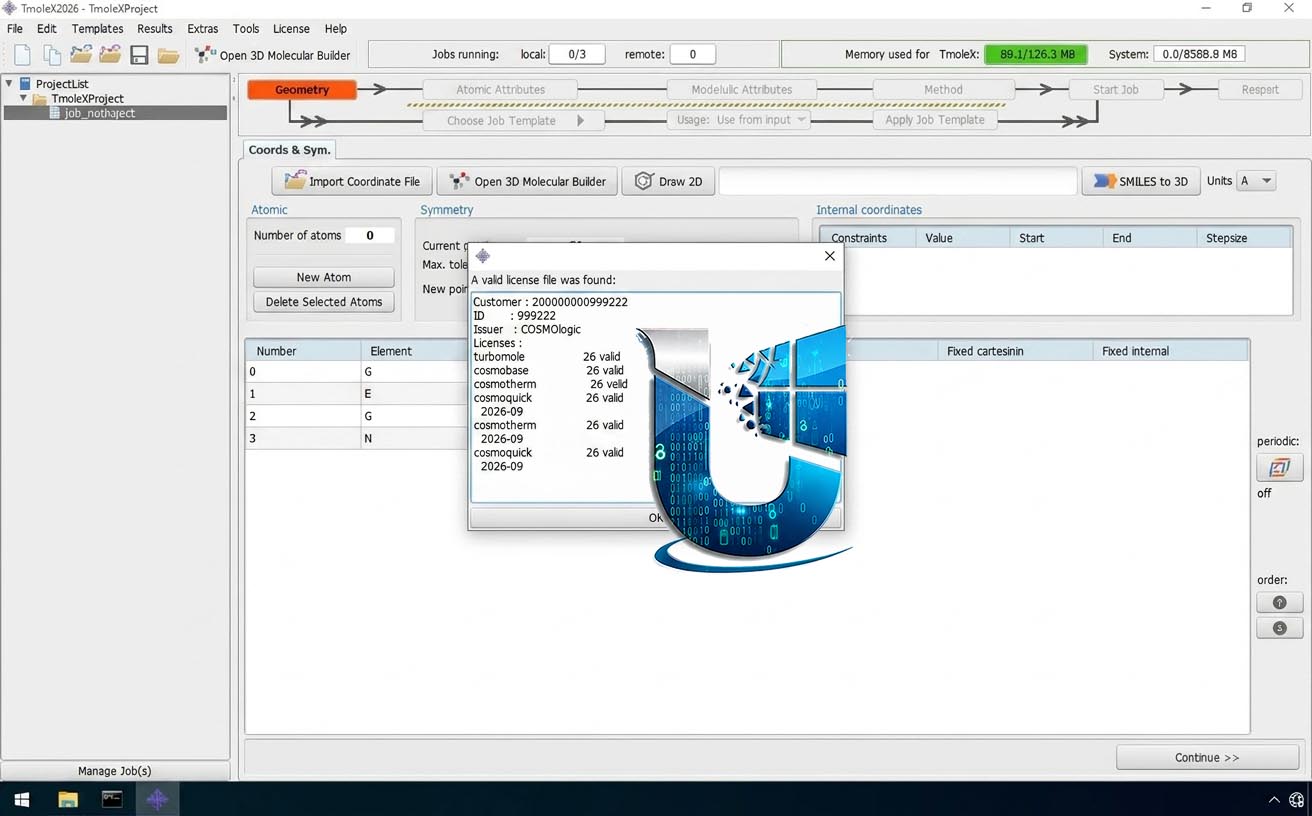
BIOVIA TURBOMOLE 2026.0: Fast Quantum Chemistry Suite for Molecules & Solids
BIOVIA TURBOMOLE 2026.0 is a powerful and highly efficient quantum chemistry software suite, featuring all standard and state-of-the-art methods for electronic structure calculations . It is renowned for its very fast DFT code, which can be applied to both molecules and periodic solids, and its comprehensive capabilities for excited states and spectra using DFT or Coupled Cluster methods .
Developed by a group of theoretical chemists from the University of Karlsruhe, TURBOMOLE has a long history of delivering reliable, production-level quantum chemical calculations . It has become an essential tool in both academic and industrial research, known for its accuracy, speed, and user-friendly interface. The software is integrated with the BIOVIA COSMOlogic suite, providing COSMO files for subsequent thermodynamic property predictions using COSMO-RS methods.
👥 Primary Users
This professional quantum chemistry software is designed for:
-
Computational Chemists & Materials Scientists performing high-accuracy electronic structure calculations on molecules and periodic systems
-
Pharmaceutical Researchers studying molecular properties, reaction mechanisms, and drug-target interactions
-
Spectroscopists simulating vibrational, UV/Vis, and CD spectra using DFT or Coupled Cluster methods
-
Catalysis & Surface Science Researchers modeling chemical reactions on surfaces and in solids
-
Academic Researchers & Graduate Students in chemistry, physics, and materials science departments
⚡ Key Features & Capabilities
🧮 Electronic Structure Methods
BIOVIA TURBOMOLE provides a comprehensive suite of quantum chemical methods :
-
Density Functional Theory (DFT): Very fast DFT code for molecules and solids with a wide range of functionals (GGA, meta-GGA, hybrid, double-hybrid)
-
Wavefunction Methods: Hartree-Fock (HF), Møller-Plesset perturbation theory (MP2, MP3, MP4), and Coupled Cluster (CCSD, CCSD(T))
-
RI-Approximations: Efficient use of the Resolution-of-Identity (RI) approximation for significant speed-ups in DFT and MP2 calculations
-
Localized Orbital Methods: LMP2 and LCCSD methods for large molecules
🔬 Excited States & Spectra
-
Excited States: Calculation of excited states using Time-Dependent DFT (TD-DFT) and Coupled Cluster methods (CC2, CCSD)
-
Spectra: Simulation of UV/Vis, CD, and other spectra
-
Properties: Prediction of molecular properties including dipole moments, polarizabilities, and NMR chemical shifts
🧪 Periodic Systems & Surfaces
-
Solid-State DFT: Fast DFT code for periodic systems, including surfaces and solids
-
COSMO-RS Integration: Generation of COSMO files for subsequent thermodynamic property predictions using COSMO-RS methods
-
Solvent Effects: COSMO (Conductor-like Screening Model) for solvation effects in molecules and solids
⚡ Performance & Usability
-
Very Fast DFT Code: Optimized for high-performance computing, enabling calculations on large molecular systems
-
User-Friendly Interface: Accessible through a graphical user interface (GUI) or command-line operation
-
Batch Processing: Support for high-throughput screening and automated workflows






Reviews
There are no reviews yet.