

Download BrainMagix 2.1.1 – Vendor-Neutral Neuroimaging Analysis Platform
BrainMagix 2.1.1 is a vendor-neutral neuroimaging analysis platform designed for clinical radiology, neurosurgery, neurology, radiation oncology, and neuro-imaging research. It facilitates seamless multi-modal image fusion from various scanner vendors, aiding in diagnostic and surgical planning workflows by professionals such as neuroradiologists, neurosurgeons, neurologists, and researchers.
Overview and Clinical Applications
BrainMagix functions as a comprehensive neuroimaging analysis solution, offering compatibility with imaging devices from leading manufacturers including Siemens, Philips, GE, and Toshiba. Its design emphasizes a vendor-neutral approach, allowing for the integration of data from diverse imaging sources into a unified analytical environment. The platform supports a range of target users, from clinical diagnosticians like neuroradiologists and neurologists to surgical planning specialists such as neurosurgeons, and extends its utility to neuro-imaging research professionals.
Multi-Modal Image Fusion and Registration
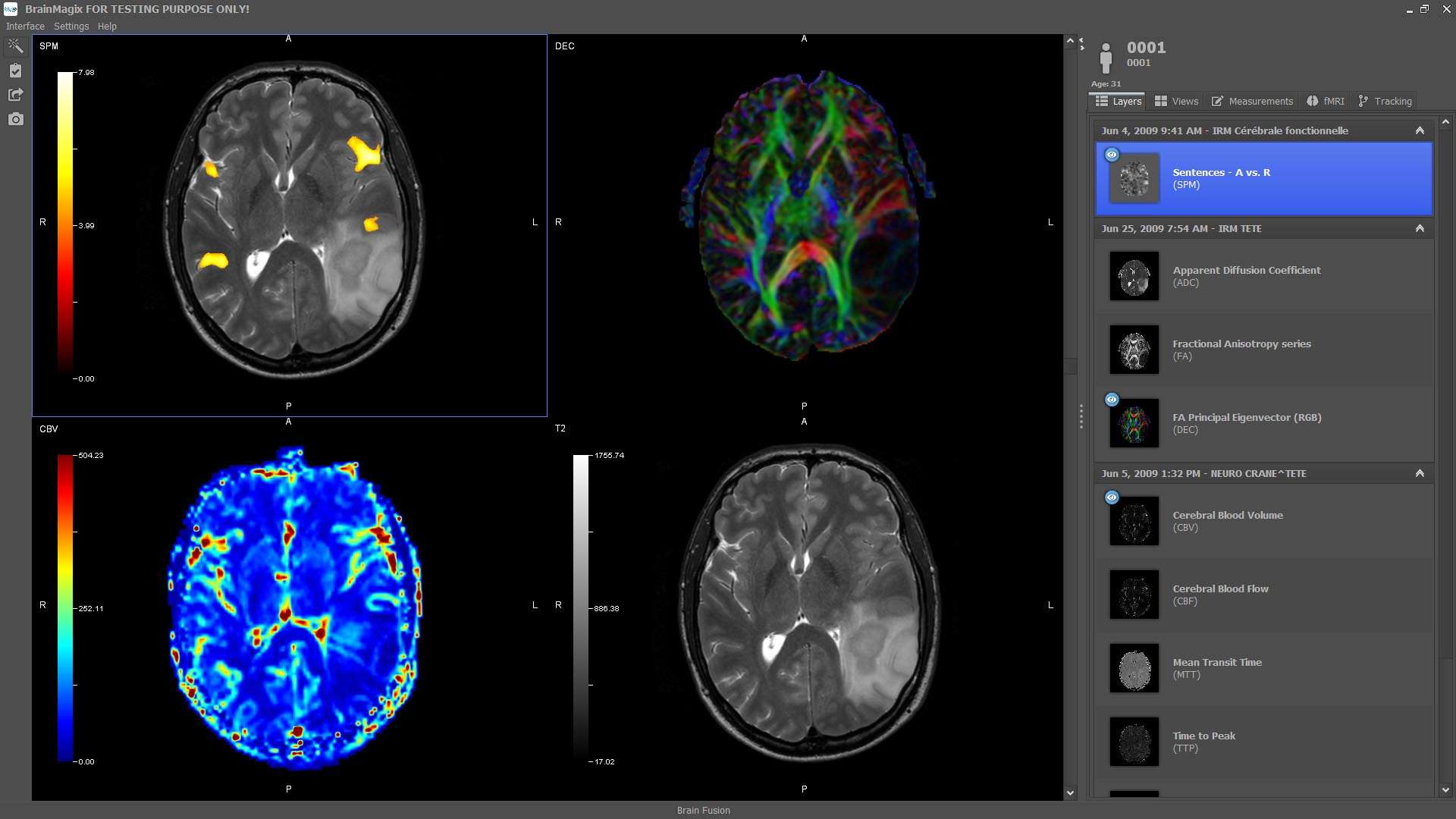
Achieving seamless integration of radiological data is a core capability of BrainMagix. The software allows users to import DICOM data from virtually any vendor’s MRI, CT, or PET scanners. Key features for image analysis include:
- Automatic registration algorithms for aligning multi-modal volumes (MRI, CT, PET).
- Display of fused images in orthogonal views, mosaic layouts, and cine loops.
- Semi-transparent overlay functionality for enhanced visualization of anatomical structures and pathological findings.
- Region of Interest (ROI) quantification on fused datasets.
Structural Analysis: Brain Atrophy Quantification
The SurferMagix module within BrainMagix is dedicated to detailed structural quantification of the brain. This module enables precise measurement and analysis to detect and track neurodegenerative conditions. Its capabilities include:
- Volumetric analysis differentiating between gray matter, white matter, and cerebrospinal fluid (CSF).
- Specific hippocampal volume measurement, crucial for assessing conditions like Alzheimer’s disease.
- Comparison of patient scans against a normative database to identify deviations.
- Assessment of longitudinal changes to monitor disease progression or treatment response over time.
Functional and Diffusion Capabilities
fMRI Mapping Module
BrainMagix addresses functional brain analysis through its fMRI mapping module, providing insights into neural activity. This module supports advanced clinical and research applications by offering:
- Tools for defining and analyzing custom functional paradigms.
- Automated processing pipelines for realignment and statistical analysis of BOLD signals.
- Overlays of BOLD activation maps onto anatomical images for clear visualization.
- Localization of eloquent cortex areas to aid in surgical planning and minimize functional deficits.
Diffusion Tractography Module
For analyzing white matter integrity and connectivity, the Diffusion Tractography Module utilizes Diffusion Tensor Imaging (DTI) and Constrained Spherical Deconvolution (CSD) techniques. This platform provides capabilities such as:
- Fiber tracking to visualize neural pathways like the corticospinal tracts, arcuate fasciculus, and optic radiations in 3D.
- Generation and analysis of Fractional Anisotropy (FA) and Apparent Diffusion Coefficient (ADC) maps.
- Extraction of tract-specific metrics for quantitative assessment of white matter integrity.
Perfusion Analysis and Stroke Assessment
BrainMagix offers advanced perfusion imaging analysis, particularly valuable for acute stroke assessment and decision support. The Dynamic Susceptibility Contrast (DSC) perfusion module provides:
- Quantitative maps including Cerebral Blood Volume (CBV), Cerebral Blood Flow (CBF), Mean Transit Time (MTT), Time to Peak (TTP), and Time to Maximum (TMAX).
- Implementation of various deconvolution algorithms for robust perfusion metric calculation.
- Visualization of perfusion/diffusion mismatch, a critical indicator for identifying salvageable brain tissue (penumbra) in acute stroke patients.
- Segmentation of ischemic core and penumbra to guide treatment strategies.
Longitudinal Disease Tracking and Reporting
The platform supports longitudinal studies, enabling precise tracking of disease progression or treatment effects over time. This feature is essential for managing chronic neurological conditions. Key functionalities include:
- Registration of multi-contrast MRIs acquired at different time points.
- Generation of subtraction maps to highlight changes between scans.
- Quantification of lesion volume changes, particularly useful for conditions like Multiple Sclerosis (MS) or tracking tumor growth.
- Automated generation of interval reports summarizing changes observed between imaging sessions.
Integration and Workflow Optimization
BrainMagix is designed for seamless integration into existing clinical environments, enhancing efficiency and workflow. The software offers:
- Export capabilities for processed images and reports to major Picture Archiving and Communication Systems (PACS) and treatment-planning systems.
- Support for updating DICOM tags to maintain compatibility with the latest scanner software versions.
- User interface (UI) refinements aimed at improving ease of use and reducing user interaction time.
- Customizable reporting templates to meet institutional and individual clinician needs.
What’s New in Version 2.1.1
Version 2.1.1 of BrainMagix introduces several enhancements focused on improving performance, expanding capabilities, and refining the user experience. Key updates include:
- Improved registration accuracy for more precise multi-modal image alignment.
- Faster fiber tracking algorithms within the DTI module, reducing analysis time.
- Expanded options for fMRI paradigms and analysis configurations.
- New automated tools specifically for Multiple Sclerosis (MS) lesion detection and quantification.
- Updated DICOM and PACS support, ensuring broader compatibility with clinical infrastructure.
- General UI and reporting refinements for a more streamlined workflow.
Frequently Asked Questions
How does BrainMagix achieve vendor-neutral multi-modal image fusion?
BrainMagix achieves vendor-neutrality by importing DICOM data from all major MRI, CT, and PET scanners using standardized protocols. Its automatic registration algorithms then precisely align these diverse volumes. A semi-transparent overlay system allows clinicians to view fused images in orthogonal and cine modes, ensuring that these advanced visualization capabilities do not disrupt the existing clinical workflow.
Can I quantify brain atrophy and track disease progression over time?
Yes, BrainMagix provides robust tools for both atrophy quantification and longitudinal disease tracking. The integrated SurferMagix module performs automated volumetric analyses of gray matter, white matter, and CSF, including specific measurements of hippocampal volumes. These findings can be compared against normative databases and tracked across multiple scans to monitor disease progression effectively.
Is BrainMagix compatible with PACS and treatment-planning systems?
BrainMagix ensures compatibility with existing clinical IT infrastructures by offering seamless integration. The software can export post-processed images and reports directly to major PACS platforms and treatment-planning systems. This is achieved through DICOM-compliant outputs, facilitating the smooth incorporation of BrainMagix analyses into established diagnostic and therapeutic workflows.




Reviews
There are no reviews yet.