
Download CivilTech Allpile 7.3b – Advanced Pile Design Software
CivilTech Allpile 7.3b is a specialized software application developed by CivilTech for civil engineers focusing on geotechnical applications and the design of pile foundations. It provides engineers with advanced tools to analyze the behavior of piles under various conditions, making it an essential resource for geotechnical engineering projects.
Introduction to CivilTech Allpile
Overview and Purpose
CivilTech Allpile serves as a critical tool for geotechnical engineers, offering a dedicated platform for the comprehensive analysis and design of pile foundations. The software addresses the complex challenges inherent in foundation engineering, ensuring that designs are both stable and cost-effective. Its purpose is to streamline the design process, enabling engineers to accurately predict pile performance and optimize foundation solutions for various infrastructure projects.
Key Features of Allpile
Comprehensive Analysis Capabilities
CivilTech Allpile is equipped with a robust set of features designed to support detailed pile analysis and design. These capabilities allow engineers to thoroughly evaluate foundation performance under diverse conditions.
- Bearing Capacity Charts: Generate analyses to determine the ultimate bearing capacity of piles based on soil properties and pile characteristics.
- Deformation Diagrams: Visualize and analyze pile settlement and lateral displacement under various loading scenarios.
- Load-Settlement Curves: Obtain detailed load-settlement relationships to understand pile behavior and predict performance.
- Pile Group Analysis: Evaluate the combined behavior and load distribution of multiple piles acting as a group.
- Soil Profile Integration: Incorporate detailed soil stratigraphy and properties into the analysis for accurate modeling.
Applications in Civil Engineering
Target Industries and Use Cases
CivilTech Allpile is primarily utilized within the civil and construction sectors, with a strong emphasis on geotechnical engineering. Its analytical power makes it suitable for a wide range of infrastructure development projects.
- Foundation Design for Buildings: Designing deep foundations for commercial, residential, and industrial structures.
- Bridge and Viaduct Foundations: Analyzing and designing piles to support bridge piers and abutments, ensuring stability in challenging soil conditions.
- Offshore Structures: Supporting the design of foundations for offshore platforms, wind turbines, and other marine installations.
- Retaining Walls and Earth Support Systems: Analyzing embedded retaining walls and other earth retention structures that may involve pile elements.
- Slope Stability Analysis: Assessing the impact of pile foundations on overall slope stability.
Technical Specifications
Supported Parameters and Inputs
The software allows engineers to define a wide array of parameters crucial for accurate pile design and analysis. This flexibility ensures that the software can model a variety of real-world scenarios.
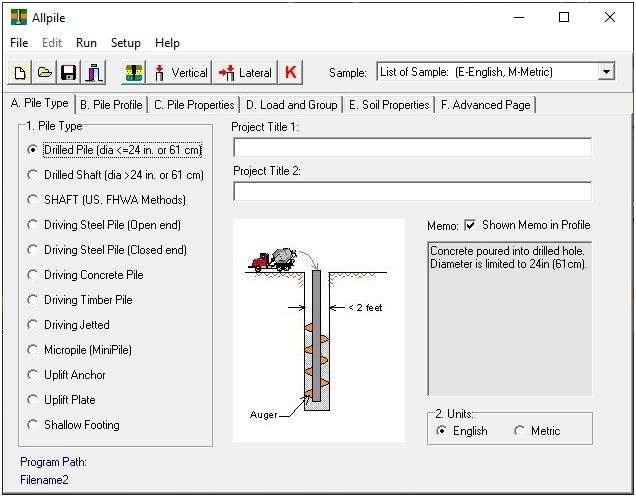
- Pile Type: Support for concrete, steel (H-piles, pipe piles), and timber piles.
- Pile Dimensions: Inputs for pile length, diameter, cross-sectional area, and wall thickness.
- Material Properties: Specification of concrete strength, steel grade, and timber characteristics.
- Soil Stratigraphy: Detailed layering of soil strata, including properties like cohesion, friction angle, unit weight, and Young’s modulus.
- Loading Conditions: Axial, lateral, and moment loads, as well as cyclic loading scenarios.
- Environmental Factors: Consideration of factors such as groundwater level and seismic conditions.
Comparison with Other Pile Design Tools
Strengths and Limitations
CivilTech Allpile distinguishes itself through its focused approach to pile foundation analysis. While many general civil engineering software packages include foundation modules, Allpile concentrates specific capabilities for pile design.
Its primary strength lies in providing detailed, specialized analyses for various pile types and soil conditions. This depth of analysis can offer more refined results compared to broader software solutions. However, like many specialized tools, its integration capabilities with other disciplines such as structural framing or detailed BIM workflows might be less extensive than more comprehensive platforms. Users may find its interface geared towards specific geotechnical tasks rather than general project management.
Real-World Projects Using Allpile
Case Studies
While specific project details for CivilTech Allpile are not readily available, its capabilities are employed in numerous infrastructure developments. Engineers typically use such pile analysis software for projects involving significant foundation loads or challenging subsurface conditions.
- Projects requiring deep foundations to transfer loads to strong soil layers or bedrock.
- Coastal and marine engineering projects necessitating robust pile foundations for docks, piers, and offshore platforms.
- Urban development where limited ground space requires deep foundations that minimize surface disruption.
- Infrastructure projects like bridges and highways that demand high-capacity foundations for stability.
Frequently Asked Questions
What types of piles can be analyzed using CivilTech Allpile?
CivilTech Allpile can analyze various pile types, including concrete, steel, and timber piles, taking into account different environmental and load conditions. This versatility allows engineers to select the most appropriate foundation material for their specific project requirements.
Is CivilTech Allpile suitable for academic purposes?
Yes, CivilTech Allpile is suitable for academic use, particularly in civil engineering courses, allowing students to simulate real-world engineering problems and solutions related to pile foundation design. It offers an excellent platform for learning and applying theoretical concepts in a practical context.
Can CivilTech Allpile integrate with other engineering software?
While specific integration capabilities are not detailed, Allpile can typically be used alongside other engineering modeling tools for comprehensive project analysis. Engineers often export results or import soil data to interface with other design and analysis software in their workflow.


Reviews
There are no reviews yet.