

Download COMSOL Multiphysics 6.3 – Comprehensive Simulation Software for Engineering and Physics
COMSOL Multiphysics 6.3, developed by COMSOL Inc., is a powerful finite element analysis software designed for engineers and scientists working with coupled physical phenomena. This specialized tool facilitates the modeling and simulation of complex systems across various engineering and applied science domains, making it a go-to solution for multiphysics simulation tasks.
Introduction to COMSOL Multiphysics
Overview of the Software
COMSOL Multiphysics is a comprehensive simulation platform that enables users to model and simulate real-world physics-based problems. Its core strength lies in its ability to handle coupled phenomena, allowing for the simulation of interactions among different physical domains within a single, unified environment. This makes it an indispensable tool for research and development in academic institutions and industries requiring detailed analysis of complex interactive systems.
Key Features and Capabilities
Unified Working Environment
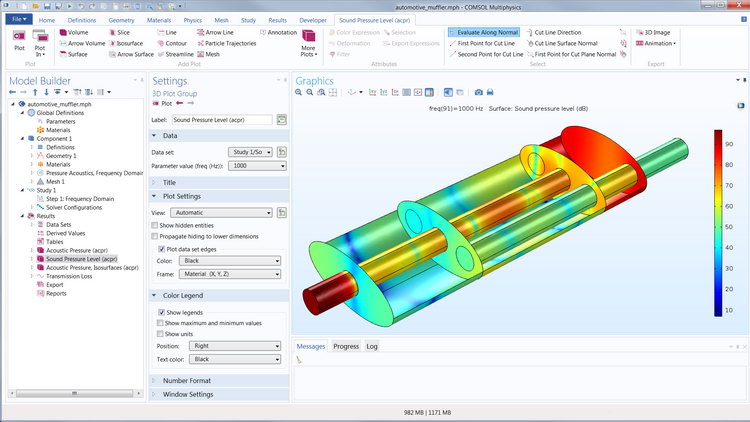
The software provides a user-friendly interface where all aspects of a simulation, from geometry definition and material properties to meshing, solving, and postprocessing, are managed within a single workflow. This unified working environment simplifies the complex process of multiphysics simulation and enhances productivity. Furthermore, its design facilitates integration with other software platforms, offering flexibility in existing workflows.
Advanced Numerical Methods
At its heart, COMSOL Multiphysics employs robust numerical methods, including the finite element method, to solve systems of partial differential equations (PDEs) that describe physical phenomena. Version 6.3 introduces advanced numerical solvers and techniques that enhance accuracy and performance when dealing with highly complex and computationally intensive simulations, ensuring reliable results for challenging engineering problems.
APIs and Extensibility
COMSOL Multiphysics offers Application Programming Interfaces (APIs) that allow for programmatic control and customization. Users can leverage the MATLAB Live Link™ for COMSOL Multiphysics and the Java API to automate tasks, integrate simulations into larger workflows, build custom user interfaces for specific applications, and extend the software’s capabilities beyond its graphical interface.
Applications Across Industries
Engineering and Physics Applications
The software supports a wide array of engineering and physics disciplines, including electrical engineering for electromagnetic devices, mechanical engineering for structural and acoustics analysis, fluid dynamics for flow simulations, and chemical engineering for reaction kinetics and transport phenomena. Its ability to couple these domains makes it suitable for advanced research and product development.
Examples of Use Cases
COMSOL Multiphysics is employed in numerous real-world scenarios, such as simulating the thermal management in electronic devices, analyzing the acoustic performance of automotive components, modeling fluid flow in microfluidic channels, and optimizing the design of energy conversion systems. These applications highlight the software’s versatility in addressing intricate multiphysics challenges.
Comparative Analysis with Similar Software
Compared to other finite element analysis software, COMSOL Multiphysics distinguishes itself through its innate focus on solving coupled partial differential equations from its inception. This allows it to intrinsically handle multiphysics simulations more seamlessly than tools that may require extensive add-ons or workarounds. Its unified interface and extensive module support, covering a broad spectrum of physics, are key differentiators, offering a more integrated and comprehensive simulation experience for complex interactive systems.
Getting Started with COMSOL Multiphysics
While COMSOL Multiphysics is a sophisticated engineering simulation software, COMSOL Inc. provides a range of resources to aid users. Extensive documentation, tutorials, and a vibrant user community offer support for learning and problem-solving. The platform’s structured interface, though powerful, is designed to be progressively learned, starting with basic principles and moving to advanced multiphysics coupling.
Conclusion
COMSOL Multiphysics 6.3 stands as a significant tool in the realm of engineering and scientific simulation. Its advanced numerical methods, unified workflow, and powerful APIs enable professionals to tackle complex multiphysics challenges across diverse industries. The software’s capabilities in modeling coupled phenomena make it an essential asset for innovation and detailed analysis in physics and engineering.
Frequently Asked Questions
What is COMSOL Multiphysics primarily used for?
COMSOL Multiphysics is utilized for modeling and simulating a wide range of physics-based problems, allowing engineers and scientists to simulate interactions among different physical phenomena. It excels in scenarios where multiple physical effects, such as thermal, electrical, and mechanical couplings, must be considered simultaneously.
How does COMSOL Multiphysics integrate with MATLAB?
COMSOL Multiphysics features a comprehensive API that enables users to interact with MATLAB, allowing for enhanced modeling capabilities and external control of simulations. This integration, provided via the MATLAB Live Link™, facilitates script-based model creation, parameter sweeping, and optimization routines.
What industries benefit from using COMSOL Multiphysics?
Industries such as engineering, manufacturing, chemistry, and environmental science utilize COMSOL Multiphysics for its sophisticated simulation capabilities in designing and analyzing complex systems. It is instrumental in fields like acoustics, fluid dynamics, structural analysis, and thermodynamics where precise numerical modeling is critical.








Reviews
There are no reviews yet.