

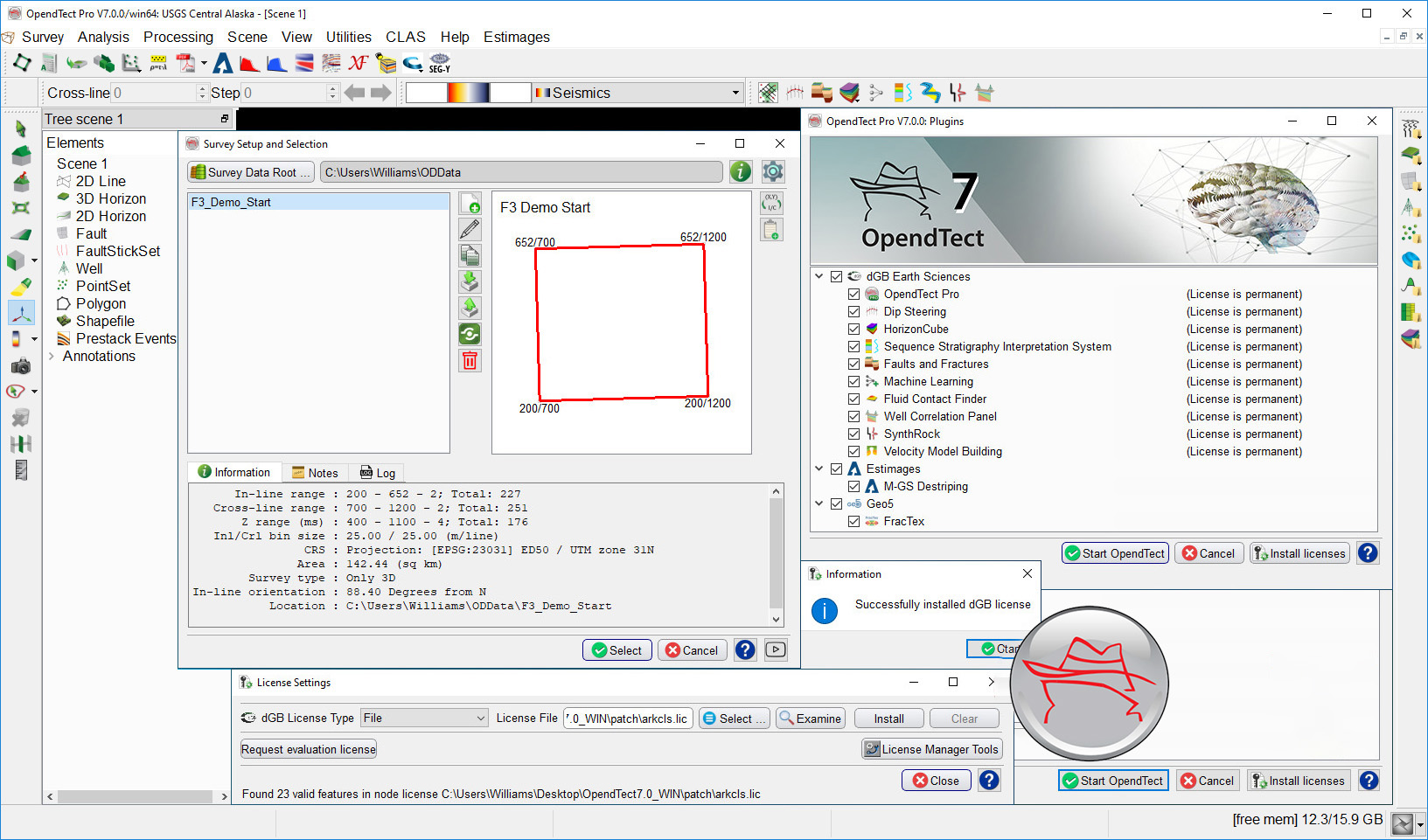
Download dGB Earth Sciences OpendTect 7.0.9 – Advanced Seismic Interpretation Software
dGB Earth Sciences OpendTect 7.0.9 is a comprehensive seismic interpretation software package tailored for the oil and gas exploration industry. It offers a robust platform for geoscientists and engineers, enabling advanced analysis and visualization of seismic data. The software uniquely combines open-source foundations with powerful commercial enhancements, providing flexibility and specialized functionalities for intricate geoscience tools and machine learning seismic analysis workflows.
Overview of OpendTect
OpendTect serves as a pivotal application for seismic interpretation, bridging the gap between fundamental data processing and advanced analytical tasks. It provides geoscientists with the tools necessary to interpret subsurface geological structures effectively. The software’s architecture is built upon an open-source core, promoting accessibility and user customization, complemented by a suite of commercial plugins and extensions that cater to highly specialized applications within the oil and gas sector.
Key Features and Functionalities
Open Source Functionality
The open-source core of OpendTect offers a versatile environment for seismic data handling and interpretation. It supports a broad range of seismic data types and provides essential tools for seismic visualization, marker interpretation, and basic attribute analysis. This foundational layer empowers users with flexibility in managing and analyzing their seismic datasets, making it an adaptable solution for standard interpretation workflows.
- Comprehensive data handling capabilities for seismic surveys.
- Tools for seismic visualization and structural interpretation.
- User-friendly interface for geological data management.
- Support for developing custom interpretation plugins and modules.
Commercial Enhancements with OpendTect Pro
OpendTect Pro extends the capabilities of the base software, introducing advanced functionalities and a highly expandable plugin architecture. This commercial version is designed for users requiring specialized tools for complex projects, intensive data analysis, and integration with cutting-edge technologies. The ability to select and integrate specific commercial plugins allows professionals to tailor the software precisely to their project’s unique demands.
- Access to advanced processing and interpretation algorithms.
- Extensive plugin support for photorealistic rendering, structural modeling, and more.
- Optimized performance for large-scale seismic datasets.
- Integration capabilities with external geological and geophysical applications.
Machine Learning Integration
OpendTect significantly enhances machine learning workflows for seismic analysis, integrating advanced AI and pattern recognition techniques directly into the interpretation process. This allows geoscientists to leverage sophisticated models for tasks such as fault detection, horizon prediction, and reservoir characterization, thereby improving accuracy and efficiency. The software facilitates the extraction of training data from seismic volumes, the application of predictive models trained on this data, and the visualization of ML model outputs directly within the seismic context.
- Tools for extracting and preparing training data from seismic volumes.
- Application of supervised and unsupervised machine learning models.
- Enhanced accuracy in fault interpretation and seismic facies analysis.
- Integration of AI-driven prospect identification and risk assessment.
Supported Data Formats and Compatibility
Ensuring seamless data flow is critical in seismic interpretation, and OpendTect supports a wide array of data formats for import and export. This compatibility allows for flexible integration into existing geoscientific workflows and ease of collaboration. The software is designed to work with industry-standard file types, facilitating data exchange between different software packages and data repositories commonly used in oil and gas exploration.
- Support for SEG-Y, SEGY-ASCII, and industry-standard seismic data formats.
- Compatibility with well log formats such as LAS.
- Integration with GeoJSON for geo-spatial data representation.
- Export capabilities for visualization and further analysis in other applications.
- Interoperability features for data exchange with other leading oil and gas software like Petrel.
Use Cases in the Oil and Gas Industry
OpendTect is extensively utilized across the oil and gas exploration lifecycle, aiding professionals in identifying and evaluating potential hydrocarbon reserves. Its versatile functionalities make it suitable for various geological challenges, from detailed subsurface mapping to the characterization of complex reservoirs. Real-world applications demonstrate its prowess in enabling innovative seismic workflows that enhance discovery success rates.
- Detailed fault and fracture network interpretation for unconventional reservoirs.
- Seismic attribute analysis for identifying hydrocarbon indicators.
- Horizon tracking and mapping for structural and stratigraphic interpretation.
- Reservoir characterization utilizing advanced quantitative seismic methods.
- Integration of well data with seismic volumes for subsurface modeling.
Comparative Analysis with Other Seismic Software
OpendTect distinguishes itself in the competitive landscape of seismic interpretation software through its distinctive blend of open-source flexibility and powerful commercial capabilities. Unlike some proprietary solutions, OpendTect’s open core allows for greater customization and accessibility, while its extensible plugin architecture provides specialized functionalities that rival established commercial packages. This approach offers a cost-effective yet highly capable alternative for geoscientists.
Key differentiators include its strong foundation in machine learning integration for seismic analysis, offering tools that are often add-ons or unavailable in simpler platforms. The extensive plugin ecosystem is another significant advantage, allowing users to build a tailored solution without being locked into a single vendor’s ecosystem.
Recent Updates and Improvements in Version 7.0.9
Version 7.0.9 of OpendTect brings several key enhancements and performance improvements designed to streamline the seismic interpretation process. These updates focus on usability, data handling efficiency, and expanded analytical capabilities, reflecting dGB Earth Sciences’ commitment to continuous development.
- Enhanced LAS (Log ASCII Standard) import interfaces for improved well data management.
- Improved well display tools, offering more options for visualizing wellbore data alongside seismic sections.
- Significant performance boosts in the synthetic seismic trace generation process, speeding up complex modeling tasks.
- Introduction of new support formats, such as GeoJSON, to broaden compatibility with other geo-spatial data tools.
- Refinements in machine learning data preparation and model application workflows.
Frequently Asked Questions
What is OpendTect and what are its main applications?
OpendTect is a seismic interpretation software designed for geophysical analysis in the oil and gas industry. Its main applications include processing and visualizing seismic data and developing innovative interpretation tools using both open-source and commercial capabilities, aiding geoscientists in effective subsurface exploration.
What improvements does OpendTect 7.0.9 offer over previous versions?
Version 7.0.9 introduces various enhancements such as better LAS import interfaces, improved well display tools, and significant performance boosts in synthetic seismic trace generation, along with new support formats like GeoJSON. These updates aim to increase user efficiency and analytical power.
How does OpendTect integrate machine learning into seismic analysis?
OpendTect incorporates machine learning capabilities by allowing users to extract training data from seismic datasets, apply predictive models, and utilize various advanced training parameters for enhanced accuracy in analysis. This integration assists in complex tasks like fault detection and reservoir characterization directly within the seismic interpretation environment.


Reviews
There are no reviews yet.