
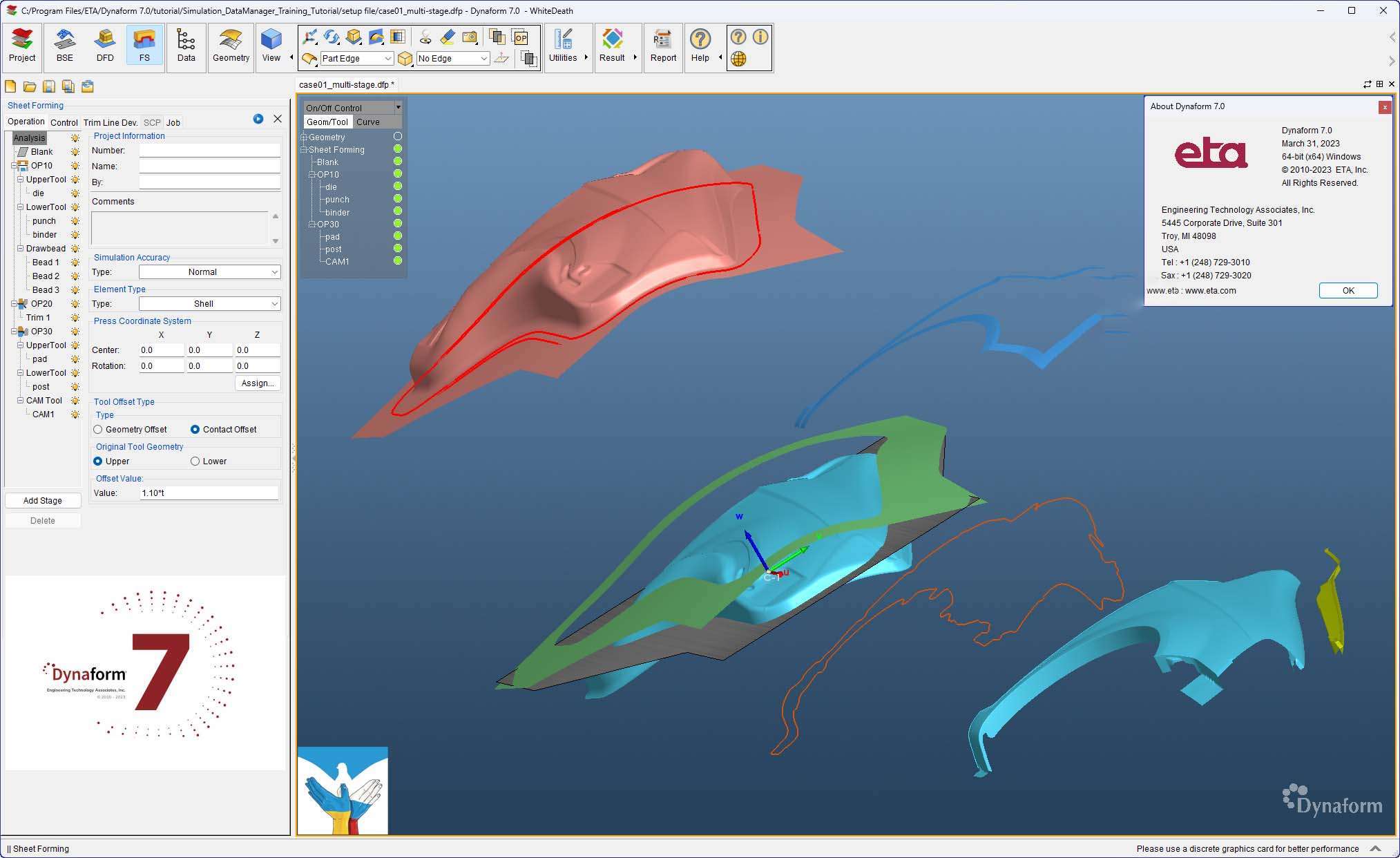
Download ETA Dynaform 7.2 – Advanced Simulation and Optimization Software
ETA Dynaform 7.2 is a sophisticated Computer-Aided Engineering (CAE) application developed by ETA International, Inc. It is engineered to optimize and simulate complex manufacturing forming processes, serving professionals in the automotive, aerospace, and general manufacturing sectors. This software provides advanced analysis tools to refine manufacturing systems and reduce production costs.
Overview of ETA Dynaform
Software Development Background
ETA Dynaform has evolved as a significant tool within the Computer-Aided Engineering (CAE) landscape. Its development is rooted in providing engineers with robust solutions for simulating and optimizing metal forming processes. Over its history, Dynaform has established itself as a critical component in the design and evaluation of manufacturing systems, contributing to more efficient product development cycles.
Key Features and Capabilities
Advanced Simulation Models
Dynaform offers a comprehensive suite of simulation capabilities designed to address various stages of the manufacturing process. These tools enable engineers to predict and resolve potential issues before physical production begins.
- Blank Size Engineering: Optimizes the initial material blank dimensions to minimize waste and ensure successful forming.
- Formability Simulation: Analyzes how materials will deform, identifying areas of potential thinning, tearing, or wrinkling.
- Die System Analysis: Evaluates the performance and durability of dies under operational stress.
- Stamping Process Simulation: Models the entire stamping operation to fine-tune press parameters and tooling.
High Performance Analysis
Leveraging advanced computational techniques, ETA Dynaform is built for speed and efficiency. The software is optimized to utilize modern multi-core processor architectures, significantly reducing simulation times.
- High-speed computational capabilities allow for rapid analysis and iteration.
- Effective use of multi-core system architectures enables faster processing of complex models.
- User-friendly interface provides clear visualization and interaction with simulation results, facilitating quicker understanding and decision-making.
Applications in the Manufacturing Industry
Use Cases in Automotive and Aerospace
Within the automotive and aerospace sectors, ETA Dynaform plays a crucial role in the development and production of critical components. Its simulation tools are invaluable for ensuring the integrity and feasibility of designs.
- Automotive applications include the detailed analysis of sheet metal forming for body panels, chassis components, and intricate structural elements, ensuring dimensional accuracy and material integrity.
- Aerospace engineers utilize Dynaform for simulating the forming of high-strength alloys and complex geometries required for aircraft parts, focusing on material performance and structural reliability.
Cost Reduction and Efficiency Improvement
By providing accurate simulation results early in the design process, ETA Dynaform directly contributes to significant cost savings and enhanced manufacturing efficiency.
The software allows engineers to virtually test numerous design variations and manufacturing scenarios, identifying optimal process parameters and tooling designs. This capability minimizes the need for expensive physical prototypes and reduces trial-and-error during production, leading to shorter lead times and lower material waste.
Comparison with Other CAE Software
ETA Dynaform differentiates itself within the Computer-Aided Engineering (CAE) market through a combination of advanced functionality and user-centric design. While many CAE packages offer simulation capabilities, Dynaform focuses on optimizing the specific challenges of forming processes.
Compared to other manufacturing optimization software, Dynaform’s highly intuitive interface streamlines complex analyses, making it accessible to a broader range of engineers. Its superior computational speed, attributed to its architecture designed for multi-core systems, allows for quicker turnaround times on die evaluation and simulation tasks, setting it apart from competitors with slower processing capabilities or less specialized toolsets.
Getting Started with ETA Dynaform
ETA Dynaform is designed with a focus on user accessibility within the engineering community. While it offers advanced capabilities, its structured interface aims to simplify the learning curve for new users.
Engineers can effectively leverage Dynaform’s tools by starting with basic simulation setups and gradually exploring more complex analyses as their familiarity grows. The software’s features support a methodical approach to process optimization, enabling users to build confidence and proficiency in utilizing its full potential for manufacturing analysis.
Frequently Asked Questions
What is ETA Dynaform and its primary function?
ETA Dynaform is a computer-aided engineering (CAE) software specifically developed to optimize and simulate manufacturing forming processes. Its primary function involves providing engineers with tools for advanced tasks such as die evaluation, formability analysis, and optimizing overall manufacturing system performance, particularly within sectors prioritizing precision metal forming.
What industries benefit most from using Dynaform?
Dynaform is particularly advantageous for the automotive and aerospace industries, where complex metal forming processes are critical. Its advanced simulation tools help these sectors to optimize die designs, reduce material waste, enhance product quality, and improve the overall efficiency of their manufacturing operations, leading to significant cost savings.
How does Dynaform improve the efficiency of manufacturing processes?
Dynaform enhances manufacturing efficiency by enabling engineers to conduct detailed virtual simulations of forming processes. This allows for the early identification and resolution of potential production issues, testing of various design alternatives, and optimization of tooling and material usage. By reducing the need for physical prototypes and minimizing trial-and-error on the production floor, it significantly shortens development cycles and lowers manufacturing costs.




Reviews
There are no reviews yet.