

Download HSPiP 6.1.2 – Comprehensive Solubility Analysis Software
HSPiP 6.1.2 is specialized software developed by Hansen Solubility Parameters designed for sophisticated solubility calculations and analysis. It leverages the theoretical framework of Hansen Solubility Parameters to assist professionals in chemical engineering, material science, and polymer analysis. This tool is particularly valuable for researchers and practitioners who require precise understanding of chemical interactions for developing new materials and optimizing existing formulations.
Overview of HSPiP 6.1.2
Background of Hansen Solubility Parameters
The Hansen Solubility Parameters (HSP) theory provides a quantitative method for predicting the solubility of a wide range of substances, particularly polymers. Developed by Charles M. Hansen, this framework is based on the principle that substances with similar solubility parameters are likely to be soluble in each other. HSPiP software implements this theory, offering a robust platform for performing such analyses.
The methodology considers three main components of cohesive energy density: dispersion forces, polar forces, and hydrogen bonding forces. By quantifying these interactions, HSP allows for accurate predictions of miscibility between different materials, which is critical in diverse chemical engineering applications.
Key Features and Capabilities
Extensive Chemical Database
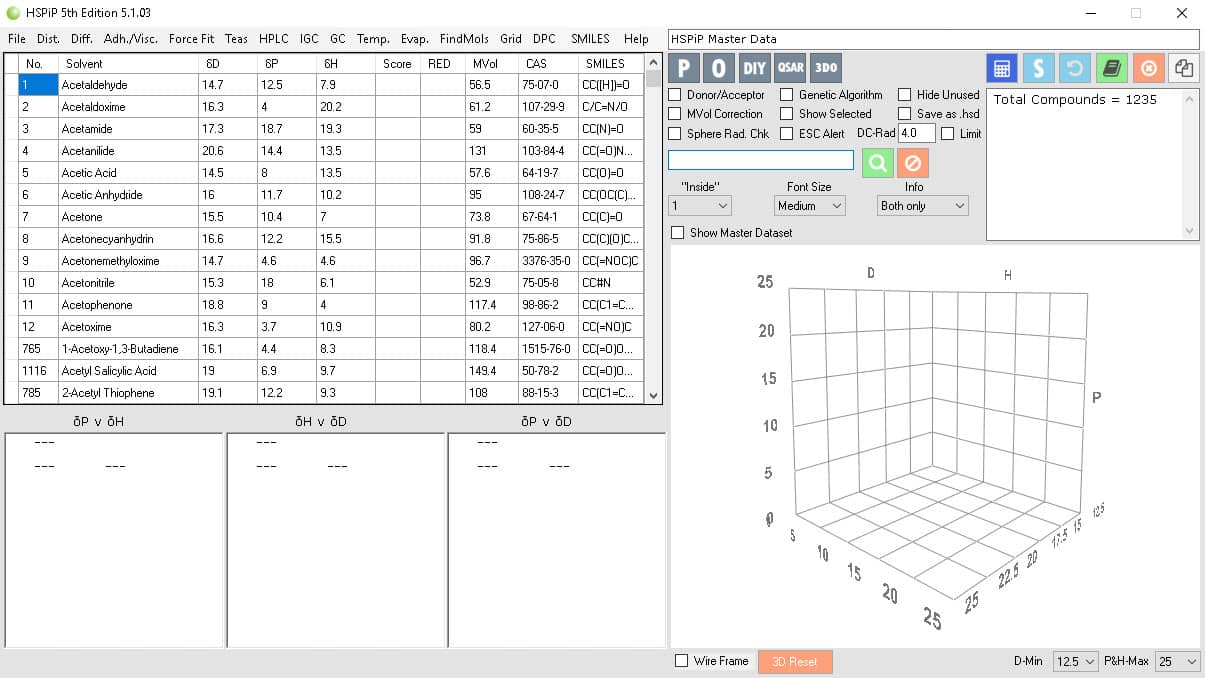
HSPiP 6.1.2 features a comprehensive database that includes solubility parameters for over 1200 chemicals. This extensive collection supports detailed analysis of a wide array of compounds, enabling users to explore potential solvent-material interactions with high confidence.
- Access to pre-calculated HSP values for a vast library of common chemicals.
- Inclusion of data for polymers, solvents, and other relevant substances.
- Capability to import and manage custom chemical data for specialized research.
Advanced Analysis Tools
The software provides advanced analytical tools necessary for in-depth solubility studies, aiding in the interpretation of complex chemical interactions. These tools facilitate effective data visualization and interpretation through advanced modeling.
- Three-dimensional (3D) modeling capabilities to visualize solubility spaces and interactions between Hansen Solubility Parameters (dispersion, polar, hydrogen bonding).
- Data visualization options for plotting chemical properties, diffusion coefficients, and chromatographic data.
- Predictive algorithms for estimating solubility, compatibility, and material behavior in various environments.
- Tools for assessing diffusion and permeability through different media, essential for material science applications.
Applications in Industry
HSPiP 6.1.2 finds extensive application across several critical sectors within the chemical and material sciences. Its foundational methodology and robust analytical environment support complex problem-solving in these fields.
- Polymer Science: Essential for predicting polymer solubility, selecting appropriate solvents for polymer processing, and understanding polymer-blend compatibility.
- Material Engineering: Used in the development of new materials, coatings, adhesives, and composites by accurately assessing material interactions and performance criteria.
- Chromatography: Supports the selection of optimal mobile and stationary phases for chromatographic separations based on solubility principles.
- Chemical Product Development: Aids in formulation design for products such as inks, paints, pharmaceuticals, and personal care items, ensuring ingredient compatibility and stability.
- Diffusion Studies: Enables the prediction and analysis of diffusion rates of substances through various matrices, crucial for barrier materials and drug delivery systems.
Data Management and Sharing
HSPiP 6.1.2 offers integrated features for managing extensive chemical data and analysis outputs. This ensures that research is reproducible and that findings can be easily shared among collaborators.
- Storage and retrieval of chemical formulas, molecular weights, and physical properties.
- Saving and managing HSP analysis results, simulation outputs, and visualization data.
- Options to export data and analysis reports in various standard formats for integration with other software or reporting.
- Facilitates the reuse of previously computed data, streamlining iterative research processes.
Usage Examples and Case Studies
The practical application of HSPiP software is demonstrated through numerous real-world scenarios in research and industry. These examples highlight its effectiveness in solving complex solubility challenges.
- Formulating new environmentally friendly solvent systems by identifying safer alternatives that maintain desired solubility characteristics.
- Developing advanced polymer composites by predicting the compatibility of polymer matrices with various fillers and reinforcements.
- Optimizing chromatographic methods for the purification and analysis of complex chemical mixtures based on Hansen Solubility Parameters.
- Investigating the degradation mechanisms of materials exposed to different chemical environments by understanding solvent interactions.
- Improving the performance of coatings and adhesives by ensuring precise compatibility between the formulation components and the substrate.
Conclusion and Further Resources
HSPiP 6.1.2 stands as a powerful tool for chemical engineers, material scientists, and researchers focused on solubility analysis. Its framework based on Hansen Solubility Parameters, extensive chemical database, and advanced analytical capabilities make it indispensable for precise material characterization and formulation development.
For users seeking to deepen their understanding and proficiency with the software, further resources are available. These typically include comprehensive user guides, tutorials demonstrating specific functionalities, and access to community forums or support channels provided by Hansen Solubility Parameters.
Frequently Asked Questions
What is HSPiP and how does it work?
HSPiP is specialized software designed for solubility analysis based on Hansen Solubility Parameters. It provides tools to analyze the compatibility and solubility of various chemicals, particularly polymers, utilizing a comprehensive database and advanced algorithms that quantify intermolecular forces like dispersion, polar, and hydrogen bonding energies.
How can HSPiP enhance my polymer analysis?
HSPiP enhances polymer analysis by providing detailed solubility data for over 1200 chemicals, allowing users to predict solubility properties and select suitable solvents based on empirical data. This leads to improved formulation processes and material selection in chemical engineering by accurately predicting polymer-solvent interactions.
What type of data can I manage with HSPiP?
Users can manage extensive chemical data, including molecular formulas, molecular weights, and physical properties. HSPiP also allows for the storage, reuse, and sharing of analysis output files, such as dispersion forces, polar forces, and hydrogen bonding parameters, making it a versatile tool for researchers.






Reviews
There are no reviews yet.