
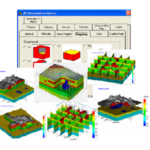
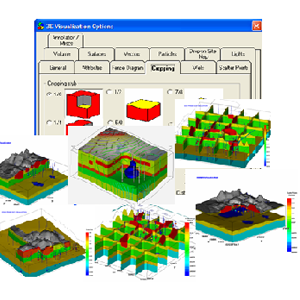
IGW-Desktop 6.0 – Advanced Groundwater Modeling and Simulation Software
IGW-Desktop 6.0 is an advanced groundwater modeling software developed by Environmental Simulations, Inc., designed for professionals in hydrogeology, environmental consulting, and water resource management. This comprehensive simulation environment integrates multiple industry-standard numerical engines, including MODFLOW 6, to provide robust tools for analyzing complex aquifer systems, predicting groundwater flow, and simulating contaminant transport. Targeting a range of users from regulatory agencies to academic researchers, IGW-Desktop 6.0 streamlines the groundwater modeling workflow from data integration to advanced post-processing.
Comprehensive Groundwater Flow and Transport Simulation
IGW-Desktop 6.0 offers extensive capabilities for simulating groundwater flow and contaminant transport. It fully supports MODFLOW 6, the latest generation of the USGS modular groundwater flow model, which allows for flexible modeling using structured and unstructured grids, including finite difference, finite volume, and support for local grid refinement. The software also integrates widely recognized solute transport models such as MT3D-USGS and RT3D, alongside SEAWAT for variable-density flow and transport simulations. This integration enables detailed analysis of hydrogeological systems, including saltwater intrusion and the movement of dissolved contaminants. Furthermore, IGW-Desktop 6.0 can simulate heat transport, which is critical for applications involving geothermal energy or predicting the impact of thermal pollution in groundwater. The software accommodates various boundary conditions and complex hydrogeological scenarios, making it a versatile tool for simulating regional aquifers and local groundwater issues.
Advanced Variably Saturated Flow Modeling
Addressing the complexities of the unsaturated zone, IGW-Desktop 6.0 incorporates solvers based on VS2DT and VS2DRTI. These engines utilize Richards’ equation to accurately simulate variably saturated flow conditions. This capability is crucial for understanding processes such as infiltration from precipitation or irrigation, evaporation from the soil surface, and root water uptake by vegetation. The software facilitates the modeling of coupled surface-subsurface hydrologic processes, which is essential for comprehensive water balance assessments and environmental impact studies. Its support for variably saturated flow modeling makes it particularly valuable for agricultural water management, landfill design, and predicting runoff processes.
Integrated GIS Data Handling and Grid Construction
A key differentiator of IGW-Desktop 6.0 is its strong integration with Geographic Information Systems (GIS). The software can directly import and export common GIS data formats, including shapefiles and GeoTIFFs, and supports various coordinate systems such as WGS84 and UTM. This seamless data handling simplifies the incorporation of real-world spatial data into the modeling process. IGW-Desktop 6.0 features automated tools for generating both structured grids and unstructured USG (Unstructured-grid) grids, which adapt to complex geological boundaries and flow paths. The ability to implement local grid refinement allows for highly detailed analysis in areas of specific interest, such as around pumping wells or contamination sources, without unnecessarily increasing computational load on the entire model domain.
Visualization and Model Post-Processing Tools
IGW-Desktop 6.0 provides a powerful suite of visualization and post-processing tools to interpret model results effectively. Users can generate detailed 2D and 3D graphics, including contour plots of hydraulic heads and contaminant concentrations, flow vector fields, and particle tracking animations to visualize groundwater movement pathways. Time-series analysis is supported through hydrographs of water levels, breakthrough curves for solute transport, and mass balance outputs. For model calibration, the software integrates with the PEST (Parameter Estimation) suite, allowing for automated calibration against observed data and parameter estimation. These integrated visualization and calibration capabilities enhance the understanding of model behavior and the reliability of simulation outcomes.
Real-World Applications Across Industries
The versatility of IGW-Desktop 6.0 makes it applicable to a wide array of real-world challenges across various industries. In water resource management, it is used for assessing aquifer sustainability, managing water supply, and projecting the impacts of changing climate conditions or increased demand. For the mining industry, it aids in predicting dewatering requirements and assessing the impact of mine operations on local hydrology. Environmental consultants utilize IGW-Desktop 6.0 for contamination assessment, simulating the fate and transport of pollutants, and designing effective remediation systems, including pump-and-treat or in-situ treatment strategies. Furthermore, regulatory agencies and academic institutions employ the software for groundwater planning, policy development, and research into complex hydrogeological phenomena.
Frequently Asked Questions
What numerical models does IGW-Desktop 6.0 support for groundwater simulation?
IGW-Desktop 6.0 supports a range of numerical engines including MODFLOW 6 for groundwater flow, MT3D-USGS and RT3D for contaminant transport, SEAWAT for variable-density flow, and VS2DT for variably saturated flow modeling. This comprehensive integration ensures users can tackle diverse hydrogeological challenges with industry-standard simulation capabilities.
How does IGW-Desktop integrate GIS data into groundwater models?
IGW-Desktop directly reads and writes GIS formats like shapefiles and GeoTIFFs, supports map projections such as WGS84 and UTM, and uses GIS data for grid construction and spatially distributed parameters like recharge, well locations, and river networks. This facilitates accurate spatial representation of geological and hydrological features within the model.
Can IGW-Desktop be used for contaminant transport and remediation system design?
Yes, IGW-Desktop includes contaminant transport modeling engines and supports reactive transport and heat transport, enabling design and optimization of remediation systems such as pump-and-treat and bioremediation. Its advanced simulation capabilities allow for realistic prediction of contaminant plume movement and effectiveness of remediation strategies.






Reviews
There are no reviews yet.