

Download INSUL 10.0.7 – Acoustic Simulation for Building Sound Insulation Performance
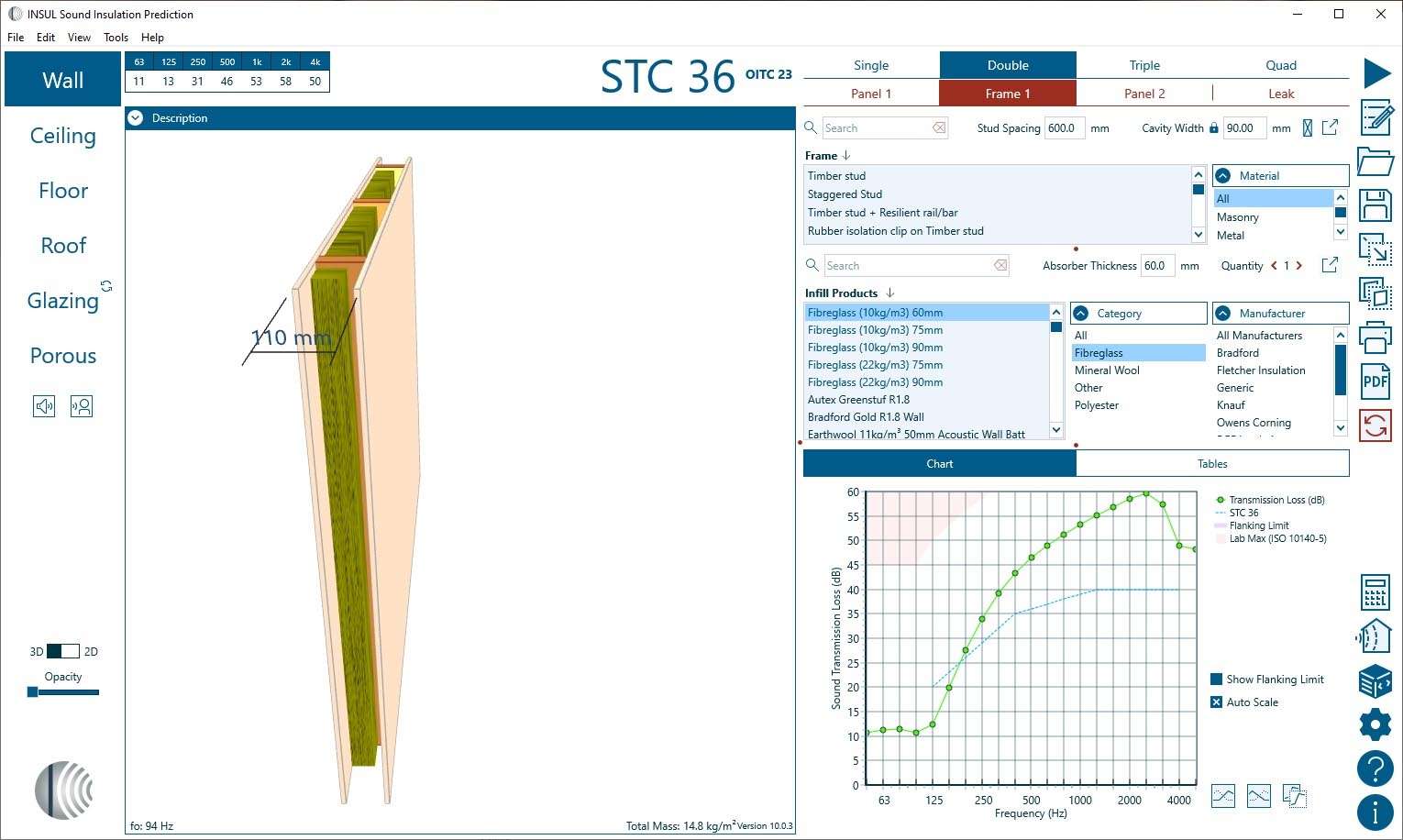
INSUL 10.0.7, developed by Marshall Day Acoustics Ltd, is a leading acoustic simulation and sound insulation prediction software. It is widely used by acoustical consultants, architects, building designers, and HVAC/MEP engineers to predict the Transmission Loss (TL) and Impact Sound Levels (Ln) of building elements. The software provides crucial metrics such as STC, Rw, IIC, and LnTw ratings, making it an indispensable tool for ensuring compliance with building codes and achieving desired acoustic performance in various construction types.
Simulating Sound Transmission in Building Elements
INSUL is engineered to accurately predict how sound travels through and between building components. Its primary function is to calculate the sound insulation performance of walls, floors, roofs, and glazing. This capability is essential for designing spaces that meet specific acoustic criteria, whether for offices, residential buildings, concert halls, or residential developments. The software supports the analysis of a wide range of construction types, allowing professionals to evaluate and optimize soundproofing strategies. By simulating Transmission Loss (TL) in a 1/3-octave band, INSUL provides detailed insights often translated into industry-standard weighted ratings like STC and Rw.
Airborne and Impact Noise Analysis Capabilities
The software excels in modeling diverse building constructions to assess both airborne and impact noise transmission.
Multi-layer and Cavity Modeling
INSUL offers advanced modeling for various partition designs. This includes single-leaf and double-leaf walls, critical for understanding the acoustic separation provided by different material combinations and cavity configurations. Additionally, it facilitates simulation of complex floor and roof structures, such as timber joist floors, concrete slabs, and pitched roofs, which are common in residential and commercial architecture. The software’s flexibility extends to analyzing various glazing designs, from simple single panes to sophisticated double and triple-glazed units.
Impact Sound and Rain Noise Prediction
Beyond airborne sound, INSUL accurately models impact sound transmission, primarily for floor systems. It allows for the prediction of Impact Insulation Class (IIC) ratings and normalized Impact Sound Levels (LnTw) by incorporating various floor coverings and underlayments. This is crucial for residential spaces where footfall noise is a significant concern. Furthermore, INSUL can assess the potential for rain noise on roof systems, a key consideration for buildings in various climates, by simulating the sound transmission characteristics of roof assemblies under simulated rainfall conditions.
Validation, Accuracy, and Regulatory Compliance
The predictive power of INSUL is grounded in its validation against established laboratory measurement standards. Its algorithms are designed to closely reproduce results as per ASTM E413 (for STC) and ISO 717-1 (for Rw). The software provides spectrum adaptation terms, such as C and Ctr, which are vital for assessing the performance of constructions against different types of noise, including low-frequency sounds common in mechanical services and traffic. This adherence to international standards ensures that INSUL’s predictions align with regulatory requirements and are reliable for code compliance checks in architectural acoustics projects.
Custom Materials and Database Expansion
INSUL features an extensive, built-in database containing acoustic properties for a wide array of common building materials. This includes materials like concrete, gypsum board, various types of insulation such as mineral wool and glass fiber, and structural elements. The recent version 10.0.7 has expanded this database with specific entries for Cross-Laminated Timber (CLT) floor types, as well as manufacturer-specific floor covers from AMC and CDM Stravitec. Crucially, INSUL also allows users to define and input custom material properties, extending its application to novel or proprietary building systems and ensuring precise simulation for unique project requirements.
Reporting, Export, and Workflow Integration
INSUL provides comprehensive outputs to facilitate analysis and reporting for acoustic projects. The software generates detailed numerical data alongside graphical representations of sound insulation performance.
Graphical and Numerical Outputs
Users can visualize sound transmission data through 1/3-octave band frequency plots. These detailed spectral analyses can be overlaid for comparing different constructions or scenarios. The software produces comprehensive reports summarizing key acoustic ratings, adaptation terms, and simulation parameters. This granular data enables acoustical consultants and engineers to thoroughly document their findings and recommendations.
Data Export and Project Management
To support integration with other design tools and workflows, INSUL allows for the export of numerical and graphical data in various formats, including Excel, text files, and images. The project file organization within INSUL is streamlined, and version 10.0.7 introduces enhanced Save and Save As functionalities to improve project management efficiency. This ensures that user data is well-organized and easily accessible throughout the design and construction process.
What’s New in Version 10.0.7
Version 10.0.7 of INSUL brings significant advancements focused on accuracy, user flexibility, and performance. This release includes refined algorithms for sound transmission calculations, notably enhancing the accuracy of predictions for complex building elements. A key update is the introduction of wave-based glazing analysis, offering more precise predictions for windows and curtain walls by considering wave propagation effects. Furthermore, INSUL 10.0.7 has removed external Python dependencies, simplifying installation and improving stability, alongside general performance optimizations for faster simulations.
Frequently Asked Questions
Can INSUL 10.0.7 model cross-laminated timber (CLT) floor constructions?
Yes. Version 10.0.7 introduces dedicated CLT base floor modeling, allowing you to simulate multilayer timber assemblies with accurate Transmission Loss and Impact Sound predictions. This feature is crucial for architects and engineers working with modern engineered timber structures.
Does INSUL support wave-based glazing analysis for windows and curtain walls?
Absolutely. INSUL 10.0.7 enhances the Composite TL Calculator with wave-based glazing analysis, enabling more precise predictions for single-, double-, and triple-glazed units by accounting for wave propagation phenomena.
How reliable are INSUL’s acoustic predictions compared to laboratory measurements?
INSUL’s algorithms are validated against standardized laboratory tests, such as ASTM E413 and ISO 717-1, and typically achieve close agreement within a few decibels of measured Transmission Loss and Impact Sound levels. This suggests its simulations are highly reliable for practical applications.




Reviews
There are no reviews yet.