

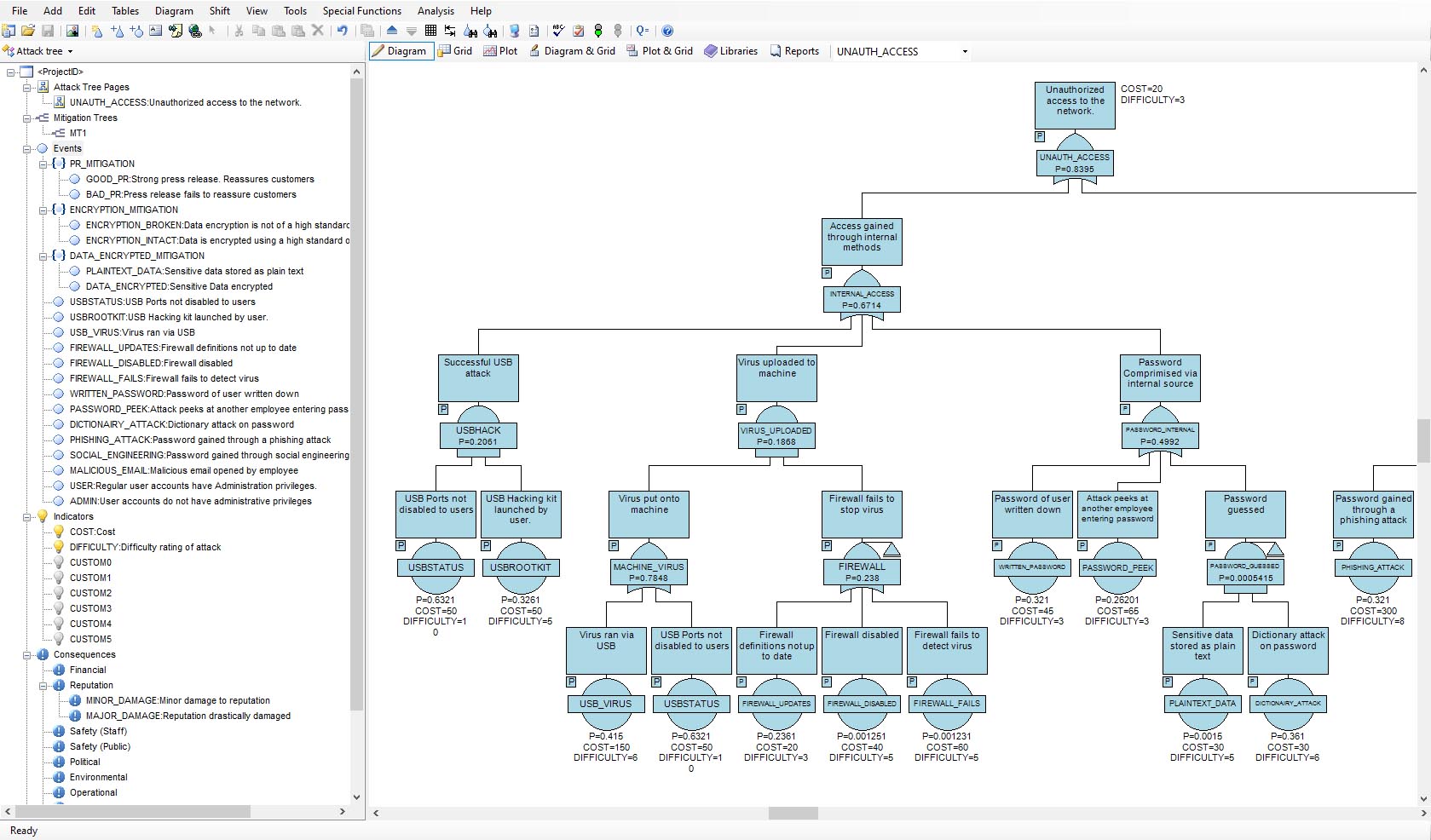
Isograph AttackTree 5.0: Professional Security Threat Analysis & Attack Modeling Platform
Isograph AttackTree 5.0 (also known as AttackTree+) is a specialized platform for structured attack modeling and threat assessment of industrial control systems (ICS) and complex cyber-physical systems . The software enables step-by-step representation of penetration paths and attack combinations using logical gates (AND/OR) within an attack tree framework.
The analytical core of AttackTree is built on a graphical structure and cause-effect relationships between vulnerabilities, exploitation paths, and consequences. Each node can include probabilistic parameters such as attack likelihood, timing constraints, technical prerequisites, and mutual dependencies . This structured approach enables analysts to unambiguously extract and document threat actors, critical paths, and compound attack scenarios.
Attack trees provide a concise graphical format for modeling threats against system security, including cybersecurity, network security, banking system security, and personnel security . With increased risks of hacking attacks on computer systems and computer-based fraud, AttackTree is an invaluable tool for system designers and security personnel .
The software supports integration with other Isograph family tools (Reliability Workbench, FaultTree+), enabling combined analysis of physical failures and security events for comprehensive risk assessment.
???? Primary Users
This professional security analysis software is designed for:
-
Cybersecurity Engineers & Analysts modeling and assessing threats against industrial control systems, IT networks, and critical infrastructure
-
Security Architects & System Designers identifying attack paths, vulnerabilities, and developing countermeasures
-
Automotive Cybersecurity Professionals conducting threat analysis and risk assessment (TARA) compliant with ISO/SAE 21434
-
Critical Infrastructure Operators in energy, transportation, oil & gas, and power generation sectors
-
Risk & Compliance Officers evaluating security risks against standards such as ISO 27001, IEC 62443, and NIST frameworks
⚡ Key Features & Capabilities
???? Structured Attack Modeling
-
Graphical Attack Tree Construction – Create and develop attack trees with logical AND/OR gates to represent penetration paths and physical threat combinations
-
Mitigation Trees – Model the effectiveness of mitigating measures designed to reduce consequences of successful attacks, including procedures for data breach response, emergency response plans, and PR strategies
-
Hierarchical Decomposition – Break down complex attacks into basic conditions and quantifiable events
???? Probabilistic & Scenario Analysis
-
Probability Assignment – Assign probability distributions to nodes for numerical analysis of attack success likelihood
-
Monte Carlo Simulation – Advanced simulation for calculating probability distribution of attack outcomes, cumulative risk assessment, and parametric sensitivity analysis
-
Cut-Set Analysis – Determine all combinations of events that will lead to a successful attack, ranked by probability of success
-
Indicator Modeling – Define quantifiable indicators for attack cost, operational difficulty, required equipment, and other relevant metrics
⏱️ Time-Dependent & Sequential Attack Modeling
-
Sequential Attack Scenarios – Analyze multi-step attacks considering time of occurrence, penetration duration, and system vulnerability windows
-
Predictive Analysis – Extract time-to-successful-penetration metrics and vulnerability exposure periods
????️ Countermeasure Impact Assessment
-
Security Strategy Evaluation – Assess effect of security controls, design changes, and protective measures on attack success probability and damage extent
-
Cost-Effectiveness Optimization – Prioritize security improvements based on quantitative risk and cost-benefit analysis
???? Consequence Modeling & Risk Assessment
-
Multiple Consequence Categories – Model financial, political, operational, and safety consequences of successful attacks
-
Partial vs Total Success – Differentiate consequence levels for partially successful versus completely successful attacks
-
Risk Value Calculation – Compute risk values for each consequence category
???? Integration with Isograph Suite
-
FaultTree+ & Reliability Workbench – Direct integration for combining security analysis with reliability and safety models
-
Seamless Data Flow – Attack tree results can be referenced in fault trees, RBD models, or component/service databases
???? Advanced Reporting & Documentation
-
Technical Node Definitions – Define technical properties of nodes and document attack paths
-
Graphical & Analytical Reports – Generate reports for strategic security decision-making meetings
-
Professional Report Designer – Fully customizable reports with export to Microsoft Word and PDF formats
-
Data Import/Export – Support for Microsoft Excel, Access, and text file formats
???? Enterprise System Capabilities
-
Large-Scale Collaboration – Central database for team-based project management with check-in/check-out functionality
-
User & Group Control – Granular read, write, and modify permissions for system administrators
-
Version Control – Secure management of analysis iterations across enterprise teams
???? Standards Compliance
-
ISO/SAE 21434 – Automotive cybersecurity standard compliance for threat analysis and risk assessment (TARA)
-
ISO 26262 – Functional safety standard integration
-
ISO 27001 – Information security management alignment
-
IEC 62443 – Industrial control system security framework compatibility






Reviews
There are no reviews yet.