

Download Itasca Xsite 3.0.53 – Hydraulic Fracturing Simulation Software
Itasca Xsite 3.0.53 is a specialized numerical simulation software developed by Itasca Consulting Group. This application is designed to model and analyze hydraulic fracturing processes, catering primarily to professionals in the mining, oil & gas, and environmental engineering sectors. It provides advanced capabilities for simulating complex geological scenarios, making it a valuable tool for understanding subsurface behavior.
Overview of Itasca Xsite
What is Itasca Xsite?
Itasca Xsite is a powerful numerical modeling tool engineered for the simulation of hydraulic fracturing. Developed by Itasca Consulting Group, a firm recognized for its expertise in geomechanics and numerical analysis software, Xsite enables engineers and geoscientists to conduct detailed simulations of fracture propagation. The software is built to handle complex geological formations and diverse operational conditions, supporting advanced hydro-mechanical simulations.
Key Applications in Mining Engineering
The primary focus of Itasca Xsite is to provide sophisticated simulation capabilities for industries dealing with subsurface geomechanics, particularly in mining and energy extraction. Its application extends to simulating the effects of fluid injection and fracture networks in various geological environments. This is crucial for optimizing extraction strategies, assessing environmental impact, and ensuring operational safety.
- Supports modeling for mining operations to understand rock mass behavior under stress and fluid injection.
- Facilitates hydro-mechanical simulations essential for oil & gas exploration and production.
- Aids environmental engineering in analyzing subsurface fluid flow and contamination pathways.
- Enables the simulation of discrete fracture networks (DFNs) and their impact on resource recovery.
Unique Features and Capabilities
User-Friendly Interface
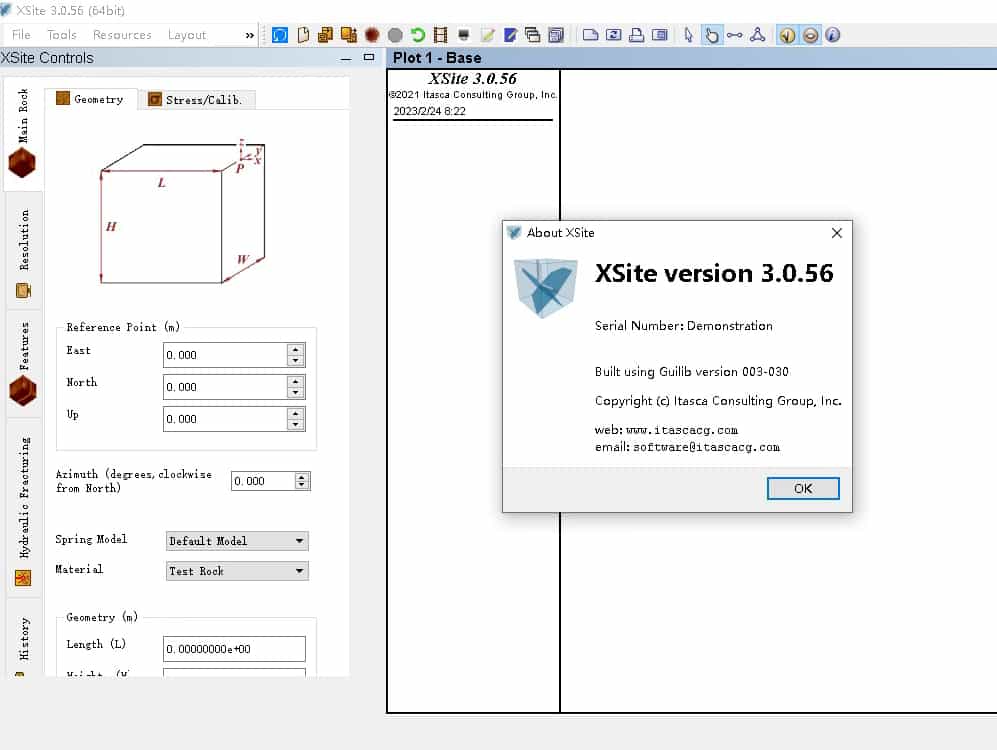
Itasca Xsite distinguishes itself with a focus on an intuitive and user-friendly interface. This design philosophy simplifies complex simulation tasks, allowing users to build models, define parameters, and initiate simulations without requiring extensive programming or scripting knowledge. The accessibility of its interface is a significant advantage for engineers and geologists who may not have specialized computational backgrounds.
Advanced Simulation Techniques
At its core, Itasca Xsite offers robust capabilities for hydraulic fracturing simulation. It supports the modeling of intricate fracture geometries and their propagation through various geological conditions. The software is equipped to handle multi-well scenarios and detailed cluster modeling, providing insights into the complex interplay between fluid injection and rock mass response.
- Advanced modeling of hydraulic fracture propagation, including complex geometries.
- Support for multi-well simulations to analyze interference effects.
- Detailed cluster modeling for optimized fracture network design.
- Integration of Synthetic Rock Mass (SRM) and Lattice methods for representing rock mass heterogeneity.
- Capability for full hydro-mechanical simulations to capture coupled processes.
Post-Processing and Data Exporting
Post-simulation analysis in Itasca Xsite is supported by comprehensive visualization and data exporting tools. Users can generate detailed reports and visualizations of simulation results, such as fracture geometry, stress distribution, and fluid flow patterns. The ability to export data in various formats facilitates further analysis and integration with other engineering workflows.
Real-World Use Cases
Itasca Xsite has been applied to address complex challenges in real-world engineering projects. Its ability to model intricate geological structures makes it particularly valuable in unconventional reservoirs and stressed mining environments. For instance, simulations can guide the design of well stimulation programs to maximize resource recovery while minimizing environmental risks. The software aids in understanding how induced fractures interact with natural fault systems or existing mine workings.
Comparative Analysis
Compared to other numerical modeling software for geomechanics and fracturing, Itasca Xsite offers a focused approach to hydraulic fracturing simulations. While general-purpose geomechanics software like FLAC or PLAXIS can model rock mass behavior, Xsite provides specialized tools and workflows optimized for simulating the physics of fracture initiation and propagation. Its emphasis on easily importing geological data, such as DXF files, and its user-friendly interface distinguish it from more complex, code-centric modeling platforms.
Conclusion
Itasca Xsite 3.0.53 provides a powerful yet accessible platform for hydraulic fracturing simulation, offering significant value to the mining, oil & gas, and environmental engineering fields. Its user-friendly design, advanced simulation techniques, and robust post-processing capabilities make it an effective tool for analyzing complex subsurface phenomena. For professionals seeking to optimize extraction processes and understand geomechanical responses in challenging geological settings, Itasca Xsite presents a compelling solution for their numerical modeling needs.
Frequently Asked Questions
What is Itasca Xsite used for?
Itasca Xsite is primarily used for hydraulic fracturing numerical simulation, allowing engineers and geologists to model the behavior of fractures in various geological formations. It is essential in the mining and oil & gas industries for optimizing extraction processes and understanding rock mass responses to fluid injection.
Does Itasca Xsite require scripting for operations?
No, Itasca Xsite is designed with a user-friendly interface that does not require scripting or complex command inputs, making it accessible for users without extensive programming knowledge. This design allows for easier model setup and simulation execution.
Can I import geological data into Itasca Xsite?
Yes, Itasca Xsite allows users to easily import geological geometries from DXF files, enabling straightforward definition and modeling of various geological structures. This capability simplifies the process of incorporating real-world site data into simulation models.






Reviews
There are no reviews yet.