

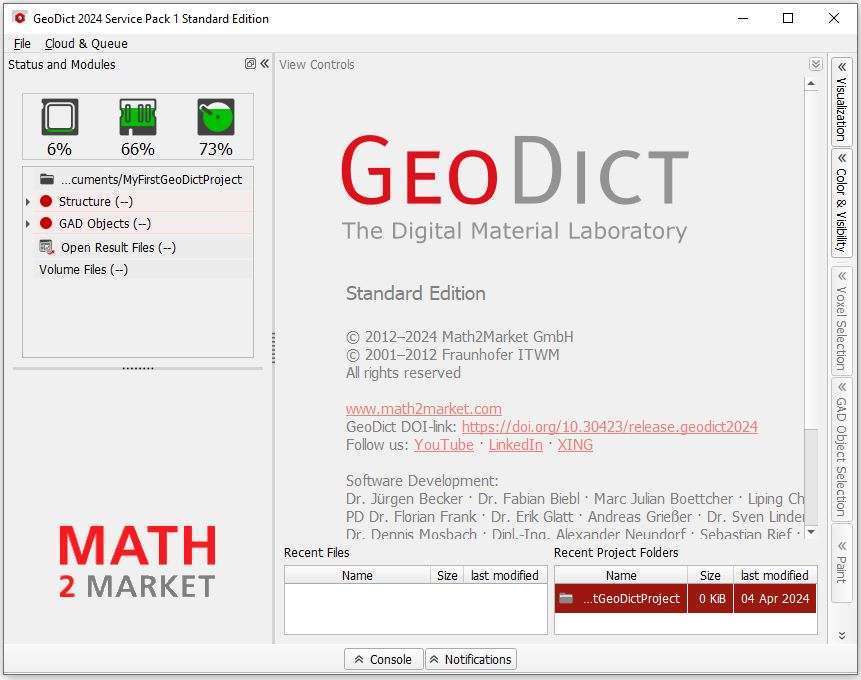
Download Math2Market GeoDict 2024.1 – Advanced Simulation for Membrane Structures
Math2Market GeoDict 2024.1 is a specialized simulation software designed for advanced materials science, particularly focusing on the intricate analysis of membrane structures and waterproof materials. Developed by Math2Market GmbH, this application plays a crucial role in Integrated Computational Materials Engineering (ICME) by providing high-fidelity modeling capabilities that bridge material models across various scales. Professionals in materials engineering and related fields utilize GeoDict software to accelerate the design and processing of novel materials.
Overview of GeoDict
What is GeoDict?
GeoDict is a powerful materials science software that facilitates the simulation of complex material structures and their properties. It is engineered to support integrated computational materials engineering (ICME) workflows by linking materials models across multiple scales. This approach allows for a more comprehensive understanding and predictive capability concerning material behavior under various conditions, significantly aiding in the development and optimization of materials for demanding applications.
Company Background
Math2Market GmbH, the developer of GeoDict, is a company dedicated to advancing materials simulation and engineering. Their focus on creating sophisticated tools for materials analysis underscores their commitment to supporting innovation in fields like chemical and materials engineering. GeoDict is a testament to their expertise in developing software solutions that tackle complex material challenges.
Key Applications in Materials Science
Simulation of Membrane Structures
GeoDict excels in providing detailed simulations for membrane structures. The software’s capabilities allow for a deep understanding of the structural characteristics and performance metrics of various membrane types. This is vital for applications where precise control over transport properties and mechanical integrity is essential, such as in separation processes or advanced filtration systems.
Dynamic Simulation of Pore Morphology
Through specialized modules like SatuDict, GeoDict offers dynamic simulation of pore morphology. This capability is critical for predicting water permeability and moisture behavior. By accurately modeling the complex network of pores within a material, GeoDict helps researchers understand how fluids interact with the material, which is fundamental for developing effective waterproof materials and optimizing their performance under pressure.
Modules and Features
GrainGeo and FiberGeo Modules
GeoDict incorporates specialized modules such as GrainGeo and FiberGeo, which are tailored for distinct simulation needs. GrainGeo focuses on the detailed modeling of grain structures, crucial for understanding bulk material properties. FiberGeo, on the other hand, is designed for simulating fibrous materials and complex composites. Both modules emphasize high-fidelity modeling to ensure that simulated material properties closely reflect real-world performance.
Comparative Advantage in Material Testing
The advanced simulation capabilities offered by GeoDict provide a significant advantage in the materials R&D process by reducing reliance on extensive and time-consuming empirical testing. By accurately predicting material properties and performance, such as moisture behavior and water permeability, GeoDict enables researchers to iterate designs more quickly and identify optimal material compositions and structures more efficiently.
Real-World Use Cases
Case Studies in Waterproof Material Development
In the development of waterproof materials, GeoDict has been instrumental in simulating the behavior of complex material architectures. For example, it can model the interaction of water with microporous membranes, predicting sealant effectiveness and long-term durability. These simulations are vital for industries requiring reliable protection against moisture, from construction materials to high-performance textiles.
Industry Insights and Feedback
The adoption of GeoDict within the materials science industry is driven by its ability to deliver precise insights into material behavior. Professionals leveraging this software often report enhanced understanding of structural-property relationships. This leads to more informed material design choices and a faster path to market for innovative products requiring rigorous performance validation.
Integration and Future of GeoDict
Compatibility with Other Tools
GeoDict is designed to integrate effectively within broader materials modeling workflows. Its capability to work with various data formats and standards facilitates its use alongside other simulation software and experimental analysis tools. This interoperability is key for implementing comprehensive ICME strategies, allowing for a seamless transition of data and models across different analytical stages.
The Role of ICME in Future Developments
The principles of Integrated Computational Materials Engineering (ICME) are central to GeoDict’s development and future direction. By linking simulations across multiple length and time scales, GeoDict supports a holistic approach to materials design and discovery. Future advancements are expected to further enhance these integrations, enabling more predictive power and accelerating innovation in materials science.
Conclusion
Math2Market GeoDict 2024.1 stands as a critical tool for modern materials science, offering unparalleled simulation capabilities for complex structures like membrane structures and waterproof materials. Its advanced modules and adherence to ICME principles empower researchers and engineers to innovate more effectively, reducing development cycles and enhancing material performance. The sophisticated analysis provided by GeoDict software ensures its continued relevance in pushing the boundaries of materials engineering.
Frequently Asked Questions
What are the main features of GeoDict?
GeoDict features advanced simulation capabilities including the GrainGeo and FiberGeo modules for modeling membrane structures and predicting water permeability under varying conditions. It significantly enhances the efficiency of waterproof materials research and testing by providing detailed insights into material pore morphology and moisture behavior.
How does GeoDict enhance waterproof materials R&D?
GeoDict reduces the need for extensive empirical testing by providing high-fidelity simulations of membrane structures and their moisture behavior under pressure. This allows for more efficient research and development processes, enabling quicker iteration and optimization of materials for superior waterproofing performance.
What industries benefit from using GeoDict?
Industries involved in materials science, particularly those focused on waterproof technologies, membrane structure design, and chemical processing, benefit significantly from GeoDict’s advanced simulation capabilities. Its application extends to fields where precise analysis of material properties and pore structures is crucial.






Reviews
There are no reviews yet.