

Download Mentor Graphics Calibre 2024.1 for Linux – Industry-Leading IC Design Verification Tool
Mentor Graphics Calibre, developed by Siemens EDA, is a pivotal electronic design automation software essential for the semiconductor design and manufacturing industry. This advanced toolset is designed to perform critical integrated circuit (IC) design verification, ensuring that complex designs meet rigorous electrical and structural specifications before fabrication. Professionals in the semiconductor field rely on Mentor Graphics Calibre for its robust capabilities in validating the accuracy and manufacturability of ICs.
Overview of Mentor Graphics Calibre
History and Development
Mentor Graphics Corporation, established in 1981, built a reputation for developing sophisticated electronic design automation solutions. Following its acquisition by Siemens in 2017, the company, now operating as Siemens EDA, has continued to advance its product lines. The Calibre suite of tools, including the notable Calibre nmLVS, has evolved significantly, playing a vital role in the accuracy and integrity of integrated circuit verification. These tools are foundational for modern semiconductor manufacturing processes, ensuring that designs are both electrically sound and structurally precise.
Key Applications in Integrated Circuit Design
Applications Across Industries
The Mentor Graphics Calibre suite provides indispensable support across various sectors of the semiconductor and electronics industries. Its capabilities are crucial for companies engaged in the intricate process of integrated circuit (IC) design and fabrication. Key use cases include ensuring the manufacturability of intricate chip layouts, validating electrical rule checks (ERC), and performing physical verification to meet design for manufacturing (DFM) requirements. This makes Calibre a cornerstone for developing advanced processors, memory chips, and custom integrated circuits used in everything from consumer electronics to high-performance computing.
Advanced Features of Calibre Tools
Precision Circuit Verification
The Calibre tool suite offers a comprehensive set of features for high-precision circuit verification, critical for modern integrated circuit development. Key functionalities include:
- Calibre nmLVS (Netlist Verification of Circuits): This technology performs signoff accuracy checks to ensure that the netlist extracted from the device layout accurately represents the intended circuit schematic, preventing costly errors in fabrication.
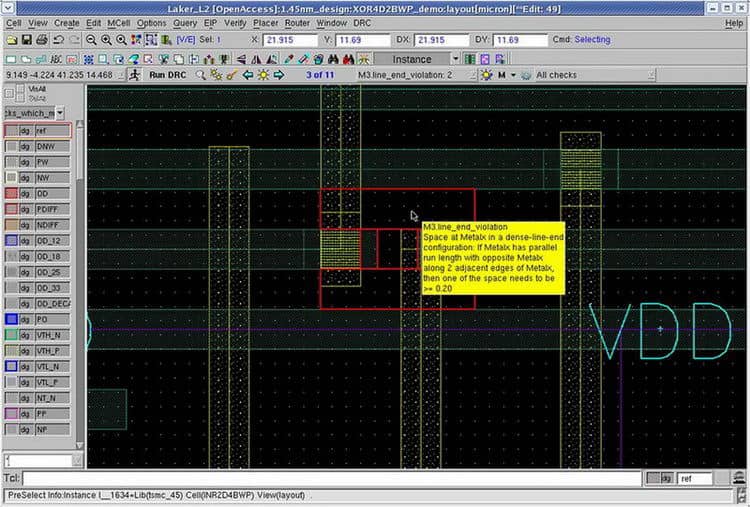
- DRC (Design Rule Checking): Calibre meticulously analyzes the physical layout against a set of manufacturing constraints provided by the foundry, identifying and flagging any violations that could lead to yield loss or device failure.
- Pattern Matching Technologies: Advanced pattern matching algorithms are employed to detect specific geometric structures or signatures within the design that may indicate potential manufacturing issues or require special handling.
- Interactive Debugging Tools: Calibre provides sophisticated debugging capabilities that allow engineers to visually inspect, diagnose, and resolve verification failures interactively, significantly speeding up the design closure cycle.
Seamless Integration for Enhanced Workflow
Compatibility with Design Environments
Mentor Graphics Calibre is engineered for seamless integration into existing electronic design automation (EDA) workflows, enhancing productivity and design accuracy. The software is compatible with a wide range of industry-standard Computer-Aided Design (CAD) tools used for IC layout. Furthermore, Calibre offers customization through its user programming environment, allowing design teams to tailor verification processes, build custom checks, and automate repetitive tasks. This flexibility ensures that Calibre can be effectively incorporated into complex design flows, supporting collaborative efforts and optimizing the overall design-to-manufacturing pipeline.
Real-World Use Cases and Success Stories
Performance in Industry Projects
Mentor Graphics Calibre has been instrumental in the successful validation of numerous high-profile semiconductor designs across the industry. For instance, leading foundries and fabless semiconductor companies leverage Calibre for signoff verification of advanced nodes, including complex System-on-Chip (SoC) designs for mobile devices and high-performance computing applications. One notable aspect is its application in validating intricate analog and mixed-signal circuits where complex rule decks and precise layout compliance are paramount for achieving desired performance and reliability specifications. The software’s ability to handle massive datasets and complex verification rule sets has been critical in enabling the development of next-generation integrated circuits.
Comparison to Competing Tools
Assessing Industry Standards
Within the electronic design automation landscape, Mentor Graphics Calibre is recognized as an industry-standard tool for IC physical verification. While competing EDA solutions offer various verification capabilities, Calibre distinguishes itself through its high accuracy, scalability, and comprehensive feature set tailored for signoff. Its specialized tools like Calibre nmLVS and advanced DRC engines provide robust solutions that are often benchmarked against industry requirements. Furthermore, Calibre’s hyperscaling technology offers a significant advantage in processing extremely large and complex chip designs, a capability that is crucial for cutting-edge semiconductor manufacturing nodes where design complexity escalates rapidly.
Frequently Asked Questions
What makes Mentor Graphics Calibre essential for IC design?
Mentor Graphics Calibre is crucial for integrated circuit design due to its advanced verification capabilities such as nmLVS and DRC, which ensure that designs meet stringent industry standards for performance and reliability. These features help to identify and correct potential manufacturing defects early in the design cycle, reducing costly errors and ensuring design integrity.
How does Calibre support large design datasets?
Calibre employs hyperscaling technology that enhances scalability, allowing users to efficiently process and verify extensive IC designs and simulation data without performance loss. This architecture is specifically designed to manage the massive complexity and data volumes inherent in modern deep-submicron and advanced process node designs.
Can Calibre integrate with other EDA tools?
Yes, Calibre is designed to integrate seamlessly with various electronic design automation tools, enhancing the workflow and allowing for effective collaborative design processes within existing environments. Its open architecture and support for standard file formats facilitate interoperability with popular CAD platforms and other components of the IC design ecosystem.





Reviews
There are no reviews yet.