

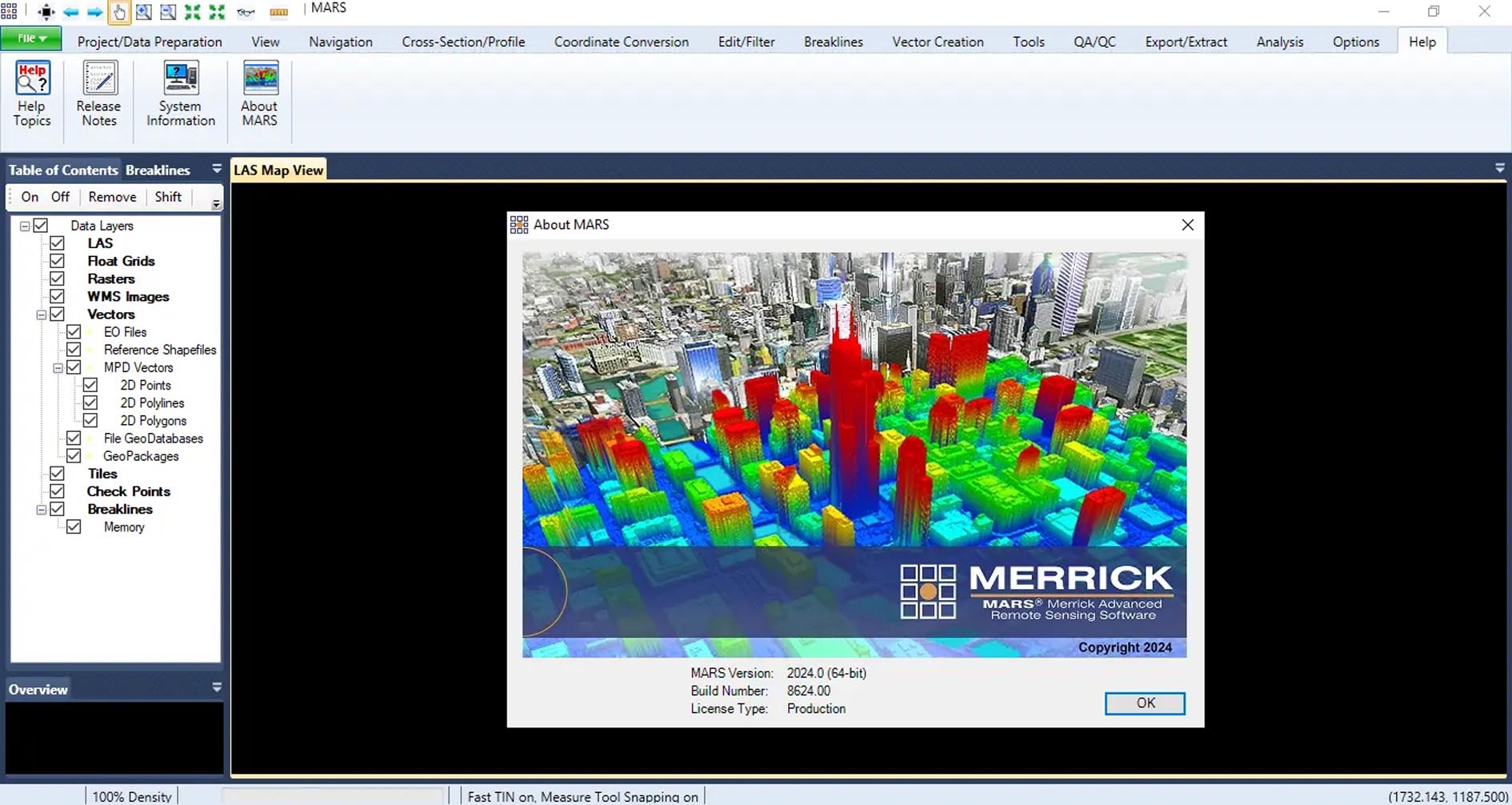
Download Merrick MARS 2024 – Advanced LiDAR Point Cloud Processing Software
Merrick MARS 2024, developed by Merrick & Company, is a comprehensive Windows-based software suite designed for advanced LiDAR point cloud processing. This sophisticated geospatial analysis tool is tailored for professionals in surveying, civil engineering, mapping, infrastructure management, and environmental analysis, enabling efficient handling, visualization, and extraction of critical geospatial information from massive aerial LiDAR datasets.
Precision Geospatial Analysis with Merrick MARS
Merrick MARS 2024 serves as a powerful platform for professionals engaged in geospatial analysis, surveying, civil engineering, and mapping. The software empowers users to manage, visualize, and extract detailed geospatial insights from extensive LiDAR point cloud data. Its capabilities are crucial for applications ranging from detailed infrastructure management and environmental monitoring to complex urban planning and utility network analysis, supporting survey-grade accuracy through integration with GNSS/IMU data.
Robust Tools for Managing Massive Point Cloud Datasets
Handling extremely large LiDAR datasets requires specialized tools that optimize performance without sacrificing detail. Merrick MARS 2024 provides an environment engineered for efficiency and precision.
Efficient Large-Scale Data Handling
The software incorporates optimized memory management techniques and advanced rendering engines capable of processing and displaying billions of points. This ensures smooth, responsive visualization and manipulation of even the most extensive point cloud datasets, preventing performance bottlenecks common in other geospatial analysis tools.
Automated and Manual Feature Extraction
Merrick MARS 2024 offers a comprehensive suite of classification and filtering tools that adhere to industry-standard ASPRS specifications. Users can perform automated feature extraction, leveraging AI-powered classification advancements to quickly identify and categorize elements such as buildings, power lines, vegetation, and terrain surfaces. Manual editing tools provide fine-grained control for specialized requirements or complex environments.
Integrative Photogrammetry and 3D Modeling Capabilities
The software seamlessly integrates aerial imagery data with LiDAR point clouds, enhancing the depth and accuracy of geospatial models. Users can leverage these combined datasets to generate detailed 3D terrain and surface models, create contour lines, and define cross-sections, offering a more complete understanding of the physical environment. The latest version also features enhancements for reality mesh support, providing richer contextual visualization.
Workflow Enhancements in MARS 2024
The 2024 release of Merrick MARS introduces significant advancements aimed at increasing processing speed, improving user experience, and fostering greater collaboration and interoperability.
Key enhancements include:
- AI-powered automated classification that significantly reduces processing time and manual effort for feature extraction.
- A redesigned user interface offering improved accessibility and more intuitive navigation for both novice and expert users.
- Integrated cloud processing capabilities, allowing for distributed computations that can handle exceptionally large datasets more effectively.
- Expanded export format support, ensuring seamless interoperability with a wide array of CAD, GIS, and BIM software, facilitating integration into established professional workflows.
Industry Applications and Real-World Use Cases
Merrick MARS 2024 is instrumental across various professional fields, providing detailed insights for critical projects. Its capabilities are applied in:
- Infrastructure Management: Detailed mapping and monitoring of roads, bridges, and utilities for maintenance and expansion planning.
- Environmental Monitoring: Analysis of vegetation health, land cover classification, and terrain modeling for conservation and impact assessment.
- Urban Planning: Creating accurate 3D city models for development simulations, shadow analysis, and infrastructure layout.
- Utility Network Analysis: Identifying power lines, pipelines, and supports for network integrity checks and vegetation management near critical assets.
- Surveying and Mapping: Producing survey-grade accurate digital terrain models and topographic maps utilizing integrated GNSS/IMU data.
Frequently Asked Questions
What types of LiDAR data processing can Merrick MARS 2024 perform?
Merrick MARS 2024 supports advanced LiDAR point cloud classification, filtering, thinning, and quality control compliant with ASPRS standards. It enables automated and manual feature extraction for buildings, vegetation, power lines, terrain models, and integrates photogrammetry data for enhanced analysis.
How does Merrick MARS 2024 improve accuracy for surveying projects?
The software supports survey-grade accuracy by integrating high-precision GNSS and IMU data, ensuring that LiDAR-derived products meet precise geospatial standards crucial for engineering and mapping work.
What new features were introduced in Merrick MARS 2024?
The 2024 release includes AI-powered automated point cloud classification, enhanced reality mesh support, a redesigned user interface for easier navigation, cloud processing integration to handle large datasets, and expanded export options for CAD, GIS, and BIM compatibility.






Reviews
There are no reviews yet.