

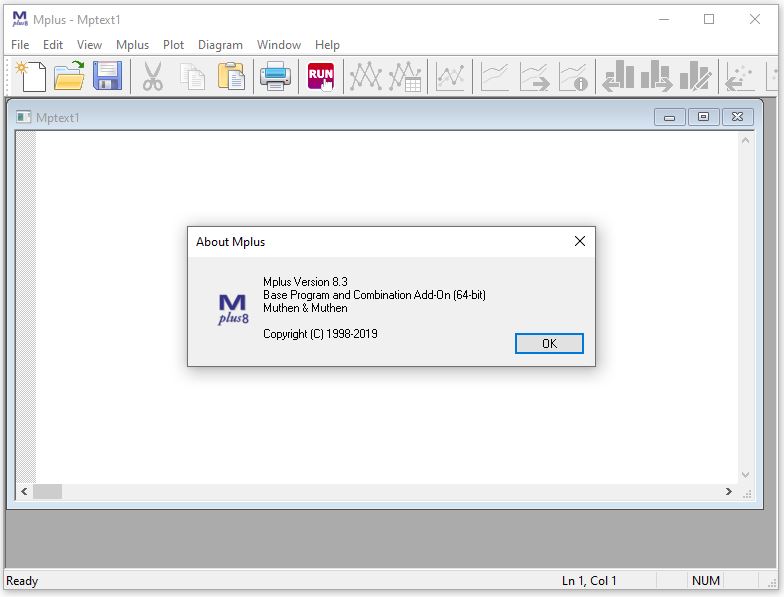
Download Mplus – Advanced Statistical Modeling Software
Mplus is a powerful statistical software package developed by Muthén & Muthén, designed for researchers and analysts in fields such as social sciences, psychology, and education. It is recognized for its robust capabilities in statistical modeling, particularly for complex analyses involving latent variables and multilevel structures. This data analysis software provides researchers with the tools necessary to explore intricate relationships within their datasets.
Introduction to Mplus and Its Applications
What is Mplus?
Mplus is a statistical software package renowned for its comprehensive approach to modeling a wide array of statistical analyses. Developed by Muthén & Muthén, it caters to researchers in various disciplines who require sophisticated analytical tools. The software is particularly valued for its ability to handle complex statistical models that go beyond standard regression analyses, making it an essential tool for advanced quantitative research.
Key Features and Capabilities of Mplus
Supported Analysis Types
Mplus offers a broad spectrum of analytical techniques, enabling users to conduct in-depth statistical investigations. Its flexibility allows for the implementation of advanced methods crucial for modern research methodologies.
- Structural Equation Modeling (SEM): Mplus excels in SEM, allowing users to analyze complex relationships between observed and latent variables. This includes confirmatory factor analysis (CFA), path analysis, and full structural equation models.
- Multilevel Modeling: The software supports the analysis of data structured in hierarchies, such as students within classrooms or individuals within communities. This capability is vital for understanding variation at different levels of a data hierarchy.
- Latent Variable Modeling: A core strength of Mplus is its proficiency in modeling latent variables, which are constructs that cannot be directly measured but are inferred from observed variables.
- Longitudinal Data Analysis: Mplus can effectively analyze data collected over time, accommodating growth curve modeling, panel analysis, and other time-series approaches to understand change and development.
- Monte Carlo Simulations: The software includes capabilities for conducting Monte Carlo simulations, which are useful for testing model properties, power analysis, and exploring potential outcomes under various conditions.
Handling Data with Mplus
Data Types and Formats
Mplus is designed to be versatile in handling diverse data structures and types, ensuring that researchers can work with the data as it naturally occurs in their studies. This adaptability is key to facilitating complex research questions.
- Mplus supports a wide range of data types, including continuous, binary, ordinal, nominal, and categorical variables, allowing for the analysis of almost any kind of observed indicator.
- It is adept at analyzing longitudinal data, accommodating repeated measures on individuals over different time points.
- The software incorporates advanced missing data techniques, enabling valid analyses even when datasets contain missing values, without requiring listwise deletion. Techniques such as maximum likelihood estimation and multiple imputation are supported.
- Mplus can import data from various common file formats, simplifying the workflow for researchers accustomed to different data management systems.
Real-World Applications of Mplus
The analytical power and flexibility of Mplus make it an indispensable tool across numerous research domains. Its application enables deeper insights into complex phenomena.
- In social sciences, Mplus is used for examining social attitudes, political behaviors, and demographic trends through sophisticated latent variable models.
- In psychology, it facilitates the analysis of personality traits, mental health conditions, and psychometric assessments, often involving complex measurement models.
- In education research, Mplus supports studies on student achievement, educational interventions, and school effectiveness, frequently employing multilevel modeling to account for student-teacher-school structures.
- Health research utilizes Mplus for analyzing patient outcomes, treatment effects, and the impact of various health behaviors, often incorporating longitudinal designs and complex risk factor modeling.
Comparative Analysis with Similar Tools
Mplus distinguishes itself from other statistical software packages primarily through its integrated approach to modeling complex relationships within data. While many statistical tools offer components for certain analyses, Mplus provides a unified framework for advanced techniques.
- Compared to general statistical packages, Mplus offers more specialized and integrated capabilities for structural equation modeling and multilevel analysis, often requiring separate packages or complex syntax in other software.
- Its unique strength lies in its seamless treatment of observed and latent variables within a single analytical model, a feature that simplifies complex psychometric and sociological research designs.
- While alternatives like R or SAS offer vast statistical libraries, Mplus provides a more streamlined and syntactically consistent environment for its core modeling techniques, particularly for users focused on latent variable and multilevel analyses.
Conclusion and Recommendations
Mplus is a highly capable statistical modeling software designed for researchers who need to conduct complex analyses involving latent variables, multilevel data, and longitudinal data. Its comprehensive suite of features and robust handling of missing data make it a powerful choice for advancing quantitative research in the social sciences, education, psychology, and beyond. For researchers seeking a specialized tool to uncover intricate patterns and relationships within their data, Mplus offers significant advantages in analytical depth and methodological flexibility.
Frequently Asked Questions
What types of data can Mplus analyze?
Mplus can handle various types of data, including continuous, binary, ordinal, nominal, and categorical data. It is also capable of analyzing longitudinal data and data that may contain missing values, making it versatile for complex research needs.
How does Mplus handle missing data in analyses?
Mplus employs advanced techniques to address missing data, allowing researchers to conduct valid analyses without excluding missing observations. This can include using model-based approaches for data imputation.
Is Mplus suitable for beginners in statistical modeling?
While Mplus is powerful and offers extensive capabilities for advanced modeling, it has a learning curve. Users with some background in statistics may find it easier to navigate than complete beginners, though there are resources available for learning.






Reviews
There are no reviews yet.