

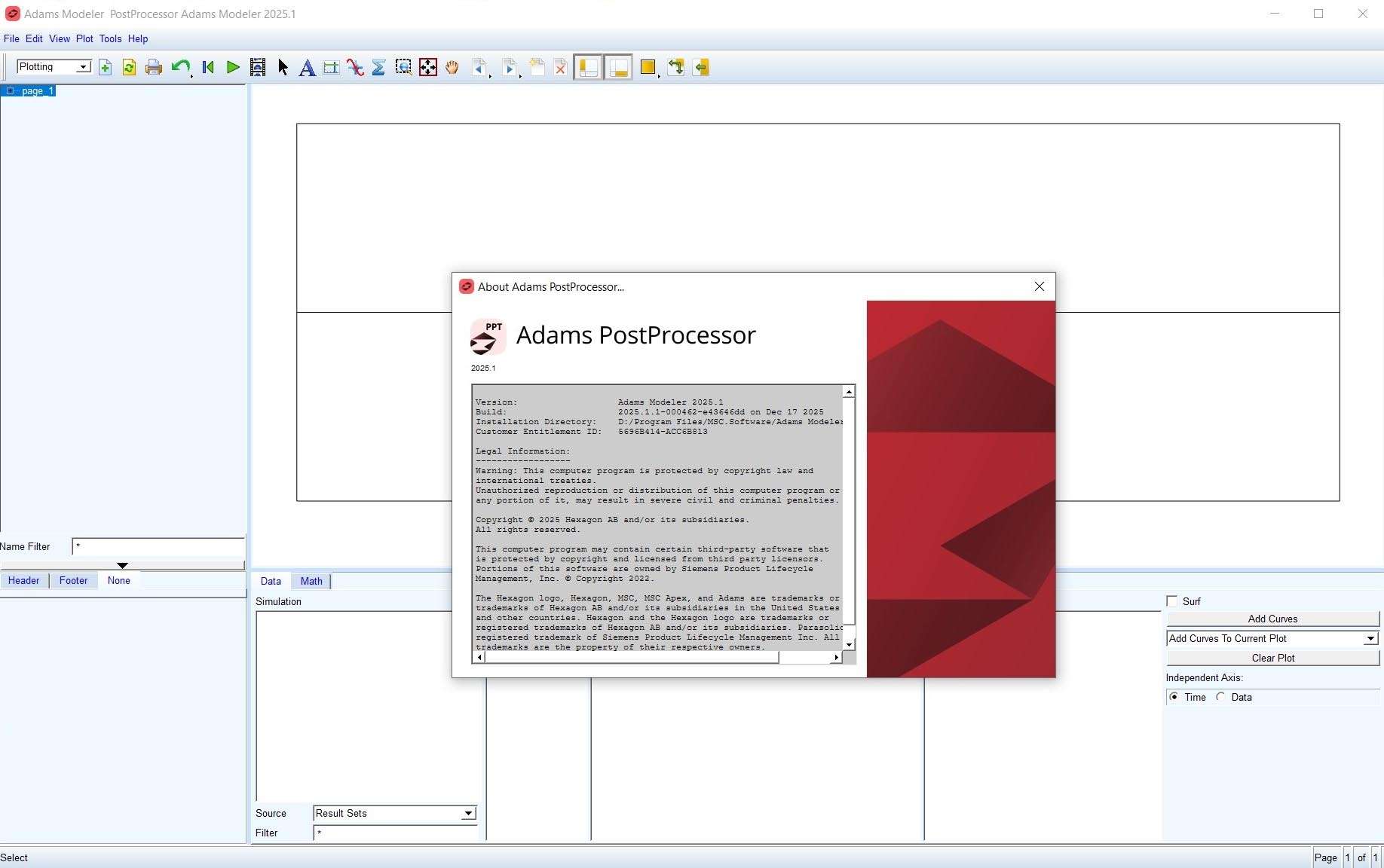
Download MSC Adams Modeler 2025.1 – Advanced Multibody Dynamics Simulation
MSC Adams Modeler 2025.1 is the latest release of the industry-leading software for multibody dynamics (MBD) simulation, developed by MSC Software Corporation. This powerful application is designed to analyze the dynamic behavior of mechanical systems, enabling engineers and researchers across automotive, aerospace, robotics, and industrial machinery sectors to predict motion and forces accurately. Its comprehensive feature set allows for the creation of complex virtual prototypes, facilitating design exploration and optimization.
Overview of MSC Adams Modeler 2025.1
Evolution and Industry Adoption
Originally developed as Automated Dynamic Analysis of Mechanical Systems, MSC Adams has evolved into the predominant solver for multibody dynamics. Its reliable performance and deep analytical capabilities have led to widespread adoption by leading companies and academic institutions worldwide. As a subsidiary of Hexagon AB, MSC Software continues to advance Adams Modeler, ensuring its relevance in complex engineering challenges.
Core Simulation Capabilities
At its heart, MSC Adams Modeler provides a robust environment for constructing virtual mechanical models. Key capabilities include:
- Rigid and Flexible Body Dynamics: Simulate systems composed of both stiff, undeformable components and bodies that exhibit elastic behavior under load.
- Joint and Constraint Definition: Model a wide array of mechanical connections and kinematic constraints, from simple hinges to complex universal joints.
- Contact and Load Application: Define intricate contact scenarios between components, including friction, and apply external forces and moments to analyze system responses.
- Time-Based Simulation: Calculate the kinematic and dynamic behavior of the assembled system over time, providing critical insights into motion, forces, and accelerations.
Advanced Multibody Techniques and Solver Technology
Kinematic and Dynamic Analysis Modes
MSC Adams Modeler is equipped with advanced solver technologies to accommodate diverse simulation needs. Users can perform:
- Time-Based Kinematic and Dynamic Simulations: Analyze the full motion and forces of a system throughout its operational cycle.
- Quasi-Static Analysis: Evaluate system behavior under slow, steady changes in configuration or load conditions.
- Modal Analysis: Determine the natural frequencies and mode shapes of flexible bodies or entire MBD systems, crucial for understanding vibration characteristics.
Contact and Impact Modeling Improvements
Accurate representation of interactions between components is critical. Version 2025.1 enhances these capabilities with:
- Robust Surface-to-Surface Contact: Implement detailed contact definitions between complex geometries, accounting for relative motion and orientation.
- Advanced Friction Models: Utilize various friction models to simulate tangential forces at contact interfaces, affecting system behavior, particularly in automotive applications.
- Penetration Compliance: Control how the solver manages minor penetrations at contact points, ensuring simulation stability and accuracy, especially during transient events or impacts.
Flexible Body Modeling and Coupled Analysis
For simulations where component deformation significantly impacts system dynamics, MSC Adams Modeler offers sophisticated flexible body analysis. This includes:
- Importing pre-computed flexible body models, commonly generated in Modal Neutral File (MNF) format from finite element analysis (FEA) software. This enables the coupling of detailed structural deformation with overall multibody motion.
- Supporting co-simulation workflows with FEA solvers, allowing for dynamic updates of structural behavior during the MBD simulation.
- Predicting deformations and stresses within components under dynamic loading, providing a more comprehensive understanding of system performance and potential failure points.
Seamless Integration with CAD, FEA, and Control Systems
MSC Adams Modeler is designed to fit within broader engineering workflows, offering extensive interoperability.
Key integration features include:
- Extensive CAD Import: Direct import of geometry from leading CAD platforms via widely supported formats such as STEP, IGES, CATIA V6, NX (including version 2306), and SolidWorks (up to version 2025). This streamlines the process of creating virtual prototypes directly from design models.
- Co-Simulation Capabilities: Seamlessly connect with control system design tools like MATLAB/Simulink and Easy5 for integrated vehicle or mechatronic system simulation. This allows control logic to interact with the dynamic mechanical plant in real-time or time-stepped modes.
- Data Exchange: Export simulation results and model data to FEA solvers for detailed stress analysis or to other downstream applications. A comprehensive Python API also allows for scripting and automation of complex tasks.
Real-World Applications in Automotive, Aerospace & Robotics
MSC Adams Modeler is instrumental in accelerating product development across demanding industries:
- Automotive: Specialized modules like Adams/Car and Adams/Tire are industry standards for full vehicle dynamics, suspension tuning, tire modeling, and ride/handling analysis.
- Aerospace: Used for simulating complex mechanisms such as aircraft landing gear deployment, flight control surfaces, and satellite boom deployments.
- Robotics: Essential for designing and analyzing robotic manipulators, mobile platforms, and automated systems, ensuring precise movement and interaction dynamics.
- Industrial Machinery: Applied to simulating heavy equipment, manufacturing automation, powertrain systems, and wind turbines, optimizing performance and durability.
Visualization, Post-Processing, and Optimization Workflows
MSC Adams Modeler provides powerful tools to analyze and interpret simulation results. Engineers can leverage:
- 3D Animation: Visualize the motion of the virtual prototype in realistic 3D animations, offering intuitive understanding of dynamic behavior.
- X-Y Plotting: Generate detailed plots of kinematic variables, forces, energies, and other simulation outputs for quantitative analysis.
- Automated Reporting: Create comprehensive reports that combine simulation results, animations, and key metrics.
- Design Exploration and Optimization: Utilize built-in Design of Experiments (DOE) and goal-driven optimization tools to systematically explore design parameters, identify optimal configurations, and improve performance against specific objectives.
What’s New in Version 2025.1
Version 2025.1 of MSC Adams Modeler introduces several key enhancements focused on performance, accuracy, and user workflow efficiency:
- Enhanced Flexible Body Solver: Significant improvements to the flexible body solver offer greater accuracy and performance, especially for complex deformation analyses.
- Improved Contact Algorithms: More robust and computationally efficient contact algorithms, including enhanced surface-to-surface contact, improve simulation stability and speed.
- Updated CAD Interoperability: Expanded support for the latest versions of professional CAD software, including CATIA V6, NX 2306, and SolidWorks 2025, ensures seamless data import.
- Solver Performance Boosts: Optimizations leverage parallel computing architectures to accelerate simulation run times, enabling faster design iterations.
- UI/UX Refinements: Minor user interface and user experience enhancements streamline common modeling and analysis tasks.
- New Joint Library Entries: Additions to the joint library provide more options for modeling specific mechanical connections.
- Post-Processing Enhancements: Updates to visualization and data analysis tools improve the efficiency of interpreting simulation results.
Frequently Asked Questions
What are the major improvements in MSC Adams Modeler 2025.1?
Version 2025.1 delivers a faster, more accurate flexible-body solver, enhanced surface-to-surface contact algorithms, expanded CAD format support (CATIA V6, NX 2306, SolidWorks 2025), and significant parallel-computing performance optimizations. UI refinements and new joint definitions further streamline modeling workflows.
How does Adams Modeler integrate with FEA and control-system tools?
Adams Modeler imports flexible bodies in MNF format from FEA solvers (Nastran, Abaqus, ANSYS) for coupled multibody-FEA analysis. It also offers co-simulation with MATLAB/Simulink and Easy5, enabling real-time validation of control algorithms against the virtual mechanical plant.
Which industries benefit most from Adams Modeler’s multibody dynamics simulations?
Adams Modeler is extensively used in automotive (vehicle and suspension dynamics), aerospace (landing gear, flight mechanisms), robotics (manipulator and mobile platform design), and industrial machinery (heavy equipment and manufacturing systems). Its academic adoption further supports research in biomechanics and renewable-energy systems.






Reviews
There are no reviews yet.