

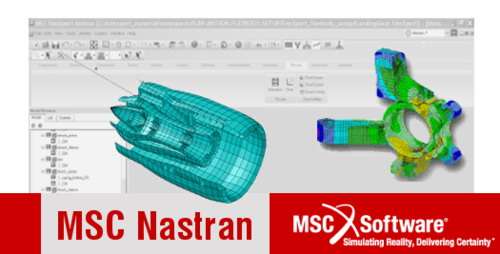
Download MSC Nastran 2025.2 – Advanced Structural Analysis Software
MSC Nastran 2025.2, developed by MSC Software, is a leading structural analysis software application designed for engineers and analysts in demanding industries. Leveraged across mechanical and manufacturing sectors, including aerospace, automotive, and civil engineering, this simulation software provides sophisticated capabilities for predicting product performance under various conditions.
Overview of MSC Nastran
MSC Nastran is a cornerstone in Computer-Aided Engineering (CAE), offering advanced Finite Element Analysis (FEA) tools. The software enables engineers to perform complex simulations, including linear and nonlinear static and dynamic analyses, and thermal analyses. Its primary purpose is to support the design and optimization of structures by simulating their behavior under diverse operational and environmental loads, thereby ensuring structural integrity and efficiency.
Key Features of MSC Nastran 2025.2
MSC Nastran 2025.2 provides a comprehensive suite of tools for advanced engineering simulations, focusing on precision and reliability. Its features are designed to support engineers through the entire product development lifecycle, from concept to validation.
- Advanced simulation capabilities enabling detailed performance prediction.
- Robust support for both linear and nonlinear analyses to accurately model material and geometric complexities.
- Comprehensive thermal, dynamic, and static analysis functionalities for simulating a wide range of physical phenomena.
- Seamless integration with explicit and implicit optimization tools and algorithms for design improvement.
Applications in Engineering
The advanced capabilities of MSC Nastran make it indispensable across multiple engineering disciplines. Its application spans from the initial design phases to the validation of complex systems, ensuring performance and safety standards are met.
- Aerospace: Used for analyzing aircraft structures, engine components, and simulation of flight conditions, ensuring aerodynamic efficiency and safety under extreme loads.
- Automotive: Applied in designing and optimizing vehicle bodies, chassis, and powertrain components for crashworthiness, noise, vibration, and harshness (NVH), and overall structural durability.
- Civil Engineering: Employed for the structural analysis of bridges, buildings, and infrastructure projects, simulating seismic activity, wind loads, and long-term structural stability.
- Manufacturing: Supports the design and performance simulation of industrial machinery, consumer products, and complex mechanical systems.
- Multidisciplinary Design: Facilitates integrated simulations that consider interactions between different physical domains, such as structural, thermal, and fluid dynamics, leading to optimized designs.
Comparison with Other Structural Analysis Software
MSC Nastran distinguishes itself in the structural analysis software market through its robust FEA solver and its emphasis on multidisciplinary simulation. While other software may offer specialized functionalities, MSC Nastran provides a powerful, integrated environment for a wide array of engineering challenges, particularly in static, dynamic, and thermal analysis.
Compared to some general-purpose simulation tools, MSC Nastran offers deeper capabilities for nonlinear analysis and complex material behavior. Its integrated approach, especially with adjacent MSC Software products like Simufact for manufacturing simulations and nCode for fatigue analysis, allows for a more holistic product development workflow, setting it apart from software that focuses on a single analysis type.
Real-World Case Studies
Companies across various sectors utilize MSC Nastran to drive innovation and achieve significant engineering milestones. The software plays a critical role in enhancing product design, ensuring reliability, and optimizing costs.
- A leading aerospace manufacturer employed MSC Nastran to optimize the structural design of a new aircraft wing, resulting in a weight reduction of 15% while maintaining stringent safety margins and improving fuel efficiency.
- In the automotive industry, MSC Nastran was instrumental in simulating occupant safety during crash tests, leading to improved vehicle designs that exceed regulatory safety requirements and enhance consumer confidence.
- A civil engineering firm used the software to analyze the long-term performance and seismic resilience of a major suspension bridge, verifying its structural integrity and sustainability under various environmental conditions.
Conclusion and Getting Started
MSC Nastran 2025.2 is an essential tool for engineers and analysts requiring precise and reliable structural analysis. Its advanced capabilities in Finite Element Analysis, coupled with its multidisciplinary approach, make it a critical component for optimizing designs, ensuring safety, and achieving cost-effectiveness in complex engineering projects.
To begin utilizing MSC Nastran for your structural analysis needs, it is recommended to consult the official MSC Software documentation and resources. Understanding the core functionalities, such as static, dynamic, and thermal analyses, and exploring its integration with optimization workflows will empower you to leverage its full potential in your specific engineering applications, whether in structural engineering, aerospace, or automotive design.
Frequently Asked Questions
What are the main capabilities of MSC Nastran 2025.2?
MSC Nastran 2025.2 provides advanced simulation capabilities, including static, dynamic, and thermal analysis, optimized through Finite Element Methods (FEM). Its features facilitate effective structural design and optimization for varied engineering fields.
How does MSC Nastran integrate with other engineering tools?
MSC Nastran can integrate with various design and simulation tools, enabling comprehensive simulations by incorporating data from CAD systems and enabling effective collaboration among multidisciplinary teams.
What industries benefit the most from using MSC Nastran?
Industries such as aerospace, automotive, civil engineering, and manufacturing leverage MSC Nastran for its precision in structural analysis and ability to simulate real-world conditions effectively.






Reviews
There are no reviews yet.