

Download MSC Simufact Additive 2025.4 – Metal Additive Manufacturing Simulation Software
MSC Simufact Additive 2025.4 is an advanced computer-aided engineering (CAE) application developed by Hexagon Manufacturing Intelligence, specializing in the simulation of metal additive manufacturing processes. This software is designed for engineers and researchers in the aerospace, automotive, medical, and energy sectors, providing high-fidelity simulation capabilities to predict and mitigate common issues in metal 3D printing, such as part distortion and residual stresses.
Advanced Simulation for Metal Additive Manufacturing Processes
MSC Simufact Additive plays a critical role in optimizing the production of metal parts through additive manufacturing. It specifically addresses the complexities inherent in processes like Powder Bed Fusion (PBF) and Directed Energy Deposition (DED). By simulating the entire build process, from powder deposition to post-processing heat treatments, the software enables users to achieve greater accuracy and efficiency. This is particularly vital for industries requiring high-performance components where material integrity and dimensional accuracy are paramount.
High-Fidelity Prediction of Distortion and Residual Stress
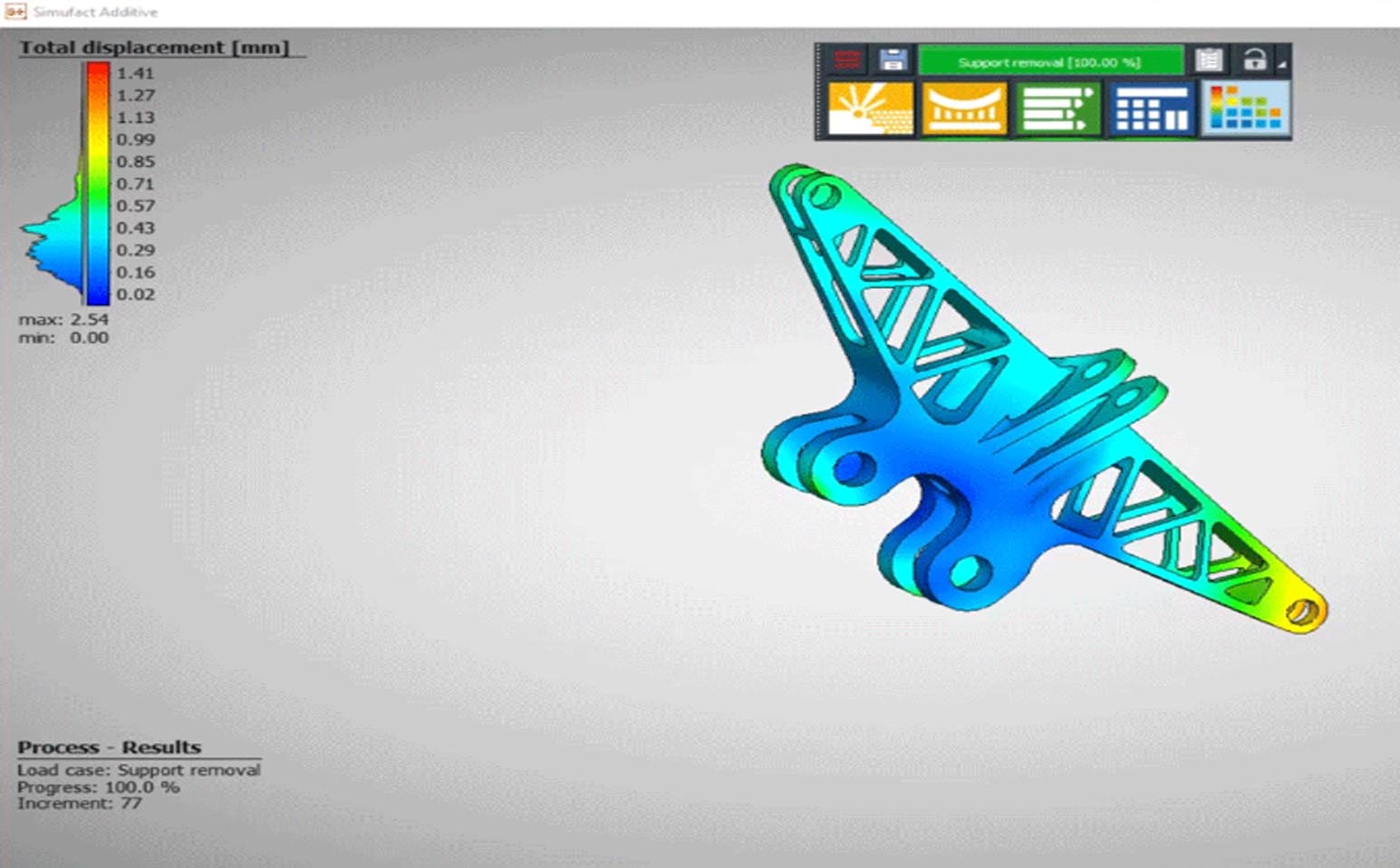
The accurate prediction of part distortion and residual stresses is a cornerstone of MSC Simufact Additive’s functionality. The software employs advanced solver technology, including multi-laser and multi-core simulation capabilities, to accurately model the thermal and mechanical phenomena that occur during the metal additive manufacturing process. This detailed simulation extends through post-processing stages like heat treatment, allowing engineers to anticipate and counteract potential issues before they impact the final part quality, thereby reducing the need for extensive physical prototyping and trial-and-error.
Automated and Optimized Support Structure Generation
Efficient support structure generation is crucial for successful metal additive manufacturing, impacting material consumption and post-processing efforts. MSC Simufact Additive provides intelligent tools that automatically generate optimized support structures. These AI-driven strategies aim to minimize the amount of support material required while ensuring build integrity and preventing defects. The software also facilitates the evaluation of different support removal strategies, contributing significantly to overall production efficiency and reducing post-processing time and costs.
Comprehensive Material Library and Accurate Material Modeling
Precise simulation outcomes are dependent on accurate material data. MSC Simufact Additive includes a comprehensive library of validated metal powder materials, featuring commonly used alloys such as Ti-6Al-4V and Inconel 718. The software utilizes detailed, temperature-dependent material properties to ensure the simulation accurately reflects real-world material behavior under the extreme thermal conditions of additive manufacturing. This focus on accurate material modeling allows for more reliable predictions of thermal effects, stress evolution, and final part performance.
Seamless Integration with Digital Manufacturing Ecosystems
To streamline complex digital workflows, MSC Simufact Additive is designed for seamless integration with other design and manufacturing tools. It interfaces effectively with major CAD platforms and Hexagon’s own simulation suite, including MSC Apex Generative Design and Simufact Welding & Forming. Support for industry-standard file formats like STL and 3MF further enhances interoperability, enabling a cohesive digital thread from design through to production for improved collaboration and efficiency.
Solver Performance and Future Process Enhancements
Hexagon Manufacturing Intelligence continually invests in advancing the solver technology within MSC Simufact Additive, focusing on enhancing simulation speed and robustness without compromising accuracy. This ongoing development ensures that engineers can perform complex simulations in a timely manner. Future enhancements are anticipated to include support for emerging additive manufacturing processes such as Binder Jetting and sintering simulation, reflecting a commitment to staying at the forefront of manufacturing simulation technology.
Real-World Use Cases in Aerospace, Medical, and Automotive Industries
MSC Simufact Additive is instrumental in driving innovation across demanding sectors. For the aerospace industry, it helps optimize lightweight yet strong structural components. In the medical field, precise simulation aids in the production of complex implants and surgical instruments. For the automotive sector, it supports the development of high-performance engine parts and customized components. In each case, the software contributes to reduced development cycles, optimized material usage, and enhanced part quality, ultimately lowering production costs and accelerating time to market.
Frequently Asked Questions
How does MSC Simufact Additive improve accuracy in metal 3D printing simulations?
MSC Simufact Additive utilizes advanced solver technology and detailed material modeling to predict part distortion and residual stresses accurately during printing and heat treatment. This simulation precision helps engineers reduce errors and improve the quality of printed metal components.
What metal additive manufacturing processes does MSC Simufact Additive support?
The software supports major metal additive manufacturing processes, including Powder Bed Fusion (PBF-LB/M) and Directed Energy Deposition (DED). Future releases are expanding capabilities to simulate Binder Jetting and sintering.
Can MSC Simufact Additive integrate with other CAD and manufacturing software?
Yes, MSC Simufact Additive offers seamless integration with major CAD platforms and Hexagon’s MSC Apex Generative Design and Simufact Welding & Forming tools. It also supports standard file formats such as STL and 3MF to enhance workflow efficiency.







Reviews
There are no reviews yet.