

Download MSC Simufact Forming 2025.4 – Comprehensive Metal Forming Simulation Software
MSC Simufact Forming 2025.4 is a specialized application designed for simulating metal forming processes within the manufacturing sector. Developed by MSC Software Corporation, this software assists professionals in the metal forming and manufacturing industries by providing powerful tools for process analysis and optimization. Its core function is to simplify complex simulation workflows, enabling efficient analysis of both hot and cold forming operations.
Introduction to MSC Simufact Forming
Overview of Metal Forming Simulation
Metal forming simulation is a critical tool in modern manufacturing, allowing engineers to predict the behavior of materials during deformation processes. By simulating these operations virtually, manufacturers can identify potential defects, optimize process parameters, and reduce the need for expensive physical prototypes. This analytical approach helps ensure product quality, shorten development cycles, and improve overall production efficiency in the metal forming industry.
MSC Simufact Forming provides an integrated environment to perform these complex simulations. It offers advanced capabilities to model various metal forming techniques, from initial material characterization to final product analysis. The software aims to make these powerful simulation tools accessible and efficient for engineers engaged in product design and manufacturing process development.
Key Features and Capabilities
MSC Simufact Forming offers a suite of specialized features designed to streamline the simulation of metal forming operations:
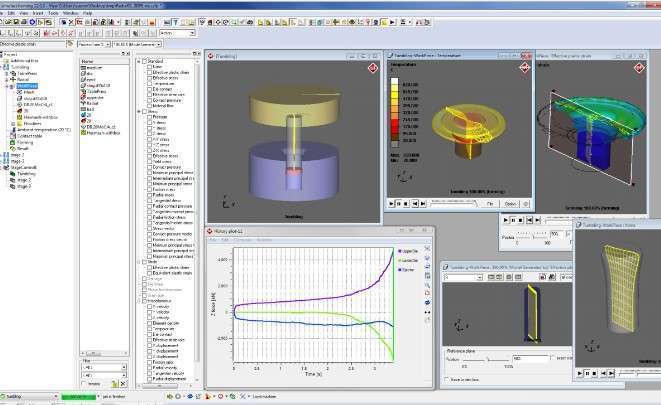
- Simplified user interface for enhanced usability: The software features an intuitive graphical user interface (GUI) that guides users through the simulation setup process. This design reduces the learning curve and allows for quicker model creation and analysis, even for complex forming scenarios.
- Support for hot and cold forming simulations: MSC Simufact Forming accommodates a wide range of manufacturing conditions, enabling accurate simulations for both high-temperature (hot forming) and room-temperature (cold forming) processes. This versatility covers diverse applications, from forging to stamping and extrusion.
- Integration with CAD formats for seamless design workflows: The software supports various industry-standard CAD file formats, facilitating the import of geometry from popular design software. This integration ensures that simulation models align precisely with design intent, enabling efficient collaboration between design and engineering teams.
- Advanced material modeling: Users can define and utilize detailed material properties, including temperature-dependent behavior and strain rate effects, for precise simulation of material responses.
- Real-time simulation feedback: The software provides immediate visual feedback on simulation progress and results, allowing engineers to identify critical areas and make informed adjustments swiftly.
Real-world Applications and Use Cases
MSC Simufact Forming is utilized across numerous applications within the metal forming industry. Its capabilities are essential for analyzing and optimizing a variety of manufacturing processes, leading to improved product performance and reduced production costs. Professionals leverage this engineering simulation tool for scenarios including:
- Automotive: Simulating the formation of car body panels, chassis components, and engine parts to ensure structural integrity and material performance under stress.
- Aerospace: Analyzing the precise forming of high-strength alloys for critical aircraft components, ensuring compliance with stringent safety and performance standards.
- Tool and Die Design: Optimizing the design of forging dies, stamping tools, and extrusion dies to predict tool wear, avoid defects, and maximize tool lifespan.
- Consumer Goods: Simulating the manufacturing of metal components for appliances, electronics, and household items, ensuring aesthetic quality and functional durability.
- General Manufacturing: Applying process analysis software to diverse metal shaping operations like rolling, deep drawing, and profiling for various industrial applications.
Efficient Project Management and Reporting
MSC Simufact Forming enhances project efficiency through robust management and reporting tools. Users can organize and manage multiple simulation projects effectively, track changes, and generate comprehensive analytical reports. The software facilitates easy comparison of different simulation scenarios, allowing engineers to select the optimal process parameters.
Key aspects of its project management capabilities include:
- Simulation Workflow Management: Tools to organize pre-processing, simulation runs, and post-processing stages, offering clarity and control over complex projects.
- Database for Material and Process Data: A centralized repository for material properties, tools, and process parameters, ensuring consistency and reusability across projects.
- Automated Report Generation: Customizable templates for generating detailed simulation reports that include key results, visualizations, and user annotations for stakeholder communication.
- Result Comparison Tools: Features that allow side-by-side comparison of outcomes from different simulation runs or variations in process parameters.
Comparative Analysis with Other Simulation Tools
When evaluating metal forming simulation software, MSC Simufact Forming distinguishes itself through its focus on user-centric design and comprehensive process analysis. While other engineering simulation tools may offer broader multi-physics capabilities, MSC Simufact Forming excels in providing deep functionality specifically for the intricacies of metal deformation.
Compared to general-purpose finite element analysis (FEA) software, MSC Simufact Forming offers specialized pre- and post-processing tools tailored for metal forming. This includes advanced meshing techniques for large deformations and specific result contours relevant to forming defects like crack formation or excessive thinning. Its integrated approach simplifies workflows that might require extensive customization or scripting in more generic platforms, thereby enhancing productivity for engineers focused on hot and cold forming operations.
Getting Started with MSC Simufact Forming
Initiating a new project in MSC Simufact Forming involves a structured approach to define the simulation accurately. The software guides users through essential steps, ensuring all necessary data is prepared before commencing the analysis.
The typical starting workflow includes:
- Project Setup: Defining project properties, units, and primary simulation objectives.
- Geometry Import: Loading CAD models of the workpiece and tooling into the software environment.
- Material Definition: Assigning appropriate material properties, considering temperature and strain rate dependencies.
- Process Definition: Setting up the forming operations, including machine kinematics, friction conditions, and boundary conditions.
- Meshing: Creating or refining the finite element mesh to ensure appropriate resolution for accurate simulation results.
This systematic process allows users to build complex simulation models and leverage the software’s capabilities effectively for analyzing their specific metal forming challenges.
Frequently Asked Questions
What types of simulations can MSC Simufact Forming perform?
MSC Simufact Forming specializes in simulating hot and cold metal forming processes, allowing users to analyze and optimize various production scenarios. The software supports operations like bending, forging, stamping, rolling, and extrusion, providing detailed insights into material behavior and process feasibility.
Is MSC Simufact Forming user-friendly for beginners?
While MSC Simufact Forming is tailored for users with technical expertise in metal forming, its intuitive user interface enables new users to navigate the software efficiently and perform simulations with minimal training. The guided workflows and clear visualization tools contribute to a more accessible simulation experience.
Can MSC Simufact Forming integrate with other CAD software?
Yes, MSC Simufact Forming allows for export in various CAD file formats, making it easier to collaborate with other design tools and seamlessly incorporate simulations into larger engineering workflows. This interoperability ensures that simulation models align with the original design data.








Reviews
There are no reviews yet.