

Nextnano Bundle 2026.02: Professional Semiconductor Nanodevice Simulation Software
Nextnano Bundle package (contains both nextnano++ package and nextnano NEGF package).
Nextnano Bundle 2026.02 is the complete professional simulation software suite for modeling electronic and optoelectronic semiconductor nanodevices . The bundle contains both the nextnano++ package and the nextnano.NEGF package, providing researchers with a comprehensive toolkit for designing, optimizing, and analyzing nanostructures from quantum wells to quantum cascade lasers .
The nextnano software is characterized by high performance, short runtimes, a Python API, seamless workflow integration, and an extensive material database . It is typically used for research purposes, particularly for structures containing quantum wells, quantum wires, quantum dots, p-n junctions, 2-dimensional electron gases, and other nanoscale configurations .
The Bundle 2026.02 release (February 2026) includes the latest versions of all simulation engines and supports Windows (native GUI), macOS (simulation tools only), and Linux (Ubuntu 20.04+)
???? Primary Users
This professional TCAD (Technology Computer-Aided Design) software suite is designed for:
-
Semiconductor Physicists & Nanotechnology Researchers modeling electronic and optoelectronic properties of quantum wells, wires, dots, and superlattices
-
Photonics & Optoelectronics Engineers designing LEDs, lasers, photodetectors, and solar cells at the nanoscale
-
Quantum Cascade Laser (QCL) Specialists performing precise simulations of QCLs, QCDs, and superlattices using NEGF method
-
Materials Scientists studying strain, band structure, and transport phenomena in heterostructures
-
Graduate Students & Postdoctoral Researchers in condensed matter physics and semiconductor device physics
⚡ Key Features & Capabilities
???? Two Comprehensive Packages in One Bundle
| Package | Primary Applications | Key Capabilities |
|---|---|---|
| nextnano++ Package | Quantum wells, wires, dots, LEDs, solar cells, MOSFETs | 1D/2D/3D simulations; k·p method (6-band, 8-band); strain & piezo effects; optical spectra; drift-diffusion |
| nextnano.NEGF Package | Quantum Cascade Lasers (QCLs), QCDs, superlattices, RTDs | Non-equilibrium Green’s Function formalism; quantum transport; gain clamping; photon-assisted transport |
???? nextnano++ Capabilities
The nextnano++ package provides tools for designing, optimizing, and analyzing optoelectronic nanodevices of arbitrary geometries in 1D, 2D, and 3D . Key features include:
-
Multi-Band k·p Model – 6-band and 8-band k·p Schrödinger-Poisson-Current solver for quantum mechanical simulations
-
Comprehensive Material Database – Group IV semiconductors (Si, Ge, SiGe); all III-V and II-VI binary compounds; ternaries, quaternaries, and quinternaries; zincblende and wurtzite crystal symmetries
-
Strain & Piezoelectric Effects – Pseudomorphic strain and minimization of elastic energy; piezo- and pyroelectric charges
-
Optical Spectra – Absorption, emission, and optical gain calculations
-
Transport Modeling – Drift-diffusion model for currents; recombination models (radiative, Shockley-Read-Hall, Auger)
-
Magnetic Field Support – Fully quantum mechanical electronic structure with magnetic fields
???? nextnano.NEGF Capabilities
The nextnano.NEGF package is a cutting-edge package specifically designed for modeling quantum transport in planar structures, making it the best choice for precise simulations of Quantum Cascade Lasers (QCLs) and Quantum Cascade Detectors (QCDs), Superlattices, and Resonant Tunnelling Diodes (RTDs) .
The tool is based on the non-equilibrium Green’s functions (NEGF) formalism (also known as the Keldysh, or Kadanoff-Baym formalism), which allows accounting for both quantum transport effects (i.e. coherent transport effects such as resonant tunneling), as well as scattering mechanisms .
Key NEGF capabilities include:
-
Scattering Mechanisms – Optical and acoustic phonons, charged impurities, interface roughness, alloy disorder, and electron-electron scattering
-
Self-Consistent Poisson Coupling – Mean-field electrostatic potential calculated simultaneously with Green’s functions
-
Gain Clamping – For quantum laser simulation; when modal gain reaches cavity losses, lasing starts and gain is clamped
-
Photon-Assisted Transport – Model electromagnetic mode interactions using self-consistent Born approximation
????️ nextnanomat GUI (Windows)
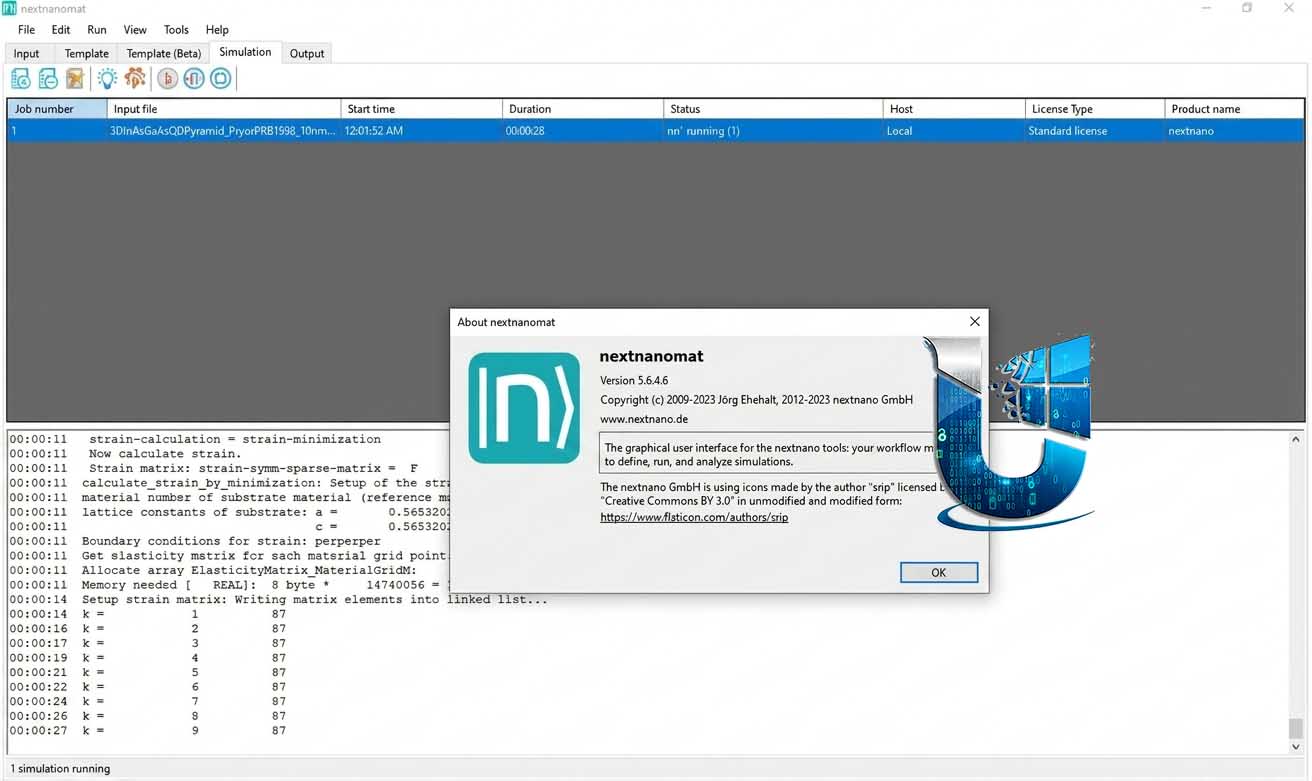
The nextnano software license includes access to hundreds of maintained example input files as well as tutorials featuring state-of-the-art physics and publications in semiconductor and quantum science . The nextnanomat GUI is a convenient graphical user interface that allows for 1D, 2D, and 3D visualizations of computed results .
???? Python Integration (nextnanopy)
For automated simulation processes, nextnano provides and maintains an open-source Python package nextnanopy, enabling seamless workflow integration and batch processing .
???? What’s New in Bundle 2026.02
Based on the official release information from nextnano:
| Package | Release Date | Version Details |
|---|---|---|
| nextnano bundle (Windows) | 2026-02-05 | nextnanomat 5.6.4.6 / nextnano++ 2.4.27.b / nextnano³ 2.7.2.s / nextnano.NEGF 2026-02-04.b |
| nextnano bundle (Linux) | 2026-02-05 | nextnano++ 2.4.27.b / nextnano³ 2.7.2.s / nextnano.NEGF 2026-02-04.a |
The 2026.02 release represents the latest stable bundle with updated simulation engines and continued support for Ubuntu 20.04 platforms





Reviews
There are no reviews yet.