

Power Plant Simulator & Designer 2025: Thermodynamic Process Simulation Software
Power Plant Simulator & Designer (PPSD) is commercial software developed by KED GmbH (Germany) for modeling thermodynamic cycles, steam generators, and power plant processes . First released in 1993 as a training simulator for power plants, PPSD has evolved into a comprehensive design and analysis tool used worldwide.
Software Overview
The software is distributed and supported by Tetra Engineering Group Inc. , which provides licensing, training, and technical support to users in North America and Europe . PPSD is used by boiler manufacturers, engineering firms, plant operators, and utilities for design, optimization, and performance evaluation of thermal power plants.
Recent versions include integration with MS Excel, VBA scripting, Java, and C++ for external access to calculation abilities, allowing PPSD to be integrated into DCS (Distributed Control Systems)
Primary Users
This professional thermodynamic simulation software is designed for:
-
Power Plant Engineers & Designers performing thermodynamic calculations and designing steam generators
-
Boiler OEMs & Manufacturers using the software for detailed design work
-
Plant Operators & Owners conducting performance monitoring, troubleshooting, and optimization studies
-
Engineering Consulting Firms evaluating heat recovery steam generator (HRSG) performance and root cause analysis
-
Research & Academic Institutions studying thermodynamic cycles and process behavior
⚡ Key Features & Capabilities
Supported Plant Types
| Plant Type | Description |
|---|---|
| Conventional Coal Boilers | Subcritical and supercritical designs |
| Natural & Forced Circulation Boilers | Both subcritical and supercritical pressure |
| Heat Recovery Steam Generators (HRSG) | Including once-through and Benson designs |
| Combined Cycle Power Plants | Gas and steam turbine combined cycles |
| Municipal Solid Waste Incinerators | Waste-to-energy plants |
| Biomass Boilers | Renewable fuel applications |
| Fluidized-Bed Combustion Boilers | CFB designs |
| Organic Rankine Cycles (ORC) | Waste heat recovery applications |
| Concentrated Solar Power Plants | Solar thermal applications |
Core Capabilities
-
Component Library – Over 60 different boiler and balance-of-plant elements (heat exchangers, attemperators, condensers, pumps, turbines, etc.)
-
Working Fluids – Supports single and two-phase fluids including water/steam (IAPWS-IF 97), over 20 gases (with real properties accounting for Joule-Thomson effect), and user-defined fluids
-
Fuel Database – Comprehensive database for coal, natural gas, oil, and user-defined fuels; multiple fuel types can be mixed prior to combustion
⚙️ Simulation Modes
| Mode | Description |
|---|---|
| Design Mode | Calculates design operating points based on geometrical and process values |
| Off-Design Mode | Computes partial load behavior of each component based on design point |
| Dynamic Mode | Simulates transient processes (start-ups, load changes, trips) as a function of time |
Advanced Analysis Capabilities
-
Thermal Radiation Modeling – Accounts for radiation from gases and dust/ash in boilers and gasifiers
-
Flow-Accelerated Corrosion (FAC) – Used for FAC assessments and determining natural circulation rates
-
Metal Temperature Profiles – Generates profiles for input to finite-element stress calculations
-
High Temperature Corrosion – Used for scrutinizing corrosion at municipal solid waste incineration plants
-
Steam Cycle Efficiency – Calculates according to ASME PTC, BS-845, or other thermal performance codes
-
Fouling & Gas Bypass Detection – Identifies performance issues in operating plants
User Interface & Integration
-
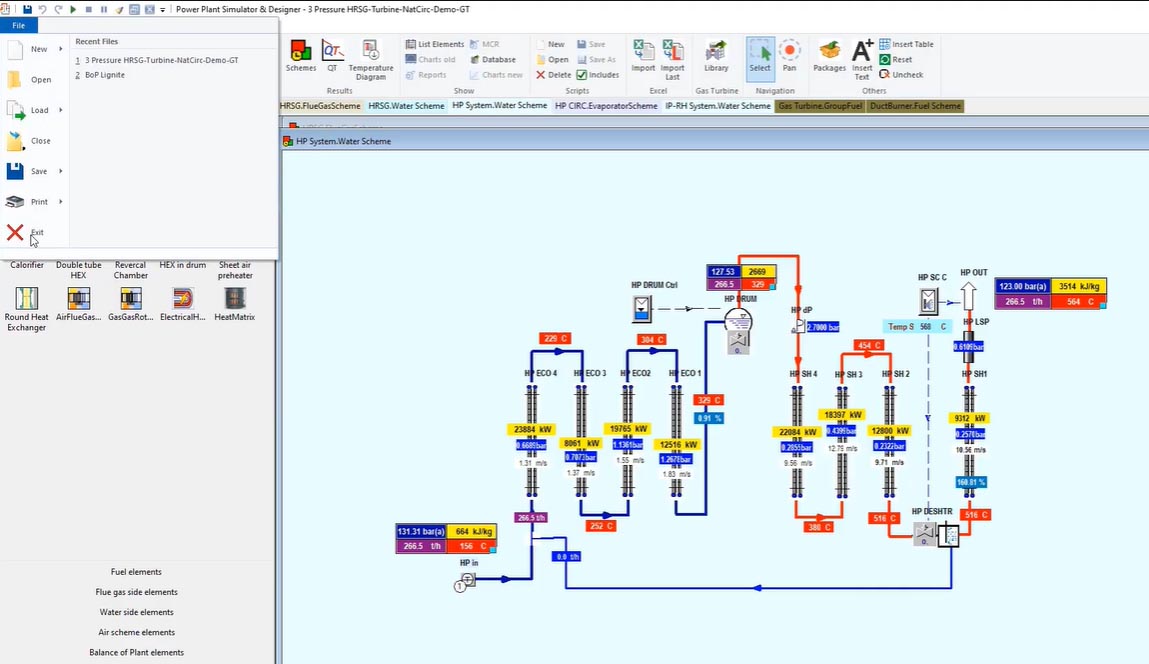
Graphical User Interface – Drag-and-drop component placement with visual connection linking
-
Hierarchical Modeling – Components can be assigned to groups, permitting unlimited hierarchical layers
-
Excel Integration – Model input and output data easily linked to Excel worksheets
-
External Programming Interfaces – Access calculation abilities via VBA, Java, C++
-
Scripting – Components can be extended with Visual Basic script






Reviews
There are no reviews yet.