

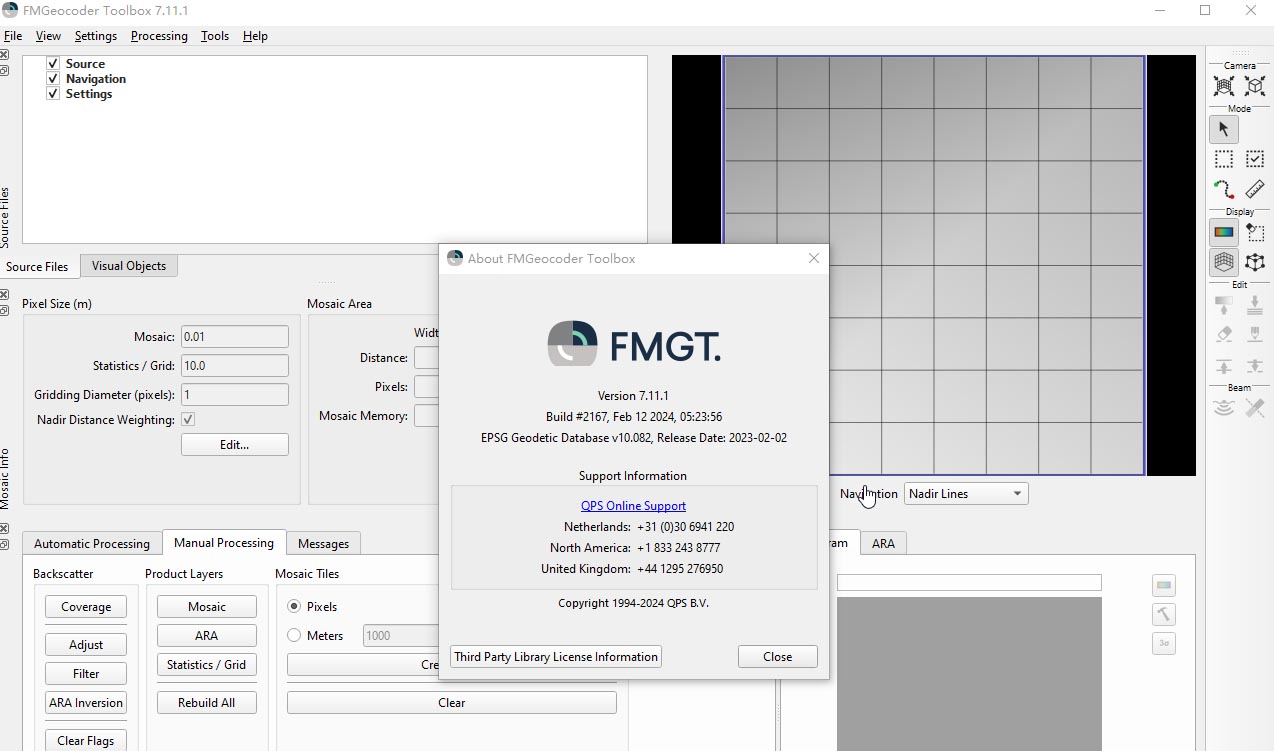
QPS FMGT 7.11.3: Fledermaus Geocoder Toolbox for Multibeam Backscatter Processing
QPS FMGT (Fledermaus Geocoder Toolbox) 7.11.3 is the dedicated multibeam backscatter processing engine of QPS’s Fledermaus software suite. Released in December 2025 , this version focuses on compatibility updates, ensuring seamless data exchange with the latest QPS ecosystem releases (Qinsy 9.8.0 and Qimera 2.8.0) .
While bathymetric (water depth) processing is handled by sister products like Qimera, FMGT specializes in the geometric and radiometric correction of acoustic backscatter strength to create seamless, angle-corrected seabed imagery. This allows geoscientists and surveyors to distinguish between different sediment types (e.g., hard rock vs. soft mud) for habitat mapping, geological analysis, and offshore infrastructure planning.
???? Primary Users
This professional hydrographic software is designed for:
-
Hydrographic Surveyors & Marine Geophysicists processing and analyzing multibeam echo sounder (MBES) backscatter data to produce georeferenced mosaics for seabed characterization.
-
Offshore & Marine Engineers assessing seafloor geology for cable routing, pipeline inspection, and offshore wind farm development.
-
Environmental Scientists & Benthic Habitat Mappers classifying seabed sediments to support marine spatial planning and ecosystem modeling.
-
Academic & Research Institutions conducting deep-sea exploration and geological mapping.
-
Government & Defense Agencies performing nautical charting, mine countermeasures, and coastal zone management.
⚡ Key Features & Capabilities
???? Backscatter Processing Engine
FMGT applies rigorous radiometric corrections to raw sonar data to ensure that the final imagery reflects the true acoustic properties of the seabed rather than artifacts of the collection method. Key corrections include:
-
Beam Pattern Correction – Normalizes the varying sensitivity of individual sonar beams across the swath.
-
Angle-Varying Gain (AVG) – Adjusts for spherical spreading and time-varied gain to flatten the backscatter response.
-
Slope Correction – Uses an imported bathymetric grid to correct for the true incidence angle of the acoustic pulse on a sloping seabed, removing topographical artifacts.
????️ Mosaic Generation & Visualization
-
Source File Management: Users load raw data or processed GSF files. The system reads navigation, attitude (roll, pitch, heave), and sound velocity to spatially locate each sounding.
-
Mosaicking Algorithm: Employs configurable algorithms to reduce banding artifacts and apply line blending, smoothing pixel transitions between adjacent track lines.
-
Pixel Resolution Control: The Mosaic Information Panel allows users to edit mosaic and statistic pixel sizes. The software pre-computes a suggested pixel size based on sonar configuration, but custom resolutions can be applied. The Gridding Diameter setting determines the size of the gridding window for statistics (e.g., a 3-pixel window means a 3×3 box will be averaged) .
-
Weighting Options: Nadir Distance Weighting determines the influence of samples based on their distance from nadir (the point directly under the vessel), allowing users to prioritize data from the outer edges of the swath .
???? Technical Configuration & Pre-Processing
-
Memory Management: The interface displays the amount of memory required to allocate the mosaic for processing. A green indicator signifies that the project is within the operational limits of the current system .
-
Workflow Integration: Tightly integrates with Qimera. Engineers typically use Qimera to clean bathymetry and generate a Digital Terrain Model (DTM), which is then fed into FMGT to perform slope-correction on the backscatter.
???? Analysis & Export
-
Angular Response Analysis (ARA): This technique analyzes backscatter strength vs. incidence angle. Variations in the ARA curve correlate strongly with sediment grain size (e.g., sand vs. mud), making it a powerful tool for automated seabed classification.
-
Export Formats: Generates georeferenced outputs including GeoTIFF mosaics and ASCII grids, which can be integrated into GIS software for further analysis and interpretation.






Reviews
There are no reviews yet.