

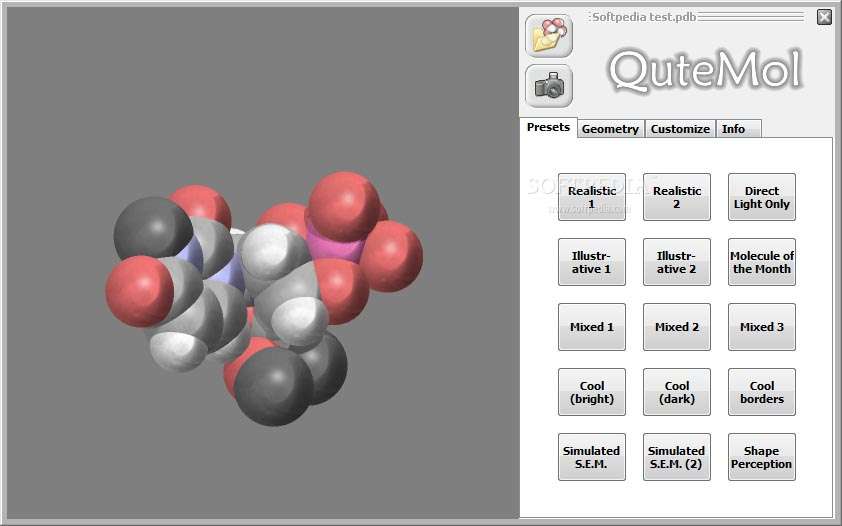
Download QuteMol 0.4.1 – Advanced Molecular Visualization Software
QuteMol 0.4.1 is an open-source molecular visualization software designed for advanced rendering of molecular structures, particularly biomolecules. Developed by contributors in the scientific visualization community, it is utilized across chemistry, biochemistry, molecular biology, and drug discovery research. This software provides enhanced visual techniques, such as ambient occlusion, to improve depth perception and spatial understanding, making it a valuable tool for academic research and scientific communication.
Understanding Molecular Visualization with QuteMol
Molecular visualization software plays a critical role in comprehending the three-dimensional structures of molecules. QuteMol addresses this need by offering specialized graphics capabilities that go beyond basic representations. Its primary purpose is to render molecular structures with exceptional clarity, facilitating a deeper analysis of complex arrangements. This focus makes QuteMol instrumental in fields where intricate molecular details are paramount, including computational chemistry and structural biology.
Illustrative Rendering and Ambient Occlusion Techniques
QuteMol distinguishes itself through its implementation of advanced rendering techniques, most notably ambient occlusion. This lighting approximation method simulates how light is blocked by surrounding geometry, casting soft shadows that enhance the perception of depth and surface detail. Unlike simpler molecular viewers that might present wireframe or basic ball-and-stick models, QuteMol leverages ambient occlusion to imbue molecular visualizations with a greater sense of volume and spatial complexity. This approach aids users in discerning the intricate relationships between atoms and functional groups within macromolecules.
Supported Molecular Representations and File Compatibility
To accommodate diverse visualization needs, QuteMol supports various molecular representation styles. These include common formats such as:
- Ball-and-stick models, illustrating atomic connectivity and relative size.
- Space-filling (CPK) models, representing atomic van der Waals radii.
- Ribbon and cartoon representations, ideal for visualizing protein secondary structures like helices and sheets.
- Surface representations, showing the molecular envelope or electrostatic potential.
The software is natively compatible with the Protein Data Bank (PDB) file format, which is standard for storing experimental and computational data on protein and nucleic acid structures. Version 0.4.1 also includes expanded support for additional molecular file formats common in scientific research.
Interactive Visualization and Performance Features
QuteMol is engineered for efficient interaction with large and complex molecular datasets. It features real-time, GPU-accelerated rendering, allowing users to manipulate, rotate, and zoom into structures without significant lag. This performance is crucial for detailed exploration of macromolecules like proteins and DNA. The improvements in version 0.4.1 specifically target enhanced rendering speed and responsiveness, ensuring a smooth user experience even with very large biomolecular models.
Use Cases in Scientific Research and Education
The comprehensive visualization capabilities of QuteMol make it suitable for a range of applications in both research and education. Researchers in computational chemistry and structural biology utilize it for analyzing protein-ligand interactions, visualizing drug-target complexes, and interpreting structural data from experiments. In academic settings, QuteMol serves as an educational tool for students and educators to understand fundamental chemical and biological structures. Its illustrative output is also beneficial for creating high-quality figures and presentations for scientific publications and lectures.
Recent Updates and Improvements in Version 0.4.1
Version 0.4.1 of QuteMol introduces several key enhancements designed to improve usability and performance. This release focuses on:
- Optimized rendering speeds, particularly for complex scenes, resulting from GPU acceleration refinements.
- User Interface (UI) improvements for more intuitive navigation and control.
- Expanded compatibility with a wider array of molecular file formats, simplifying data import.
- General performance tuning and bug fixes to ensure a more stable and efficient visualization experience across different operating systems.
Comparing QuteMol to Other Molecular Visualization Tools
While many molecular viewers exist, QuteMol stands out due to its emphasis on illustrative rendering styles. Unlike viewers that primarily offer basic wireframe or simplified representations, QuteMol employs techniques like ambient occlusion to provide more visually rich and spatially accurate depictions of molecular architecture. This focus on enhanced depth perception and detail makes it particularly useful for users who require sophisticated graphical representations for analysis and communication, setting it apart from tools geared towards simpler structural viewing or manipulation.
Frequently Asked Questions
How does QuteMol improve molecular structure visualization compared to traditional tools?
QuteMol uses ambient occlusion rendering to enhance depth perception and spatial clarity, making complex molecular structures easier to interpret compared to standard wireframe or ball-and-stick models. This technique simulates soft shadows, giving a more realistic and understandable representation of three-dimensional shapes and relationships between atoms.
What file formats does QuteMol support for importing molecular data?
QuteMol primarily supports Protein Data Bank (PDB) files, the standard for biological macromolecular structures. Version 0.4.1 has been updated to expand compatibility with additional common molecular file formats, simplifying the process for users to import and visualize diverse datasets.
Is QuteMol suitable for both educational and professional scientific use?
Yes, QuteMol caters to students, educators, academic researchers, and computational scientists by providing interactive visualization tools that are useful for learning, teaching, and advanced molecular research. Its clear graphical output and performance capabilities support both introductory understanding and in-depth scientific analysis.






Reviews
There are no reviews yet.