

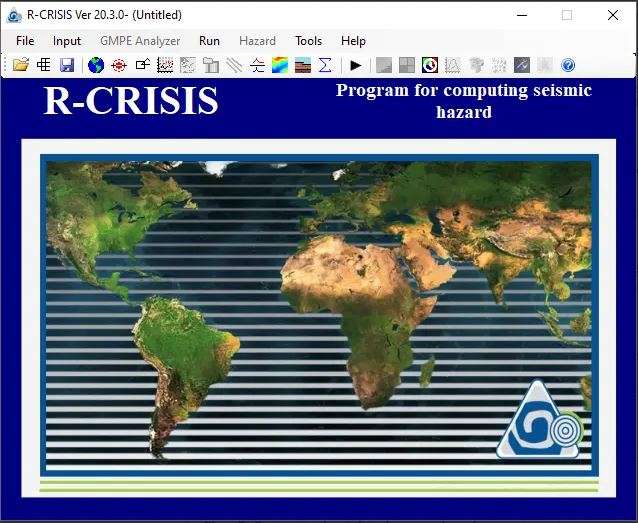
Download R-Crisis 20.3.0 – Advanced Probabilistic Seismic Hazard Analysis Software
R-Crisis 20.3.0 is a specialized software application developed by ERN, founded by Professor Mario Ordaz, designed for advanced Probabilistic Seismic Hazard Analysis (PSHA). It caters to professionals and researchers in seismology and earthquake engineering, providing sophisticated tools to assess and manage earthquake risks. With over 30 years of development history, R-Crisis represents a significant evolution in seismic analysis software.
Introduction to R-Crisis
Background and Evolution
R-Crisis is the culmination of extensive research and development in seismic hazard analysis, tracing its origins back over three decades. Initially developed as a command-line tool, its evolution into R-Crisis 20.3.0 has significantly enhanced its accessibility and functionality, primarily through the introduction of a user-friendly graphical interface. This progression underscores its ongoing relevance and adaptation to the needs of seismologists and earthquake engineers worldwide.
Key Features of R-Crisis
Probabilistic Modeling Capabilities
The core strength of R-Crisis lies in its robust probabilistic modeling capabilities. It employs established methodologies to perform Probabilistic Seismic Hazard Analysis, allowing users to quantify the likelihood of seismic events occurring within specific parameters. This includes detailed assessments of earthquake recurrence, ground motion prediction, and site-specific response analysis, forming the bedrock of comprehensive risk evaluation.
User-Friendly Interface
Significant improvements have been made to the user experience with the graphical interface of R-Crisis 20.3.0. This modern interface streamlines the complex process of seismic hazard assessment, making advanced analytical tools more accessible. Users can navigate through different analysis modules, input data, and visualize results with greater ease compared to earlier command-line versions, enhancing efficiency and reducing the learning curve.
Comprehensive Analysis Tools
R-Crisis offers a suite of specialized tools designed to address various aspects of seismic hazard and risk assessment. These tools support detailed analyses, including the identification of seismic sources, the selection and application of ground motion prediction equations (GMPEs), and the computation of hazard curves. The software is engineered to handle intricate datasets and complex calculations inherent in seismic risk evaluations.
Application and Use Cases
Industry Applications
The R-Crisis software is extensively utilized across several sectors that require rigorous earthquake risk assessment. Key industries include civil engineering, structural engineering, geotechnical engineering, and urban planning. It is indispensable for projects involving critical infrastructure, such as dams, bridges, power plants, and high-rise buildings, where understanding seismic vulnerability is paramount for safety and resilience.
Real-World Use Cases
In real-world applications, R-Crisis has been instrumental in conducting seismic hazard assessments for major infrastructure projects and regional-scale studies. For instance, it is employed to define seismic design parameters for new constructions in earthquake-prone zones, aiding engineers in designing structures that can withstand seismic forces. Furthermore, it supports the re-evaluation of seismic risks for existing facilities, guiding retrofitting strategies and emergency preparedness plans.
Comparison with Other PSHA Software
R-Crisis distinguishes itself from other PSHA software through its extensive development history, reliable performance, and a user interface that balances sophisticated functionality with accessibility. While other tools may offer specialized features, R-Crisis provides a proven, comprehensive platform with over 30 years of scientific backing. Its focus on clear probabilistic modeling and direct application in earthquake engineering makes it a trusted choice for professionals who require dependable risk analysis.
Continuing Evolution of R-Crisis
ERN continues to support and develop R-Crisis, ensuring it remains at the forefront of seismic hazard analysis technology. This ongoing commitment involves incorporating the latest research findings in seismology and earthquake engineering into the software. Updates are periodically released to enhance analytical capabilities, improve performance, and adapt to evolving standards and methodologies in the field, ensuring R-Crisis remains a state-of-the-art tool.
Conclusion
R-Crisis 20.3.0 stands as a vital tool for professionals engaged in earthquake risk assessment and management. Its blend of advanced probabilistic seismic hazard analysis capabilities, a refined user interface, and a long-standing history of reliable application makes it an essential software for ensuring structural integrity and public safety in seismically active regions. The continuous development by ERN further solidifies its position as a leading solution in earthquake engineering and seismology.
Frequently Asked Questions
What is R-Crisis and what does it do?
R-Crisis is a software solution designed for conducting Probabilistic Seismic Hazard Analyses (PSHA), helping users assess and manage earthquake risks using sophisticated probabilistic modeling techniques. It provides a comprehensive framework for analyzing seismic hazards and their potential impact.
How does R-Crisis differ from the original CRISIS software?
R-Crisis is the modern iteration of the original CRISIS software, featuring a more user-friendly graphical interface and additional capabilities that incorporate advancements in seismic analysis over the years. This evolution makes complex PSHA more accessible and efficient to perform.
Who can benefit from using R-Crisis?
R-Crisis is beneficial for engineers, researchers, and professionals involved in seismology, earthquake engineering, and risk management, providing them with tools to effectively analyze and mitigate earthquake-related risks. Its detailed analytical power supports informed decision-making in high-risk environments.






Reviews
There are no reviews yet.