

Download Remcom XFDTD 7.11 – Advanced Electromagnetic Simulation Software for FDTD Analysis
Remcom XFDTD 7.11 is a comprehensive electromagnetic simulation software developed by Remcom Incorporated, a company founded by Dr. Raymond J. Luebbers. This sophisticated application is designed for engineers and researchers working with electrical and electronics applications, specifically utilizing the Finite Difference Time Domain (FDTD) method. Originated in the mid-1990s, XFDTD has become a critical tool in fields such as telecommunications, radar systems, medical imaging, RF engineering, photonics, and defense, enabling detailed analysis of electromagnetic wave propagation and interactions within complex, three-dimensional structures.
Comprehensive Electromagnetic Modeling for Advanced Engineering Applications
Remcom XFDTD provides a robust platform for electromagnetic simulation, built upon the foundational Finite Difference Time Domain (FDTD) numerical method. This approach allows for the accurate solution of Maxwell’s equations in both time and frequency domains, offering deep insights into how electromagnetic waves behave when interacting with various structures and materials. The software has evolved to serve a broad spectrum of high-technology industries, including telecommunications for antenna design and propagation analysis, medical imaging for understanding device interactions within the human body, radar system development, and military applications requiring precise electromagnetic field simulations.
Advanced Simulation Capabilities and Multi-Physics Integration
Full Wave and Time-Domain Analysis
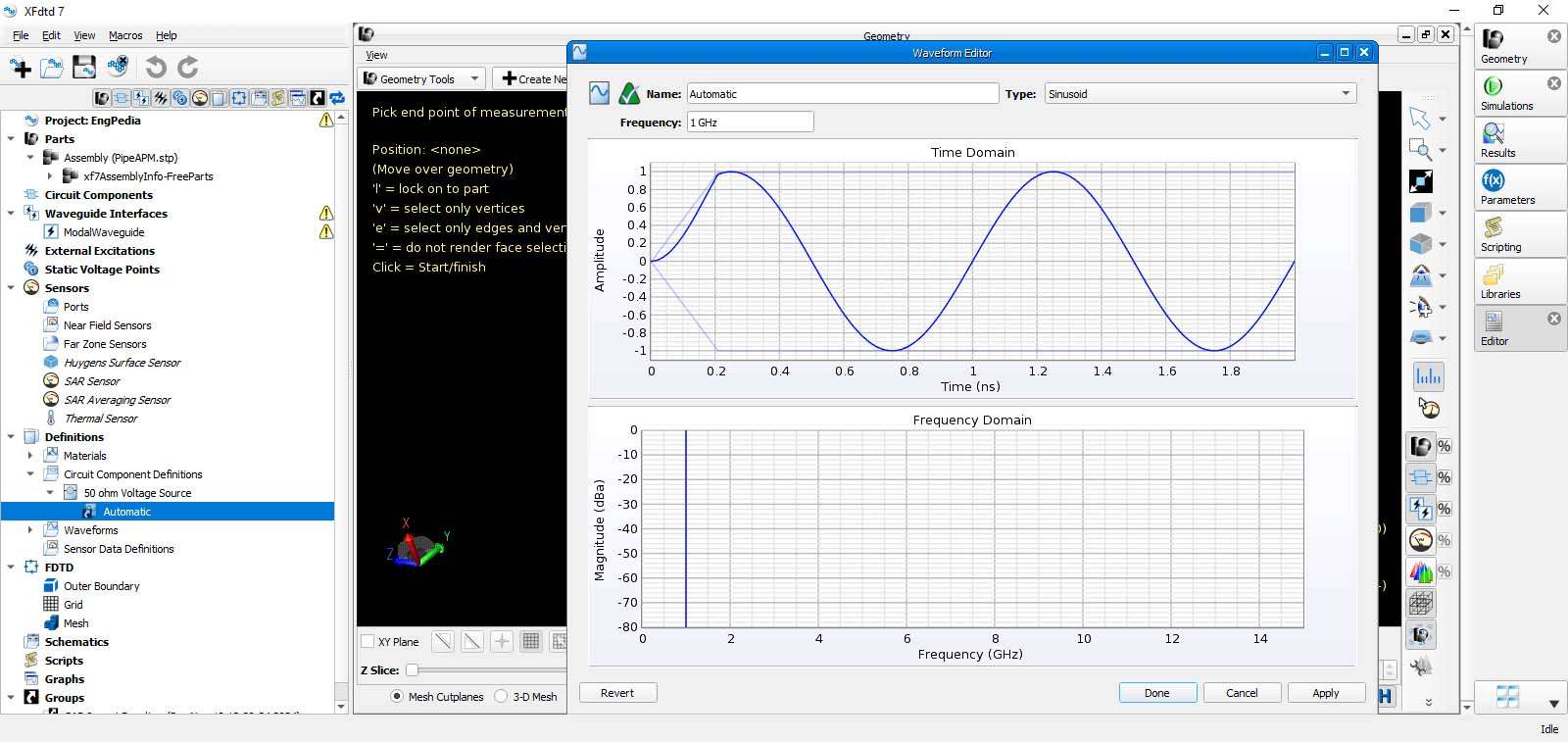
XFDTD specializes in full-wave electromagnetic analysis, leveraging the FDTD method to simulate wave propagation with high fidelity. This capability is crucial for understanding transient electromagnetic phenomena and analyzing system performance across a wide range of frequencies. The software supports both time-domain simulations, which visualize the step-by-step evolution of electromagnetic fields, and frequency-domain analysis, which provides steady-state performance characteristics.
Multi-Layer and Complex Material Modeling
The software excels at simulating scenarios involving multi-layer structures composed of diverse materials. This includes modeling complex electromagnetic behaviors, such as those found in metamaterials, or analyzing interactions within biological tissues for medical applications. XFDTD’s material modeling capabilities enable engineers to define custom material properties, including frequency-dependent permittivity and permeability, essential for accurate simulations across various applications.
Additional Solver Integrations
Beyond its core FDTD solver, Remcom XFDTD integrates a suite of complementary solvers. These include electrostatic solvers for static field analysis, thermal-biological solvers that model heat deposition and temperature effects from electromagnetic exposure, and circuit solvers for incorporating RLC components directly into EM simulations. Furthermore, it offers 2D Eigen solvers and can integrate with physically based ray-tracing methods, such as Geometrical Optics (GO) and Geometric Theory of Diffraction (GTD)/Uniform Theory of Diffraction (UTD), to efficiently model wave propagation in large-scale or open environments.
Applications in Antenna Design and RF System Optimization
XFDTD is extensively utilized for the design and optimization of antennas and communication systems. Engineers can model intricate antenna geometries, such as phased arrays, conformal antennas, and mobile device antennas, to predict and refine critical performance metrics. These include radiation patterns, input impedance, gain, and efficiency. The software’s ability to simulate antennas within realistic environments, considering ground effects, surrounding structures, and material impacts, is vital for ensuring optimal real-world performance in telecommunication systems, radar applications, and satellite communications.
Modeling Wave Propagation and Complex Environments
Simulating electromagnetic wave propagation through heterogeneous and irregular environments is a key strength of XFDTD. The software allows for detailed analysis of how signals travel, scatter, and attenuate in complex scenarios, such as urban canyons or indoor penetration. This capability is critical for understanding interference, minimizing signal loss, and calculating power absorption in various systems, aiding in the design of robust wireless communication networks, effective radar systems, and safe electromagnetic exposure devices.
Comparison with Other Electromagnetic Simulation Tools by Remcom
Remcom offers a suite of electromagnetic simulation tools, with XFDTD being its primary FDTD-based solution. For simulating wave propagation in large, open environments like urban terrains or through complex atmospheric conditions, Remcom also provides XGtd. While XFDTD uses detailed electromagnetic field solvers (like FDTD, GO, GTD/UTD), XGtd specifically employs Geometrical Optics and its extensions for efficient, high-fidelity ray-tracing propagation simulations. The selection of XFDTD or XGtd often depends on the scale of the problem, the required level of detail, and the specific electromagnetic phenomena being investigated.
Industry Impact and Research Innovations Behind XFDTD
Remcom Incorporated, co-founded by Dr. Raymond J. Luebbers, a pioneer in electromagnetic simulation research, has established a reputation for innovation in electromagnetic software. XFDTD embodies this legacy, providing advanced simulation capabilities that find application in cutting-edge research and demanding industrial projects. The software’s consistent development, driven by academic contributions and industrial needs, has cemented its role as a trusted tool for tackling complex electromagnetic challenges across critical sectors like defense, telecommunications, and emerging fields such as nanotechnology.
Frequently Asked Questions
What is the Finite Difference Time Domain (FDTD) method used in Remcom XFDTD?
The FDTD method is a numerical technique for solving Maxwell’s equations to simulate electromagnetic wave interactions in three-dimensional space over time. XFDTD uses this method to provide precise, time-domain analysis of wave propagation, antenna performance, and electromagnetic compatibility. This approach allows for detailed visualization of field dynamics and accurate characterization of system responses.
How does XFDTD support antenna and communication system design?
XFDTD allows detailed modeling of antenna structures and their electromagnetic field behavior, enabling optimization of performance parameters such as gain, impedance, and radiation patterns. It provides tools for simulating complex environments and material effects on antenna operation, facilitating the development of high-performance antennas for various communication applications.
Can Remcom XFDTD simulate electromagnetic effects in biomedical and nanotechnology fields?
Yes, XFDTD supports simulations involving biological tissues and nanostructures, offering multi-layer and frequency-dependent material modeling. This capability aids in medical imaging system design and nanotechnology research involving electromagnetic interactions, allowing engineers to analyze phenomena at various scales with precision.




Reviews
There are no reviews yet.