

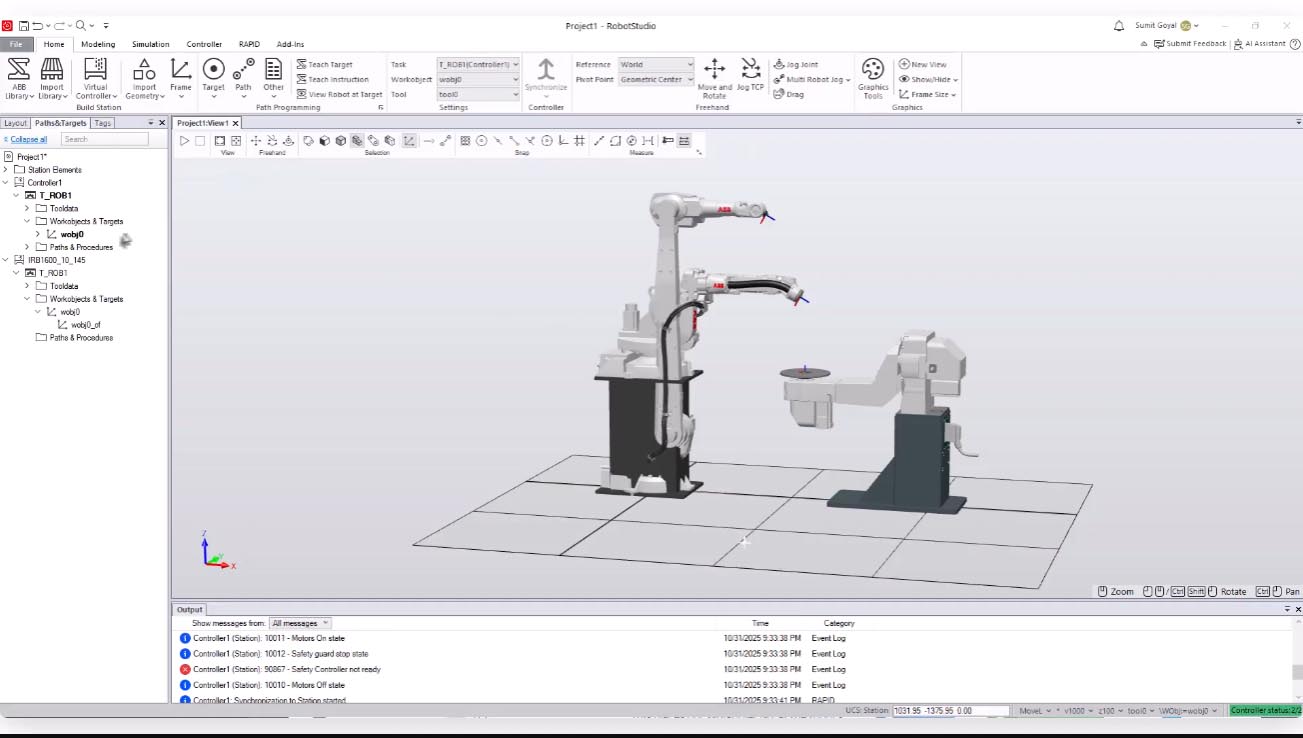
ABB RobotStudio 2026.1 – Industry-Leading Offline Programming and Simulation Software for Industrial Robots
RobotStudio is ABB Robotics’ flagship software platform for modeling, offline programming, and simulation of robotic cells. It is used by more than 60,000 robotics engineers worldwide , making it one of the most widely adopted industrial robotics programming tools in the market.
The 2026.1 version is the first official release of the 2026 product generation, succeeding the 2025.x family. This release introduces a completely new licensing system and establishes the foundation for the upcoming RobotStudio HyperReality integration with NVIDIA Omniverse , which is scheduled for release in the second half of 2026.
RobotStudio 2026.1 supports .NET 10 for add-in development, marking a shift from the .NET Framework 4.8 . The SDK and PC SDK have been updated to support the new development environment. As of this release, Integrated Vision is not supported, and users with older robots requiring this feature should continue using RobotStudio 2025.5 . Educational licenses will also be supported from RobotStudio 2026.2 onwards.
Primary Users
RobotStudio 2026.1 is designed for automation engineers, production line designers, robot programmers, system integrators, and manufacturing professionals who work with ABB industrial robots. It serves professionals who:
-
Design and simulate robotic cells for welding, painting, palletizing, and assembly applications
-
Program robots offline to minimize production downtime
-
Optimize robotic paths and cycle times through accurate physics-based simulation
-
Train robot operators without using physical equipment
-
Commission and validate automation cells virtually before deployment
Key Features & Capabilities
Offline Programming and Simulation
-
Virtual Controller: ABB is the only robot manufacturer with a virtual controller running the same firmware as the physical hardware, delivering up to 99% correlation between simulation and real-world behavior
-
Cell Design and Modeling: Create and configure complete robot cells with peripheral equipment (grippers, sensors, conveyors, machine tools) using SmartComponents
-
Path and Cycle Time Optimization: Test and refine robot programs in simulation before deployment
-
Singularity and Reach Analysis: Validate that programmed paths are physically achievable
RobotStudio 2026.1 New Features
-
New Licensing System: Transitioned to Robotics One account-based licensing with Enterprise (user-based) and Node-Locked options. A licensing portal is available at
https://softwarelicenses.robotics.abb.com/ -
.NET 10 Support: Add-ins must target .NET 10 for compatibility with RobotStudio 2026.1 or later
-
Support Tool Update: New proxy configuration settings in RobotStudio 2026 Support Tool to resolve license access issues
-
SMART Components and ScreenMaker: Enhanced library of pre-defined components and ability to create custom FlexPendant interfaces without programming knowledge
RobotStudio 2026.1 Known Limitations
-
Integrated Vision Not Supported: Users requiring Integrated Vision should stay on RobotStudio 2025.5
-
Educational Licenses: Planned for RobotStudio 2026.2; schools and universities should continue using 2025.5
-
Network License Migration: Multi-user and partner licenses are being migrated; standalone licenses have already been migrated
-
Activation Code Naming: The 5×5 code in order confirmations is called “ticket” (not “activation code”)
RobotStudio HyperReality (Coming H2 2026)
-
NVIDIA Omniverse Integration: Access to physics simulation and photorealistic scene generation libraries
-
USD Export: Parameterized robot stations exported to Omniverse with robots, sensors, lighting, kinematics, and parts
-
Synthetic Data Generation: Train vision models entirely in simulation, reducing need for real-world image capture
-
Significant Benefits: Up to 40% cost reduction, 50% faster time-to-market, and 80% reduction in setup and commissioning times






Reviews
There are no reviews yet.