
Download Reflex 10.2 – Advanced Software for Seismic and GPR Processing
Reflex 10.2 is a specialized software application developed by Sandmeier Geophysical Research, designed for advanced processing and interpretation of geophysical data. Tailored for professionals in geophysical research, seismology, and Ground Penetrating Radar (GPR) applications, this software provides sophisticated tools crucial for analyzing wave data. Its primary focus on near-surface geophysics makes it an essential tool for detailed geological and environmental surveys.
Introduction to Reflex 10.2 and Its Applications
Overview of Sandmeier Geophysical Research
Sandmeier Geophysical Research is a company dedicated to developing advanced algorithms and software solutions for the geophysics industry. Their work focuses on creating powerful tools that enable robust analysis of seismic and GPR data, supporting breakthroughs in geophysical research through sophisticated signal processing techniques.
Comprehensive Wave Data Processing Capabilities
Types of Data Supported
Reflex 10.2 is engineered to handle a wide spectrum of wave data essential for geophysical analysis. Its versatility allows for detailed examination of subsurface structures across various geological conditions and applications.
- Seismic Data: Supports both seismic reflection and refraction surveys, crucial for subsurface imaging and geological structure mapping.
- Ground Penetrating Radar (GPR): Offers specialized processing for GPR data, enabling high-resolution imaging of shallow subsurface features.
- Ultrasound Data: Capable of processing ultrasound wave data, useful in material testing and non-destructive evaluation.
- Borehole Data: Integrates and processes measurements obtained from boreholes, providing integrated subsurface profiles.
Key Features and Functionality
GPR Processing and Interpretation Features
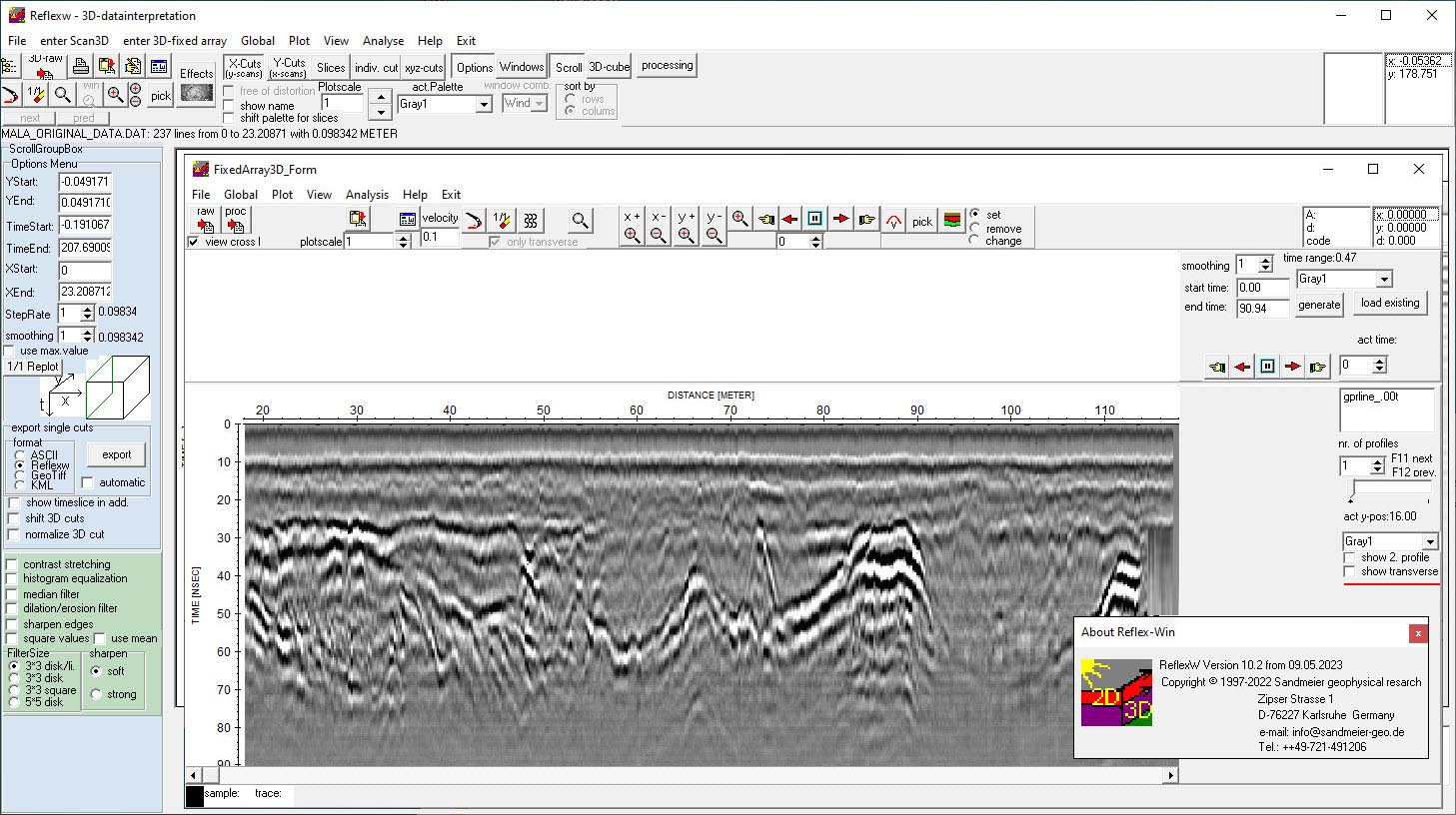
Reflex 10.2 provides an extensive suite of tools specifically designed for Ground Penetrating Radar (GPR) data, facilitating in-depth analysis and interpretation of shallow subsurface environments.
- Over 130 specialized processing steps tailored for GPR data analysis.
- Interactive velocity adaptation to fine-tune data characteristics.
- Full GPS support for precise georeferencing of GPR surveys.
- Advanced filters and gain functions to enhance signal quality and target visibility.
Seismic Reflection Processing Options
The software includes a robust set of functionalities for seismic reflection data, enabling professionals to achieve high-quality subsurface imaging and detailed structural analysis.
- Advanced prestack processing capabilities to improve data signal-to-noise ratio.
- Interactive velocity analysis tools for accurate reflector positioning.
- Comprehensive NMO-correction (Normal Moveout) techniques to align reflections across different offsets.
- Support for various seismic acquisition geometries.
Seismic Refraction Processing Techniques
Reflex 10.2 offers specialized methodologies for seismic refraction data, vital for determining the depth to geological layers and the velocity structure of the near-surface.
- Tools for accurate first-arrival picking.
- Automated and manual data analysis for refraction tomography.
- Calculation of shallow seismic velocity models.
- Integration with reflection data for a comprehensive subsurface view.
Handling Borehole Data
The software supports the processing and integration of data acquired from boreholes, enhancing the correlation between surface geophysical measurements and subsurface conditions.
- Import and processing of various borehole log data types.
- Tools for integrating borehole information with seismic and GPR profiles.
- Capability for tomographic inversion using borehole measurements.
Real-World Applications of Reflex 10.2
Reflex 10.2 is applied across various scientific and engineering disciplines, providing essential data processing capabilities for critical projects.
- Environmental Studies: Used for mapping groundwater contamination plumes, identifying landfill boundaries, and analyzing soil properties.
- Archaeology: Deployed to detect buried historical artifacts, structures, and features without invasive excavation.
- Civil Engineering: Utilized for assessing road and building foundation integrity, locating underground utilities, and mapping bedrock depth.
- Geological Surveys: Applied in mineral exploration, geological mapping, and understanding subsurface stratigraphy.
Comparison With Other Geophysical Software
Reflex 10.2 distinguishes itself in the field of near-surface geophysics by offering a highly specialized and integrated suite of tools, particularly for GPR data processing. While other geophysical software may offer broader capabilities, Reflex excels in its depth of GPR-specific algorithms and the continuous development of these techniques by Sandmeier Geophysical Research. Its comprehensive collection of over 130 processing steps for GPR, coupled with advanced seismic reflection and refraction analysis features, provides a powerful platform for detailed subsurface interpretation, making it a go-to solution for complex near-surface geophysical investigations.
Frequently Asked Questions
What types of data can Reflex 10.2 process?
Reflex 10.2 is capable of processing various types of wave data, including seismic, Ground Penetrating Radar (GPR), and ultrasound data. It uniquely supports multiple geometries such as surface reflection and refraction, borehole measurements, and more, providing a versatile platform for geophysical analysis.
How does Reflex 10.2 handle GPR data transformation?
Reflex 10.2 offers robust features for GPR data processing, including over 130 different processing steps, interactive velocity adaptation, and full GPS support to enhance the accuracy and georeferencing of interpretations.
What are the main strengths of Reflex 10.2 in seismic reflection processing?
Reflex 10.2 demonstrates comprehensive capabilities in seismic reflection processing, including advanced prestack processing, interactive velocity analysis, and NMO-correction techniques that significantly improve data quality and subsurface imaging resolution.





Reviews
There are no reviews yet.