

Download Scilab – Powerful Numerical Computation Software
Scilab is an open-source numerical computation software developed by Scilab Enterprises, designed for scientific and engineering tasks. Since its inception in 1994, Scilab has evolved into a powerful tool for data analysis, algorithm implementation, simulations, and system modeling. Its extensive capabilities make it an invaluable asset for professionals and academics in fields requiring robust mathematical and computational support.
Introduction to Scilab
Overview of Its Applications
First released in 1994, Scilab has grown into a mature and versatile platform for numerical computation. As an open-source solution, it is freely available and widely adopted across engineering, scientific research, academia, and educational institutions. The software facilitates a broad spectrum of computational tasks, from fundamental data analysis to complex simulations, making it a go-to choice for diverse technical applications.
Key Features and Capabilities
Extensive Mathematical Function Library
Scilab boasts a comprehensive library containing hundreds of built-in functions. These functions cover a vast range of mathematical operations, including advanced matrix manipulation, polynomial analysis, signal processing, optimization, and statistical computations. This extensive collection liberates users from developing basic mathematical routines from scratch, allowing them to concentrate on complex algorithm design and problem-solving.
Graphical User Interface and Visualization
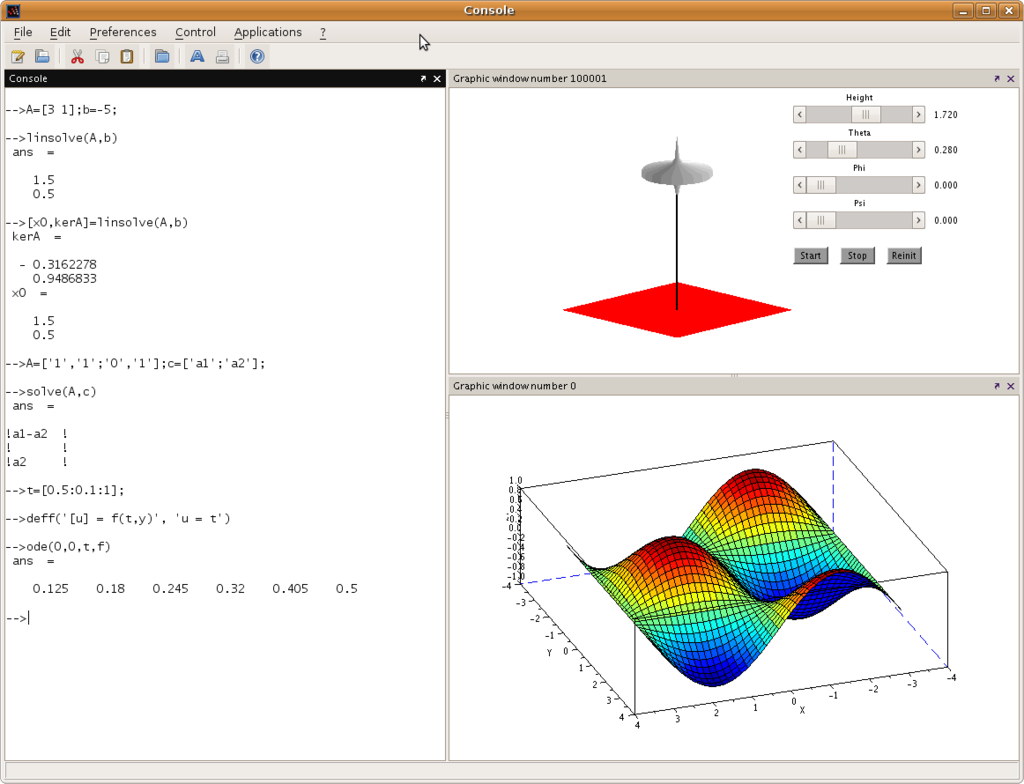
The software features an intuitive graphical user interface that enhances user interaction and productivity. Scilab excels in data visualization, offering robust capabilities for creating two and three-dimensional plots, animations, and interactive graphical displays. These visualization tools are crucial for data interpretation, understanding simulation results, and presenting findings effectively.
Programming and Customization
Scilab includes its own programming language, providing users with the flexibility to develop custom functions and scripts tailored to specific needs. Furthermore, it supports integration with multiple programming languages such as C, C++, and Fortran. This interoperability allows for the extension of Scilab’s core functionalities, enabling complex algorithm implementation and the development of bespoke engineering applications.
Applications in Engineering and Science
In academic settings, Scilab serves as a foundational tool for teaching and learning numerical analysis, control systems, and various engineering disciplines. Its open-source nature and rich feature set make it an accessible yet powerful resource for students and educators. For industrial and research professionals, Scilab is instrumental in developing and testing sophisticated algorithms, conducting simulations for system design, and modeling complex phenomena across diverse scientific fields.
Comparison with Similar Tools
As an open-source numerical computation software, Scilab offers a compelling alternative to proprietary solutions. While commercial platforms may provide extensive support networks, Scilab distinguishes itself through its accessibility and flexibility. Its robust mathematical function library and advanced visualization capabilities are comparable to commercial offerings, yet it provides the unique advantage of being freely customizable and modifiable by its user community.
Real-world Use Cases
Scilab has been employed in numerous projects within academia and research, including the modeling of dynamic systems, control system design, and signal processing algorithm development. For instance, it can be utilized in aerospace engineering for simulating flight dynamics or in electrical engineering for analyzing complex circuit behavior. Its application extends to scientific research for data analysis in physics, mathematics, and statistical modeling.
Conclusion
Scilab stands as a powerful and versatile open-source software essential for numerical computation, data analysis, and scientific simulation. Its comprehensive features, from an extensive function library and advanced visualization tools to its programming flexibility, make it an indispensable resource for engineers, researchers, and students. Download Scilab to leverage its capabilities for your complex analytical and computational challenges.
Frequently Asked Questions
What types of mathematical functions can Scilab perform?
Scilab provides a comprehensive library of mathematical functions ranging from basic algebra to advanced matrix operations, polynomial functions, and numerical analysis tools. These capabilities enable users to tackle a wide array of sophisticated mathematical problems in engineering and scientific research.
Can I integrate Scilab with other programming languages?
Yes, Scilab allows integration with several programming languages, including C, C++, Fortran, and Java, enabling users to extend its functionality through custom scripts. This interoperability is key for developing complex applications and leveraging existing code bases.
Is Scilab suitable for educational use?
Absolutely, Scilab is widely used in educational institutions for teaching numerical analysis and engineering principles due to its open-source nature and rich feature set. Its accessible platform allows students to gain practical experience with computational methods relevant to their fields.



Reviews
There are no reviews yet.