

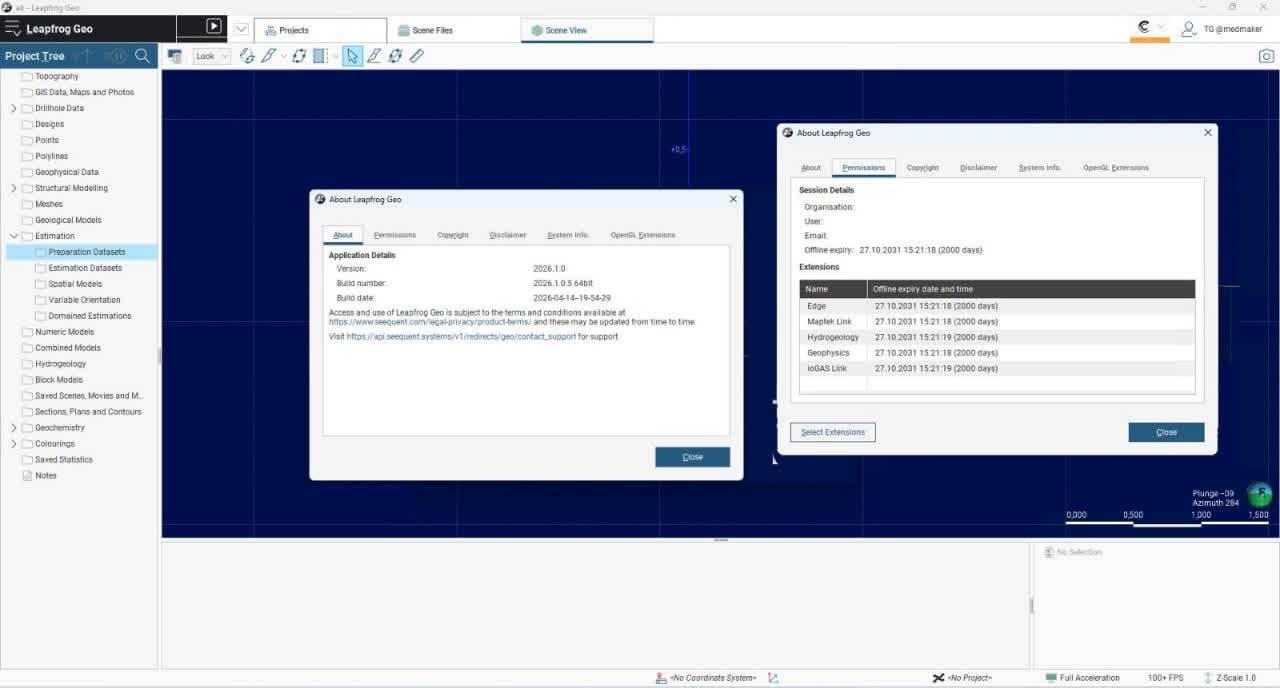
Download Seequent Leapfrog Geo 2026.1 – Advanced 3D Geological Modeling for Mining & Environmental Analysis
Bentley Seequent Leapfrog (Energy, Geo, Works) 2026.1.1
Seequent Leapfrog Geo 2026.1 is an advanced 3D geological modeling software developed by Seequent Ltd, specifically engineered for professionals in the mining, oil & gas, geothermal energy, and environmental investigation sectors. This specialized application excels at visualizing and interpreting complex subsurface geological data, providing critical insights for resource exploration, geological research, and environmental assessments. Leapfrog Geo is designed to streamline the process of building accurate 3D models from diverse data inputs, thereby enhancing decision-making in geoscientific projects.
Overview of Leapfrog Geo and Its Role in Geological Sciences
Developed by Seequent Ltd, a prominent provider of geoscientific software solutions, Leapfrog Geo stands as a leading platform for 3D geological modeling. It is fundamentally designed to decode the complexities of the earth’s subsurface, offering geologists, engineers, and environmental scientists powerful tools to visualize, interpret, and model geological structures. Its application spans across critical industries where understanding underground formations is paramount, including mineral resource estimation, hydrocarbon exploration, geothermal energy assessment, and detailed groundwater pollution investigations.
Advanced 3D Geological Modeling Tools and Visualization
Leapfrog Geo provides a suite of sophisticated tools essential for detailed geological interpretation and model creation. Its core functionality revolves around dynamic, real-time 3D visualization, allowing users to explore subsurface landscapes interactively. The software excels at integrating diverse geological datasets, including borehole logs, geophysical survey results, and structural measurements, to construct coherent and geologically plausible 3D models. This capability ensures that users can accurately represent complex geological formations and anomalies with a high degree of fidelity and detail.
Data Management and Multi-Project Handling for Large Geological Datasets
Professionals working with extensive geological information often face challenges in managing large datasets and coordinating multiple projects. Leapfrog Geo addresses this by offering robust data management capabilities. The software allows users to work with numerous projects concurrently within a single intuitive environment, facilitating efficient organization and control over vast amounts of geological data. This feature is crucial for maintaining data integrity, minimizing errors, and streamlining the overall project workflow for complex subsurface analysis.
Supported Geological Data Formats and Integration with Industry Workflows
To ensure seamless integration into existing geoscientific workflows, Leapfrog Geo supports a wide array of common geological data formats. It accommodates data inputs such as borehole logs in various formats, geophysical grids, and geological maps. This interoperability allows geologists and engineers to easily import their existing datasets and output models for use in other industry-standard software. Such compatibility is vital for fostering collaboration and ensuring that Leapfrog Geo contributes effectively to broader project pipelines in mining, energy, and environmental research.
Case Studies and Industry Applications in Mining, Oil & Gas, and Environmental Projects
The practical utility of Leapfrog Geo is evident across multiple high-impact industries. In mining engineering, it is instrumental in defining mineral resources, optimizing pit designs, and managing underground mine planning by creating precise 3D block models and resource estimates. For oil & gas exploration, the software aids in seismic interpretation and reservoir characterization. In the environmental sector, Leapfrog Geo is extensively used for groundwater modeling, mapping contaminant plumes, and understanding geological risks associated with waste disposal sites. Its application in geothermal energy involves modeling subsurface heat sources and fluid pathways.
Comparative Advantages Over Other Geological Modeling Software
Leapfrog Geo distinguishes itself through its dynamic, ‘real-time’ modeling approach, which allows for immediate visualization of geological interpretations as data is processed. Unlike some traditional software that may rely on sequential, often lengthy, model updates, Leapfrog Geo’s architecture enables a fluid interaction with the data, expediting the interpretation cycle. Furthermore, its robust project and data management system is specifically designed to handle the complexities and scale of geological datasets encountered in mining and environmental geology, offering a more integrated and efficient user experience.
Frequently Asked Questions
What types of geological data can Leapfrog Geo process and visualize?
Leapfrog Geo supports a comprehensive range of geological data types essential for subsurface analysis. This includes detailed borehole logs, results from geophysical surveys, structural measurements such as strike and dip, and regional geological map data. By processing these diverse inputs, the software constructs detailed 3D visualizations of subsurface structures, anomalies, and geological formations.
How does Leapfrog Geo handle multiple projects and large data volumes?
Leapfrog Geo is engineered for efficient management of large geological datasets and multiple concurrent projects. Its platform organizes and controls extensive data within a unified environment, which significantly reduces the possibility of errors and enhances project workflow efficiency. This architecture is critical for maintaining data consistency and clarity when dealing with the complex demands of large-scale geoscientific endeavors.
In which industries is Leapfrog Geo most commonly used?
Leapfrog Geo finds its primary applications within the mining engineering sector for resource estimation and mine planning, and in oil and gas exploration for subsurface reservoir analysis. It is also widely adopted for groundwater pollution studies, environmental impact assessments, and geothermal energy projects, owing to its advanced 3D modeling capabilities specifically tailored for interpreting complex subsurface geological data.







Reviews
There are no reviews yet.