

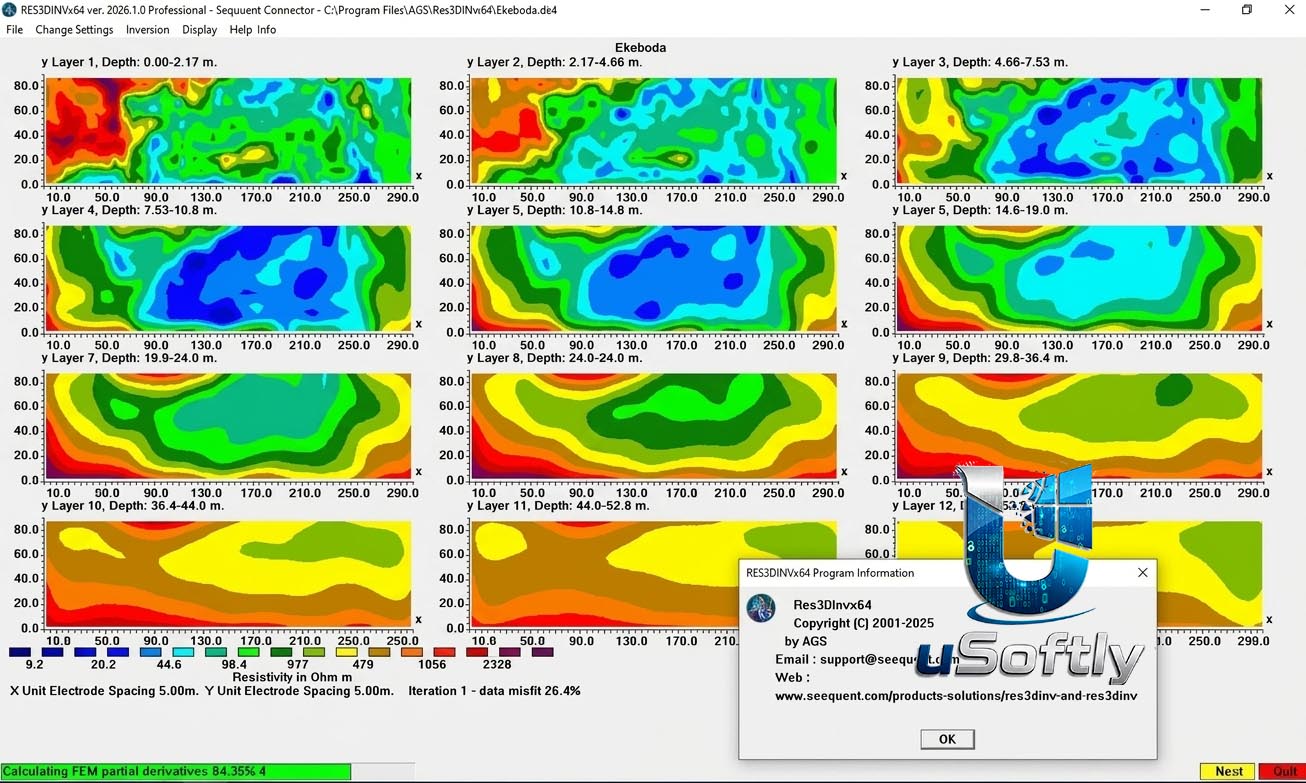
Seequent Res3DInv 2026.1.0 – 3D Inversion Software for Electrical Resistivity Tomography (ERT) and Induced Polarization (IP) Data
Res3DInv is a full-featured 3D inversion software for ERT (DC) and IP data, developed by Seequent (Aarhus GeoSoftware) . In areas where geological structures are complex, there is no substitute for a fully 3D survey, and Res3DInv provides the tools to process, invert, and visualize such datasets effectively .
The software offers a streamlined workflow from data import to inversion and visualization, while still providing advanced users with full control over inversion parameters . It is highly optimized for speed, allowing small and medium-sized surveys to be processed on modern consumer PCs, enabling initial in-field inversion for efficient survey design .
Res3DInv 2026.1.0 is a compatibility-focused release that does not introduce new features but ensures platform stability and continued integration with the Seequent ecosystem, including the Seequent Connector . The software is available in Basic, Professional, and Enterprise versions, with the Professional version offering time-lapse inversion and vector array dataset support.
Primary Users
Res3DInv 2026.1.0 is designed for geophysicists, exploration geologists, hydrogeologists, and engineering consultants who require detailed 3D subsurface models from electrical resistivity and IP surveys. It serves professionals who:
-
Conduct mineral exploration, groundwater investigations, and environmental site characterization using 3D ERT and IP methods
-
Work in areas with complex geological structures where 2D surveys are insufficient and a fully 3D approach is essential
-
Design and invert data from true 3D surveys, including arrays such as pole-pole, pole-dipole, inline dipole-dipole, equatorial dipole-dipole, Wenner-Schlumberger, and non-conventional configurations
-
Monitor subsurface changes over time using time-lapse inversion techniques (Professional version)
-
Combine multiple 2D survey lines into a single 3D model for comprehensive site characterization
Key Features & Capabilities
Comprehensive Survey Support
-
Wide Array Support: Handles pole-pole, pole-dipole, inline dipole-dipole, equatorial dipole-dipole, Wenner-Schlumberger, and non-conventional arrays
-
Flexible Survey Configurations: Supports surface electrodes, borehole and subsurface electrodes, spatially extended electrodes, arbitrary electrode locations, electrodes on and in water bodies, and streamed electrode configurations
-
True 3D Dataset Handling: Inverts true 3D datasets as well as datasets combined from 2D survey lines
Advanced Inversion and Processing
-
Smooth and Sharp Inversions: Supports both smooth and sharp inversion methods to accommodate different geological expectations
-
Data Quality Control: Removes bad data points based on dataset and inversion statistics
-
Guided Inversion: Incorporates known geophysical information to constrain and guide inversion outcomes
-
Time-Lapse Inversion: Professional version supports 2D and 3D time-lapse inversion for monitoring subsurface changes over time
High-Performance Computing
-
Large Mesh Support: Supports up to approximately 10 million nodes with 128 GB RAM
-
Up to 256 GB RAM Access: For large surveys and time-lapse inversions
-
Parallel Processing: Optimized for multi-core CPUs, with significant performance gains when upgrading from 4 to 16 cores
Data Visualization and Export
-
3D Visualization: Full 3D model visualization with tools for horizontal and vertical section viewing
-
Export Options: Export results to Aarhus Workbench, Oasis montaj, ParaView, Voxler, and other 3D visualization software
What’s New in Res3DInv 2026.1.0
The 2026.1.0 release is a compatibility-focused update :
-
No New Features: This release does not introduce new functionality
-
Platform Stability: Implements updates to maintain platform stability
-
Workflow Compatibility: Ensures compatibility with integrated workflows, including continued support for the Seequent Connector after its latest update






Reviews
There are no reviews yet.