

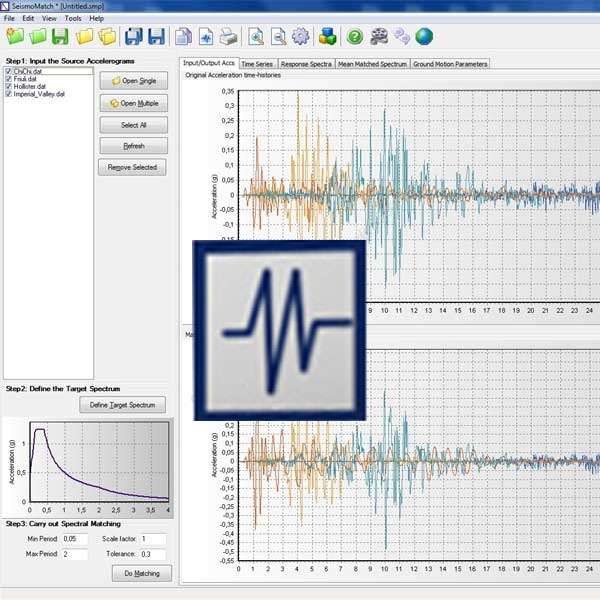
Download SeismoMatch 2025.1 – Seismic Accelerogram Matching Software for Structural Engineering
SeismoMatch 2025.1 is a specialized civil engineering application designed for advanced seismic accelerogram matching. This software is crucial for professionals in structural engineering, earthquake engineering, and seismic risk assessment, who require precise control over seismic input data for structural analysis. It plays a key role in ensuring that simulated earthquake ground motions accurately reflect the design seismic hazard for infrastructure projects.
Overview of SeismoMatch and Its Role in Seismic Engineering
The accurate representation of seismic ground motion is fundamental in designing earthquake-resistant structures. SeismoMatch addresses this need by providing engineers with a tool to adjust recorded seismic accelerograms, making them compliant with predefined target response spectra. This process is particularly vital in civil and structural engineering fields where the resilience of buildings, bridges, and other infrastructure against seismic events is paramount. The software supports workflows focused on earthquake resilience and seismic hazard analysis.
Advanced Algorithms for Accurate Seismic Spectrum Matching
SeismoMatch employs sophisticated algorithms to achieve precise seismic spectrum matching. It implements the small wavelet algorithm, a method established by Abrahamson (1992) and further refined by Hancock et al. (2006). This algorithm allows for the simultaneous adjustment of multiple recorded accelerograms. Key features include:
- Simultaneous matching of multiple selected seismic accelerograms.
- Management of spectrum deviation tolerance to ensure compatibility within specified limits.
- Generation of averaged response spectra that meet design code requirements.
These capabilities enable engineers to create a robust set of seismic input records for dynamic analysis.
Integration with Eurocode 8 and Nonlinear Dynamic Structural Analysis
For engineers adhering to European seismic design standards, SeismoMatch offers significant integration with Eurocode 8. The software can calculate target seismic spectra in accordance with Eurocode 8 rules, ensuring that the seismic input data aligns with regulatory requirements. This feature is critical for undertaking nonlinear dynamic analysis, a widely adopted method for assessing the behavior of structures under severe seismic loading. By preparing compatible accelerogram series, SeismoMatch supports the detailed evaluation of structural performance, helping to define safety margins and identify potential vulnerabilities in existing or new constructions.
File Handling and Data Compatibility Features
Efficient handling of seismic data is a cornerstone of SeismoMatch’s usability. The software is designed to accommodate various formats for seismic accelerogram input. It supports both single-value and multiple-value data entries, catering to different seismic record databases and preparation methods. This flexibility ensures that engineers can readily import a wide range of seismic records into their analysis workflows. The software is equipped to manage large datasets of seismic records, facilitating the selection and review processes essential for thorough analysis and compliance with structural design standards.
Customizable Output and Results Export for Engineering Workflow Integration
SeismoMatch provides extensive customization options for outputting analysis results, enhancing its integration into professional engineering workflows. Users can tailor graphical representations of seismic data and spectral matching to suit specific reporting needs. The software offers seamless data export capabilities to common Windows applications, including spreadsheet software like Microsoft Excel and document processors like Microsoft Word. This feature streamlines the process of incorporating detailed seismic analysis findings into engineering reports, project documentation, and client presentations, making the results easily presentable and auditable.
Practical Use Cases and Applications in Civil Engineering Projects
The application of SeismoMatch is widespread across various civil engineering projects requiring rigorous seismic analysis. It is particularly valuable in scenarios such as:
- Retrofit Assessment: Evaluating the seismic performance of existing structures and determining the necessity and extent of strengthening measures.
- New Structural Design: Ensuring that newly designed buildings, bridges, and industrial facilities meet stringent seismic safety standards by providing accurate seismic input.
- Seismic Risk Evaluation: Assessing the potential impact of earthquakes on infrastructure and developing mitigation strategies.
- Research and Development: Supporting academic and industry research in earthquake engineering by providing reliable tools for seismic data manipulation and analysis.
These applications highlight the software’s role in improving the accuracy and reliability of seismic engineering analyses.
Frequently Asked Questions
How does SeismoMatch improve seismic record matching for structural analysis?
SeismoMatch uses a small wavelet algorithm to adjust recorded accelerograms to better match a target response spectrum, improving accuracy for nonlinear dynamic analysis of structures. This ensures seismic input data are representative of the design seismic hazard.
Can SeismoMatch be used with Eurocode 8 seismic design standards?
Yes, SeismoMatch can calculate target spectra following Eurocode 8 rules, facilitating compliance with European seismic design codes in civil engineering projects.
What types of accelerogram file formats does SeismoMatch support?
SeismoMatch supports both single and multiple value accelerogram data in common spectral formats used in seismic databases, allowing flexibility in input data handling.






Reviews
There are no reviews yet.