

Download SeismoSignal 2025.1 – Advanced Earthquake Motion Data Processing Software
SeismoSignal 2025.1 is a specialized civil engineering application developed by SeismoSoft for the comprehensive processing and analysis of seismic motion data. It is designed for professionals in earthquake engineering, structural engineering, and seismology who require advanced tools for interpreting earthquake accelerometer records. This software is crucial for understanding seismic events and their potential impact on structures.
Overview of SeismoSignal in Earthquake Engineering
SeismoSignal functions as a critical tool within the fields of earthquake engineering and seismology, focusing on the detailed analysis of ground motion data recorded during seismic events. Developed by SeismoSoft, the software addresses the complex needs of engineers and researchers tasked with assessing seismic hazards and designing resilient structures. Its primary role involves transforming raw accelerometer data into actionable insights for evaluating structural safety and performance.
Comprehensive Seismic Data Analysis and Visualization Tools
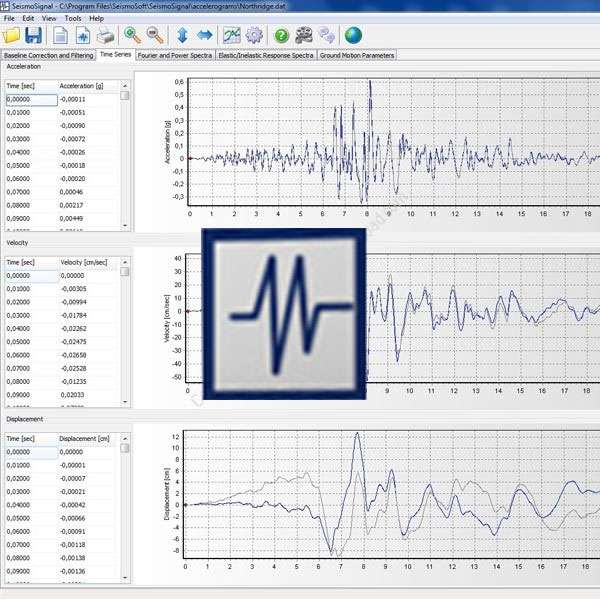
The software is equipped to process various forms of seismic motion data, including acceleration, velocity, and displacement time histories directly obtained from earthquake accelerometers. SeismoSignal provides robust capabilities for visualizing this data through detailed graphical representations. Users can generate plots for raw acceleration, velocity, and displacement time histories, alongside essential spectral analyses such as Fourier amplitude spectra and response spectra, facilitating a thorough understanding of seismic wave characteristics.
Advanced Spectral Calculations and Filtering Functionalities
SeismoSignal offers advanced functionalities for spectral calculation and data filtering. It computes both elastic and inelastic response spectra, vital for predicting structural behavior under dynamic loading. The software also calculates the Fourier amplitude spectrum, providing insights into the frequency content of seismic signals. Furthermore, it incorporates sophisticated filter functions that allow users to adjust the frequency range of the analyzed data, isolating specific seismic wave characteristics or removing unwanted noise for more targeted analysis.
Key Parameters and Metrics for Earthquake Motion Characterization
To characterize earthquake motion comprehensively, SeismoSignal calculates several key seismic parameters. These include maximum sustainable speed, the intensity of acceleration and velocity spectra, and characteristic energy densities derived from the processed data. Understanding these metrics is fundamental for earthquake resilience assessment. They provide engineers with critical data to evaluate seismic forces, predict potential structural damage, and ensure the safety and integrity of buildings and infrastructure in seismically active regions.
Applying SeismoSignal in Real-World Earthquake Engineering and Research
In practical applications, SeismoSignal is extensively employed in structural analysis and seismic data interpretation within both academic and professional settings. Researchers utilize its advanced analytical capabilities to study earthquake phenomena and develop improved design methodologies. Structural engineers rely on the software to perform detailed seismic assessments, inform the design of earthquake-resistant structures, and validate structural models against recorded earthquake motions, contributing to enhanced safety standards in civil engineering projects.
Frequently Asked Questions
How does SeismoSignal help in analyzing earthquake motion data?
SeismoSignal processes data from earthquake accelerometers to extract key seismic parameters like acceleration, velocity, displacement, and spectral information. This enables engineers to assess earthquake effects on structures through detailed spectral and parameter analysis, providing a foundation for structural safety evaluations.
What types of spectral analysis can SeismoSignal perform?
The software calculates elastic and inelastic response spectra, Fourier amplitude spectra, and can filter data to focus on specific frequency ranges, providing comprehensive insight into seismic motion characteristics. These analyses are crucial for understanding how structures might respond to different seismic frequencies.
Who primarily uses SeismoSignal software?
SeismoSignal is primarily used by earthquake engineers, structural engineers, and seismologists who analyze seismic motion data for research and design of earthquake-resistant structures. Professionals in these fields depend on its specialized tools for accurate seismic interpretation.






Reviews
There are no reviews yet.