

Download SeismoTank v5.0 – Advanced Seismic Analysis for Liquid Storage Tanks
SeismoTank v5.0 is an advanced simulation and analysis software developed by Seismosoft, specifically designed for conducting seismic analysis of liquid storage tanks. This tool is critical for structural and civil engineers working in sectors such as oil and gas storage, water and wastewater treatment, and municipal infrastructure. It provides specialized capabilities to model the complex fluid-structure interaction phenomena that occur during seismic events, ensuring the safety and integrity of vital liquid containment structures.
SeismoTank v5.0 Overview and Industry Applications
SeismoTank v5.0 offers a comprehensive suite of tools for assessing the seismic performance of various liquid storage tank designs. Its primary function is to help engineers understand how tanks and their liquid contents will behave under earthquake loading. This is paramount for preventing catastrophic failures, ensuring public safety, and maintaining operational continuity in critical industries. The software supports engineers in the oil & gas sector, water and wastewater management, and other areas requiring the reliable storage of liquids under dynamic seismic conditions. Its application extends to infrastructure regulatory review, where standardized seismic assessments are often mandated.
Seismic Analysis Methods for Liquid Storage Tanks
The software implements multiple established methods for seismic analysis of liquid storage tanks, allowing engineers to select the most appropriate approach for their design and regulatory requirements.
Equivalent Lateral Force Approach
This method is used for simplified seismic design, where the total seismic force is applied at the base of the tank. SeismoTank v5.0 calculates the base shear and overturning moment based on the tank’s seismic weight and applicable code-defined factors. It also addresses the distribution of vertical forces and their impact on structural components.
Response Spectrum Analysis
SeismoTank v5.0 supports response spectrum analysis, a common modal analysis technique. It considers multiple vibration modes of the tank-liquid system and combines their effects using methods like the Complete Quadratic Combination (CQC) or Square Root of Sum of Squares (SRSS). The analysis also incorporates sloshing modes, which represent the liquid’s free surface movement, alongside impulsive modes related to the liquid’s mass acting with the tank walls.
Time History Analysis
For a more detailed seismic assessment, SeismoTank v5.0 offers time history analysis. This allows engineers to perform direct integration using either real earthquake records or artificially generated accelerograms. The software can handle both linear and nonlinear behavior, providing a more accurate prediction of the tank’s response over time, including potential damage progression.
Modeling Fluid-Structure Interaction and Sloshing Dynamics
A core capability of SeismoTank v5.0 lies in its specialized modeling of fluid-structure interaction (FSI). The software accurately distinguishes between impulsive pressures, generated by the liquid’s inertia acting on the tank walls, and convective pressures, arising from the sloshing motion of the liquid surface. It quantures the impact of added mass effects and precisely calculates sloshing modes, enabling engineers to verify adequate freeboard and prevent liquid escape or tank instability due to excessive wave heights.
Structural Shell and Foundation Interaction Modeling
SeismoTank v5.0 analyzes the behavior of tank shells, considering both membrane and bending stresses induced by seismic loads. The software accounts for the effectiveness of structural stiffeners that might be present on the tank walls. Furthermore, it models soil-structure interaction (SSI) effects for tanks supported on foundations, and can perform uplift analysis for unanchored tanks, providing a holistic view of the structural response.
Ensuring Compliance with Global Seismic Codes
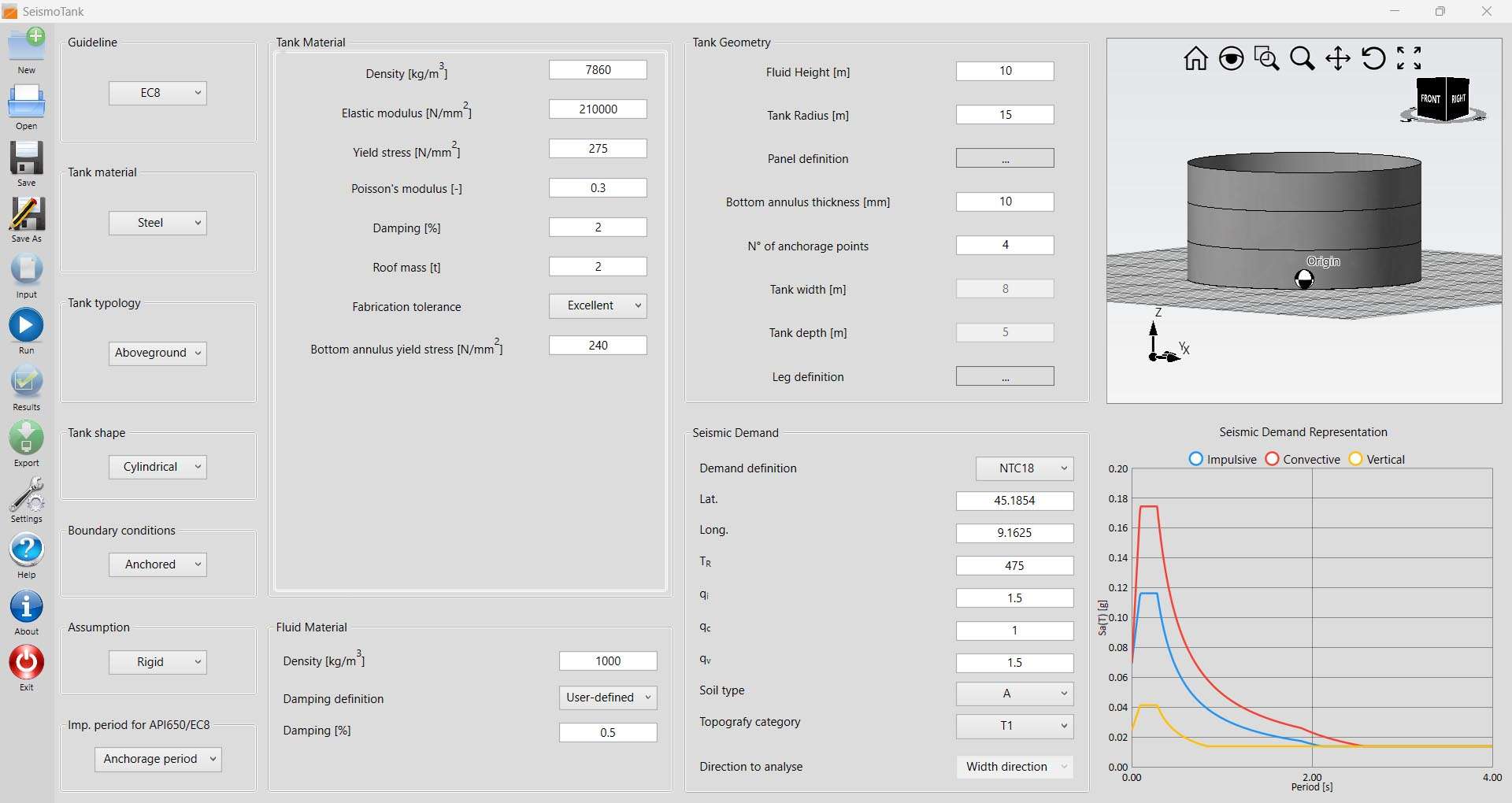
Compliance with international seismic design codes is a critical aspect of tank safety. SeismoTank v5.0 is engineered to adhere to a wide range of global standards, including Eurocode 8 (EN 1998-4), ACI 350.3, API 650 Annex E, AWWA D100, and IS 1893. The software allows for customization of code-specific parameters to match regional requirements and project specifications.
Advanced Parametric, Nonlinear, and Probabilistic Analysis
Beyond standard analyses, SeismoTank v5.0 provides advanced capabilities for complex engineering assessments. Engineers can conduct parametric studies to explore variations in tank dimensions, liquid levels, or material properties. The software supports nonlinear analysis to capture behavior beyond the elastic range, important for evaluating post-earthquake performance. Additionally, it integrates probabilistic methods for hazard assessment and can generate fragility curves, offering a deeper understanding of risk.
Visualizing Results and Generating Reports
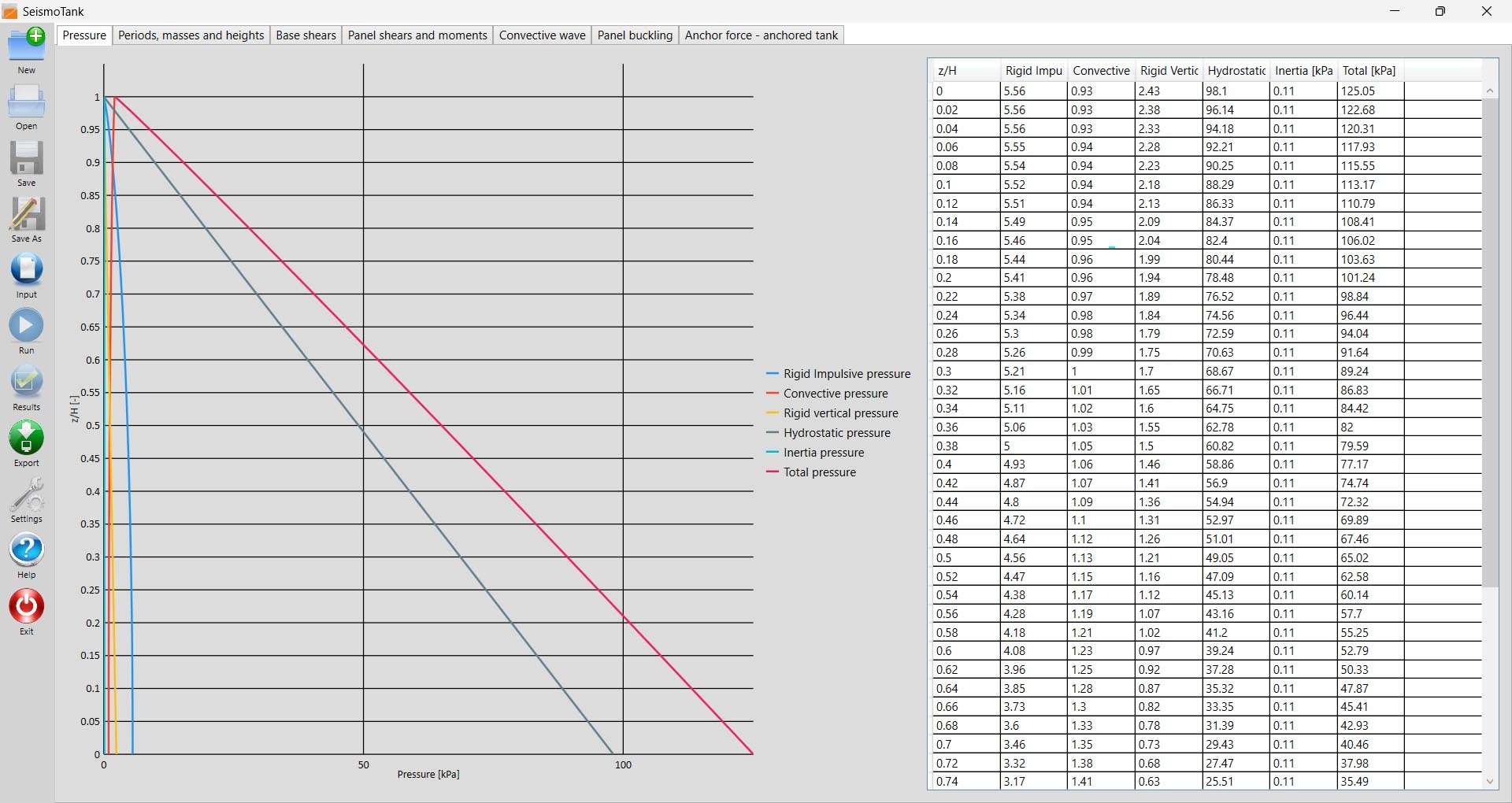
SeismoTank v5.0 offers extensive post-processing and reporting tools. Users can visualize results through graphical outputs such as pressure plots on tank walls, animated mode shapes, stress contours, and time history graphs. The software facilitates standardized reporting by exporting analysis summaries and detailed results in both PDF and Excel formats, streamlining the documentation process for design review and client submission.
Frequently Asked Questions
How does SeismoTank v5.0 account for partial fluid levels in tank analysis?
SeismoTank v5.0 allows users to define any liquid fill percentage and automatically adjusts the impulsive and convective mass participation factors. It recalculates sloshing wave heights and freeboard requirements for accurate overturning assessment, ensuring that the analysis reflects realistic operating conditions.
What tank geometries and support conditions does SeismoTank v5.0 support?
The software handles circular and rectangular tanks of all aspect ratios, both above-ground and buried, with anchored or unanchored base conditions. It also models elevated tanks on columns or pedestals and flexible-base interactions for ring foundations, catering to a wide array of structural configurations.
Can SeismoTank v5.0 integrate with other structural analysis tools like SeismoStruct?
Yes, SeismoTank v5.0 exports modal and time history data in formats compatible with SeismoStruct and other general-purpose finite element packages, facilitating workflow continuity. This interoperability allows for comprehensive structural assessments by linking seismic tank analysis with overall building or facility models.
Which seismic codes are supported by SeismoTank v5.0?
SeismoTank v5.0 supports a comprehensive list of international seismic codes essential for tank design, including Eurocode 8 (EN 1998-4), ACI 350.3, API 650 Annex E, AWWA D100, IS 1893, and NZSEE. This broad compliance ensures versatility for global projects.
What output formats are available for exporting analysis results?
SeismoTank v5.0 provides flexible output options for analysis results. Engineers can export comprehensive reports and data summaries in both PDF and Excel formats, making it easy to share findings, integrate results into broader project documentation, and perform further custom data analysis.



Reviews
There are no reviews yet.