

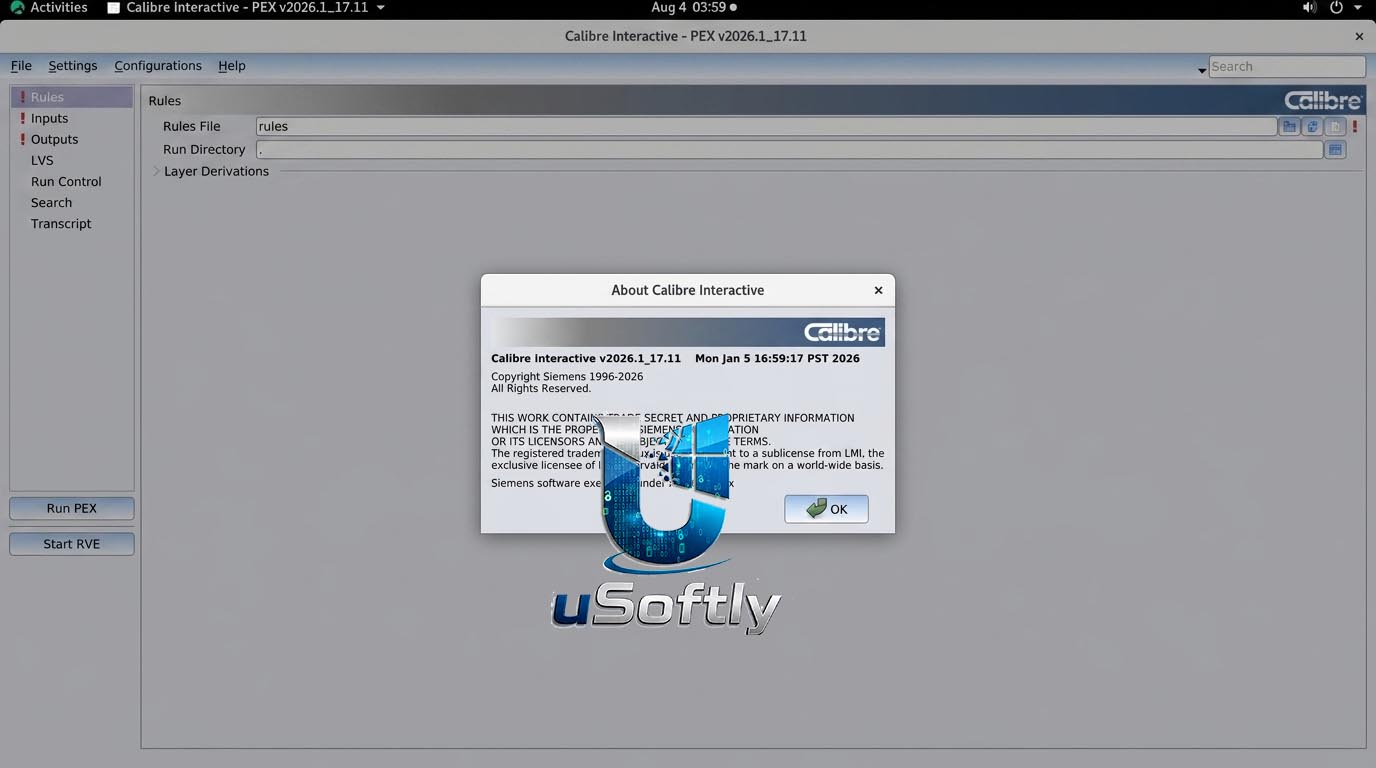
Siemens Calibre 2026.1 Linux – Industry-Standard IC Physical Verification and DFM Optimization Platform for Linux Environments
Siemens Calibre is the industry-leading EDA platform for IC physical verification and DFM optimization, developed by Siemens EDA (formerly Mentor Graphics) . It is recognized globally as the standard for design rule checking (DRC) and layout vs. schematic (LVS) verification, providing comprehensive solutions that accelerate designs from creation to manufacturing while addressing all sign-off requirements.
Calibre is a highly scalable and powerful physical verification solution that supports hierarchical processing, enabling faster verification while optimizing design hierarchy for large-scale chip designs . The platform delivers complete IC verification and DFM optimization, addressing critical sign-off requirements across the semiconductor design flow.
Calibre 2026.1 for Linux is the latest release, officially supporting major 64-bit Linux distributions including RHEL 8, RHEL 9, and SLES 15 . This version continues Calibre’s legacy as the industry benchmark for physical verification, providing engineering teams with the performance and scalability needed for complex designs at advanced process nodes.
Primary Users
Siemens Calibre 2026.1 Linux is designed for physical verification engineers, IC design engineers, foundry professionals, and semiconductor R&D teams who need a robust, high-performance verification platform for advanced chip designs. It serves professionals who:
-
Perform full-chip physical verification for complex SoCs and multi-die systems
-
Run design rule checking (DRC) to ensure compliance with foundry manufacturing constraints
-
Conduct layout vs. schematic (LVS) verification to validate physical implementation against circuit intent
-
Extract parasitic parameters for post-layout simulation and signoff performance analysis
-
Optimize designs for manufacturability (DFM) with comprehensive yield enhancement tools
-
Deploy verification solutions in high-performance computing (HPC) Linux environments
Key Features & Capabilities
Core Physical Verification
-
Design Rule Checking (DRC): Verifies that IC layouts comply with manufacturing process constraints, supporting multi-patterning and advanced node design rules
-
Layout vs. Schematic (LVS): Validates that the physical layout matches the circuit schematic, with continuously optimized engines for performance and scalability
-
Electrical Rule Checking (ERC): Detects potential electrical issues and violations within the design
Parasitic Extraction and Performance Analysis
-
Parasitic Parameter Extraction: Extracts resistance and capacitance values for post-layout simulation and high-speed circuit performance evaluation
-
Optical Proximity Correction (OPC): Optimizes photomask design for improved lithographic fidelity
Advanced Capabilities
-
Hierarchical Processing: Handles complex design hierarchies to accelerate verification while managing large-scale designs
-
Multi-Threaded and Parallel Processing: Optimized for Linux HPC environments with support for distributed computing
-
Security: Supports IEEE P1735 standards for encrypted protection of electronic design intellectual property
What’s New in Calibre 2026.1
The 2026.1 release delivers official support for current enterprise Linux distributions and continues to refine the platform’s performance and capabilities.
Linux Platform Support
Official support for the following 64-bit Linux distributions :
-
Linux RHEL 8 (x86-64)
-
Linux RHEL 9 (x86-64)
-
Linux SLES 15 (x86-64)
Version Builds
The 2026.1 release includes multiple builds:
-
Calibre 2026.1_17
-
Calibre 2026.1_26
-
Calibre 2026.1_35
Note: Version 2026.1_35 requires a valid maintenance contract through March 2026



Reviews
There are no reviews yet.