

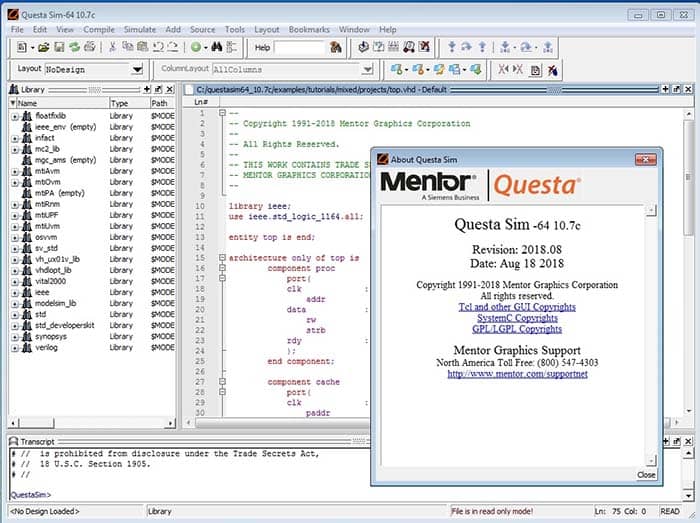
Download Siemens Questa One Sim 2026.1 – Advanced Simulation Software for FPGA and SoC Design
Siemens Questa One Sim 2026.1 is an advanced simulation and debugging software from Siemens Corporation, specifically engineered for the complex demands of FPGA and SoC design and testing. As a key component within the Questa simulation platform, this tool is indispensable for professionals working with intricate integrated circuits. It provides a robust environment for analyzing and simulating advanced chips that underpin critical technologies in sectors like telecommunications and automotive electronics.
Introduction to Siemens Questa One Sim
Overview of the Software
Siemens Questa One Sim represents a significant advancement in electronic design automation (EDA), evolving to meet the rigorous requirements of modern chip development. This simulation software is designed to provide engineers with a comprehensive platform for verifying the functionality and performance of Field-Programmable Gate Arrays (FPGAs) and System-on-Chips (SoCs). Its relevance is underscored by the increasing complexity and specialization of electronic components that drive innovation across numerous industries.
Key Features and Simulation Capabilities
Quest One Sim integrates several advanced capabilities to streamline the verification process for complex digital designs. These features are crucial for ensuring the accuracy and efficiency of simulation runs. The software’s design philosophy centers on providing powerful tools that enhance productivity and reduce time-to-market for new electronic products.
- Supports multiple hardware description languages (HDLs), including Verilog, SystemVerilog, VHDL, and SystemC.
- Engineered with multi-core simulation capabilities to accelerate complex verification tasks.
- Features advanced automation functionalities for testbench generation and execution.
- Incorporates formal verification techniques for mathematical proof of design correctness.
- Provides debugging tools that offer deep visibility into design behavior during simulation.
Applications in FPGA and SoC Design
The primary application of Siemens Questa One Sim lies in the exhaustive testing and validation phases of FPGA and SoC development. Its capabilities are leveraged across various stages of the design lifecycle, from initial functional verification to post-silicon validation support. The software’s versatility makes it a critical tool for developing next-generation electronic systems.
- Design validation for complex FPGAs used in communication systems.
- Testing of integrated circuits for automotive control units.
- Verification of embedded processors and custom logic within SoCs for consumer electronics.
- Simulation of power-aware designs using UPF (Unified Power Format).
- Ensuring compliance with industry standards through support for languages like PSL (Property Specification Language).
Advantages of Using Questa One Sim
Adopting Siemens Questa One Sim offers distinct advantages that contribute to improved design quality and development efficiency. These benefits are particularly pronounced in projects with tight deadlines and stringent performance requirements, distinguishing it from standard simulation tools.
- Significantly increased testing efficiency due to optimized simulation engines and multi-core processing.
- Enhanced debugging capabilities that provide deeper insights into design errors, reducing problem-solving time.
- High degree of design accuracy and reliability, crucial for safety-critical applications.
- Comprehensive support for leading verification methodologies, facilitating team collaboration and standardized workflows.
- Streamlined integration into broader electronic design flows, ensuring a cohesive development environment.
Integration with Other Design Tools
Siemens Questa One Sim is designed to work harmoniously within the broader EDA ecosystem. Its compatibility with industry-standard methodologies and tools ensures that engineers can seamlessly integrate it into their existing design and verification flows. This interoperability is key to maintaining efficient and productive development cycles.
- Supports Universal Verification Methodology (UVM) and Open Verification Methodology (OVM) for testbench development.
- Interfaces with synthesis tools to ensure simulation results align with synthesized hardware.
- Compatibility with embedded software development environments for co-simulation.
- Facilitates integration with advanced debugging and waveform analysis tools.
- Works alongside static analysis and formal verification tools for comprehensive design coverage.
User Experience and Usability
While Siemens Questa One Sim is a professional-grade tool, its usability is a key consideration for engineering teams. The software provides access to extensive documentation and support resources designed to assist users in mastering its advanced features. Feedback from the engineering community often highlights its power and the effectiveness of its debugging environment.
- Features an integrated graphical user interface for managing simulation runs and analyzing results.
- Offers comprehensive documentation, tutorials, and online support resources.
- Continuous updates and community forums aid in addressing user queries and challenges.
- The complexity of advanced features requires a learning curve, but the investment in training yields significant productivity gains.
Real-world Implementations and Case Studies
The practical application of Siemens Questa One Sim is evident in the development of cutting-edge electronic products across various high-technology sectors. Companies rely on its simulation capabilities to de-risk complex designs and accelerate development timelines, leading to successful product launches.
- Telecommunications companies utilize Questa One Sim to verify high-speed networking chips and communication protocols, ensuring reliable data transmission.
- Automotive manufacturers employ the software for simulating and testing sophisticated electronic control units (ECUs) and sensor systems that are critical for vehicle safety and autonomous driving features.
- Consumer electronics firms leverage its capabilities to ensure the performance and functionality of processors and integrated systems in devices like smart TVs and mobile processors.
- In the aerospace and defense sector, it is used for verifying the reliability of complex avionics and control systems where failure is not an option.
Frequently Asked Questions
What languages does Siemens Questa One Sim support?
Siemens Questa One Sim supports multiple hardware description languages, including Verilog, SystemVerilog, VHDL, SystemC, PSL, and UPF, enabling diverse design applications in electronic simulation.
How does Questa One Sim enhance simulation efficiency?
The software features multi-core simulation capabilities and automated test production that significantly enhance testing speed and efficiency, making it suitable for large and complex chip designs.
What are the primary industries benefiting from Questa One Sim?
Primarily, Questa One Sim is utilized in industries focused on FPGA and SoC design, such as telecommunications, automotive, and consumer electronics, helping companies ensure product reliability and functionality.





Reviews
There are no reviews yet.